Elgato over at the Swanky Conservative has put together this map showing the devastating effects of this weekend’s violent quake and resulting tsunami. Mouse over the countries for the tragic details, which elgato appears to be updating as new info becomes available.
Day: December 28, 2004
-
Navy SEALs Sue AP Over Iraq Prison Photos
Too often these days, one can feel disgusted by the plague of frivolous lawsuits that burden the American legal system. Juries confound with ludicrous verdicts. Lawyers turn the law into a lottery.
Still, sometimes I just have to root for the plaintiffs.
Six members of a Navy special forces unit and two Navy wives sued The Associated Press on Tuesday, saying the news agency endangered the servicemen’s lives and invaded their privacy by publishing photos showing the men interacting with Iraqi prisoners.
The lawsuit says the agency erred by not obscuring the identity of the six SEALs in photos that accompanied a story distributed worldwide earlier this month, contending publication of the photos jeopardizes future covert operations and harms the servicemen’s careers.
“There was no need for the AP to publish the faces of the SEALs,” James W. Huston, an attorney representing the plaintiffs, said in a press release. “In fact, the SEALs showed more respect for the insurgents and terrorists that they were apprehending by obscuring their faces than the AP did for the Navy SEALs who were in Iraq risking their lives.”
The story was written by San Diego reporter Seth Hettena, who is named as a defendant. The story did not name the Navy members or the wife who posted the photos on what she believed was a private Web site.
“We believe that none of the claims have any solid basis in the law as we understand it,” said Dave Tomlin, AP’s assistant general counsel. “We intend to defend ourselves and our reporter vigorously and, we expect, successfully.”
The lawsuit, filed in San Diego County Superior Court, states that Hettena took the photos from a Navy wife’s “personal digital photo album without notice or permission.” It says that the woman, identified only as “Jane Doe,” believed the nearly 1,800 photos she posted on the Internet site were protected from access by unauthorized users and required a password to view.
The initial AP story, transmitted Dec. 3, noted that the photos were found on the commercial photo-sharing Web site Smugmug.com using the search engine Google, and were not password-protected until after the reporter purchased copies online and began inquiries.
The story said the photos appear to show Navy SEALs in Iraq sitting on hooded and handcuffed detainees and also what appear to be bloodied prisoners, one with a gun to his head. It noted that the Navy had launched a formal investigation into the photographs after being shown them by an AP reporter, adding that the photos did not necessarily depict any illegal activities.
The AP later reported that the Navy’s preliminary findings showed most of the 15 photos transmitted by the agency were taken for legitimate intelligence-gathering purposes and showed commandos using approved procedures.
….
The lawsuit asks for unspecified damages, including punitive damages, and a preliminary injunction barring the AP from further use of the photos and requiring the agency to protect the SEALs’ identities.
It contends that at least two wives of the SEALs pictured have received daily harassing and threatening phone calls since the photos were published, and alleges intentional infliction of emotional distress.
I don’t know enough of the applicable areas of the law, but I suspect the plaintiff’s case is weak at best. Nevertheless, I am so appalled at the behaviour of the mainstream media, both during the presidential campaign and throughout the Iraqi campaign, that I can only dream of a sympathetic jury or a costly, punishing settlement. That the Associated Press will actually undertake a review of their motivations or alter their coverage is beyond hope, at least in the foreseeable future.
-
Mortuary Unit in Iraq Trying on Marines
A daily onslaught on one’s sense of humanity — a constant dosage of the aftermath of the brutality of war. And little or no relief when the day is done.
I would never want this necessary and unappreciated duty.
When U.S. servicemen and insurgents die in Fallujah, the bodies are brought back to camp and laid on a concrete floor under a tent hidden behind blast walls topped with concertina wire. The sign outside says: “Do Not Enter.”
Five men check the corpses and put them in refrigerators. Within 72 hours, the slain American will arrive at Delaware’s Dover Air Force Base in a flag-draped coffin, while the Iraqi will be buried in a plot outside Fallujah facing Mecca.
This is the work of Mortuary Affairs, the Marine unit that catalogues the remains of American servicemen who die in combat, referred to as angels, as well as the Iraqi guerrillas they fight and civilian victims. These Marines must cope with one of the most psychologically punishing but unavoidable tasks of war.
They are shunned by their peers because of a superstition that contact with them brings bad luck. Yet some don’t want to go home and leave their fellow Marines who are among the few who have witnessed the same horrors. They must try to stay sane even as they are confronted with the effects of gruesome killings by the shrapnel-filled roadside bombs set by insurgents and terrible U.S. firepower.
“Some of the guys, when it gets dark, don’t want to go out by themselves. Sometimes they feel like somebody’s watching them when they know there isn’t,” said Lance Cpl. Boyce Kerns, a 24-year-old from Greenville, S.C. “Some of the stuff we’ve seen you wouldn’t see in the worst horror movies and it leaves a little imprint.”
….
Many in the Mortuary Affairs unit at Camp Fallujah are reservists, former cooks and supply clerks from a unit in Washington. On a recent day, their routine was perfectly normal. Several sat around a television watching “Saving Private Ryan,” others laughed and teased each other, while some were about to leave to play video games.
Some, like Kerns, volunteered for the work because they just wanted to join the Iraq fight no matter what. Others decided to do it so their colleagues wouldn’t have to, and some were assigned.
They were sent to a two-week training course that included a stop at the Baltimore morgue to get accustomed to the sight and smell of death. Many among them had never seen a human corpse before.
“As for seeing the insurgents dead, I know that these guys were out there killing Marines, they were given a choice whether to surrender or not, so seeing their corpses mangled up doesn’t bother you,” said Cpl. Jeffrey Keating, a 26-year-old from Queens, N.Y. “But seeing the Marines dead, that hurts a little bit more. But you just got to see it as a job.”
The 16 Marines who process the dead, working eight at a time in 24-hour shifts, follow the same routine.
When a body arrives, it is brought inside the tent and placed on a concrete floor. Two men are the “dirty hands” who inspect the body, catalogue wounds and check for unexploded weapons. One sorts through the slain person’s belongings. Two more are the “clean hands,” writing down what the others find.
The dead American’s name, social security numbers and place of death are written into a hardcover lime-green log book. The body is given an evacuation number and then placed in a body bag — a stack of unused bags labeled “pouch, human remains w/6 handles” sits to the side of the tent.
Iraqi dead go to a white refrigerator while American dead go to one of two camouflage refrigerators on the other side of the tent. The entire process usually takes about 15 minutes.
American bodies are then sent to a U.S. base in Doha, Qatar and on to Dover, while Iraqi bodies are buried in a plot outside Fallujah marked with coordinates from a global positioning system so relatives can identify the remains later.
“We take a picture, make sure there’s no unexploded ordnance or personal effects, and look for identification,” said Marine Cpl. John Belizario, 23, of Washington. “We bury them in a plot — four rows of 10, all facing Mecca as a sign of respect, basically.”
Everyone has to deal with the times when they’re alone, when the darkness is around them. Those in uniform often rely on the camaraderie of the fellow troops, a relief the members of Mortuary Affairs must carry on without.
When the work is finished, the Marines clean up and go to chow hall. Anyone who knows who they are stays away or barely acknowledges them because talking to them is considered bad luck.
“When the day is done, we’re by ourselves,” Kerns said. “We’ve tried to have interaction with the other units, but when they find out what we do, that’s about the end of that.”
These men may need and deserve our thanks and support more than any other upon their return.
-
Israel Paints Colorful West Bank Base
Well, this certainly won’t be all the drab buildings I knew from Ft. Hood and Ft. Knox.
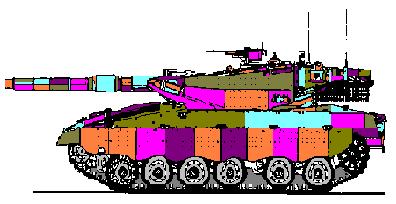
A new army base going up in the northern part of the West Bank will be Israel’s most colorful, painted in a dazzling array of pink, brown, purple, light blue and orange, an army weekly reported.
The current edition of “Bamahane,” a publication for soldiers, carries a small picture of the Jalameh base, going up near the Palestinian town of Jenin. It shows the stark structure of two-story cement blocks joined at right angles painted in eye-popping shades of orange and pink.
“I’m sick of seeing the ugly and depressing colors of military buildings — always beige and gray,” the officer behind the artsy project, Capt. Itsik Koren, told the weekly. “I decided to do something different here.”
The base is expected to be ready in two months. It will be home to a variety of units involved in Israel’s occupation of the West Bank, including infantry, roadblock guards, canine corps and field intelligence.
The picture shows the base under construction on typically rocky, barren West Bank land, but Koren told the weekly that this too, will change. He plans to plant trees around the base.
Israel is set to remove its four Jewish settlements from the northern West Bank next summer, but construction of the $5.76 million base, with its elaborate color scheme and landscaping, shows that the army is not planning to pull its forces out of the area anytime soon.
Rather than look for pictures of the base, I’ve decided to envision this color scheme applied elsewhere, such as the fine Israeli Merkava Mk-3:
So, what do you think?