Month: July 2005

  • Americans Held as Iraq Insurgent Suspects

    Well, it certainly looks like four, maybe five cases of treason.

    The U.S. military in Iraq has detained five Americans for suspected insurgent activity, Pentagon officials said Wednesday. The five have not been charged or had access to a lawyer, and face an uncertain legal future.

    Pentagon spokesman Bryan Whitman declined to identify any of them, citing the military’s policy of not providing the names of detainees. They are in custody at one of the three U.S.-run prisons in Iraq.

    One was identified by his family and U.S. law enforcement officials as Cyrus Kar, an Iranian-American filmmaker and U.S. Navy veteran.

    Saying Kar is being held unjustly, the American Civil Liberties Union sued the government on Wednesday in an effort to secure his release.

    Three of those being detained are Iraqi-Americans, Whitman said. The fifth is a Jordanian-American the Pentagon previously had acknowledged holding.

    One of the Iraqi-Americans allegedly had knowledge of planning for an attack and a second possibly was involved in a kidnapping, Whitman said. The third was “engaged in suspicious activity,” Whitman said, declining to be more specific. They were captured, one each, in April, May and June.

    Whitman said the Iranian-American was arrested with several dozen washing machine timers in his car; such items can be used as components in bombs. Military officials said he was arrested with a cameraman and a taxi driver.

    Whitman said there did not appear to be any connections among the five.

    If there are charges, it is not immediately clear whether U.S. courts or Iraq’s judicial system would handle the cases.

    Please note the following:

    The International Committee of the Red Cross has visited each of the detainees, Whitman said.

    There does seem to be questions about the detention of Kar and, as expected, these questions have the ACLU frothing at the mouth.

    In Los Angeles, Kar’s relatives said he was born in Iran and came to the U.S. as a child.

    They said Kar, 44, was in Iraq to film scenes for a documentary on Persia’s founder when Kar was arrested by Iraqi police at a checkpoint in Baghdad on May 17, a date confirmed by military officials.

    “He just had the misfortune to get into the wrong cab,” said Steven R. Shapiro, the ACLU’s legal director. “Our position is that if the government has any evidence against him, bring him home and charge in a court and then proceed accordingly.”

    His family said that an FBI agent in Los Angeles told them Kar had been cleared of any charges and that the washing machine timers allegedly belonged to the taxi driver, who was transporting them to a friend.

    “I’m here to beg President Bush … to release an innocent boy,” Kar’s aunt, Parvin Modarress, said at a news conference announcing the suit challenging Kar’s detention. “He went to Iraq to do his dream work, to make a documentary.”

    The FBI searched Kar’s Los Angeles home in May, said a U.S. law enforcement official who spoke said on condition of anonymity because the investigation is continuing.

    The ACLU’s suit, filed in Washington, contends that Kar’s detention violates his constitutional rights, federal law, international law and U.S. military regulations.

    “He’s just sat there in limbo. Whatever the government’s authority, it certainly doesn’t allow them to do that,” Shapiro said. He pointed to rulings that allow prisoners held by the U.S. at Guantanamo Bay, Cuba, to challenge their detention.

    Whitman said the five Americans were being held in accordance with laws governing armed conflict.

    Kar’s case should and will be sorted out, but I prefer erring temporarily on the side of caution in a war zone.

    As to the others, let’s warm up that gavel and spin those wheels of justice.

    Others blogging on the story are the Jawa Report, In the Bullpen, Small Town Veteran, Wizbang!, and Outside the Beltway.
  • Retention and Recruitment

    Here is a piece from Gullyborg of Resistance is Futile that I consider a must-read look at the state of military recruitment issues (courtesy the first Carnival of Liberty).

    Since leaving active duty, I have maintained an active interest in our Armed Forces, following every news story and keeping abreast of military developments long before 9/11 put our Soldiers and Sailors at the forefront of public opinion. And never in my memory has there been such a relentless attack on the morale of our troops.

    I was too young to remember the Vietnam War. But I am afraid I may living through its reincarnation, at least as far as our media establishment and our more liberal politicians are concerned.

    […]

    But retention is up. As Glenn Reynolds points out, our Troops in the field have a more positive view of things. They are seeing what’s really happening, and they believe what’s happening is a good thing.

    Go read the whole thing to understand the undeniable dichotomy that the American military is currently facing — keeping those currently in uniform, especially those who have been in areas of operation, has been easier than usual but filling new uniforms has proven difficult.

  • U.S. Considers Dropping Two-war Doctrine

    The reality of the impact of actual warfare has left the post-Cold War planning for two simultaneous campaigns shaken, not stirred.

    The Pentagon, stretched by the war in Iraq, is considering dropping a linchpin of American military strategy, the doctrine that requires it to be prepared to fight two major wars at the same time.

    Since the end of the Cold War the need to be able to fight two “near-simultaneous” wars in different theatres has dominated military thinking, with Iraq and North Korea seen as the most likely battlefields.

    Now, with military resources under increasing strain from commitments in Iraq, the Pentagon is considering a new doctrine to take into account the post-September 11 world.

    The mission in Iraq has overturned previous military thinking. While it is not officially seen as a “war” it has clearly taken one of the slots from the two-war doctrine, as it continues to absorb the manpower required for a medium-sized war.

    Officials said yesterday that among the options for the quadrennial defence review, due early next year, was preparing the military to fight just one major war while setting aside more resources for fighting terrorism and defending the homeland.

    Ryan Henry, the principal deputy undersecretary of defence for policy, suggested the “two-war doctrine” may be near the end of its shelf life. The two-war doctrine was born out of the rubble of the Pentagon’s Cold War strategy, which for 40 years had envisaged the Third World War being fought on the plains of Germany.

    It was formalised in the wake of the 1991 Gulf war, when the first President George Bush and then his successor, Bill Clinton, were slashing military budgets and the Pentagon saw it as a way of setting a limit to the cuts.

    Donald Rumsfeld, the defence secretary, has long promoted an overhaul of military thinking and, when he came to office in 2000, floated the idea that the two-war strategy was on its way out. But it survived the previous review.

    I have long held that the cuts of the 1990s were too sharp, too fast. But hey, who am I to judge? I remember in 1996 taking my tank into the field for a weekend field exercise. Because of budget constraints, each and every tank was limited to a whopping twenty gallons of fuel Sunday morning for the return to the motor pool. Here’s a newsflash: twenty gallons doesn’t go very far in a vehicle whose fuel efficiency is calculated in gallons per mile. As per the norm, we were a sweaty bunch at the end of the weekend, but I attribute the stench to more than just the heat of the turret in the late Ft. Hood springtime — no, there was the additional stress of watching the fuel guage on the roadmarch home. Nobody wanted to be on the track that sputtered to a halt and had to be towed.

    Obviously, I digress.

    Just as obvious, though, is the problem posed by the two-war doctrine, its shift of pressure onto the reserve components, the drag of a decade-long high rate of deployment for policing and peace-keeping, and the strain of the Afghani and Iraqi theaters of operations. The possibilities? First, deny the issue and maintain the present course of pretending. Second, expand the military to actually be to handle the requirements of the two-war doctrine. Third, revise the doctrine to face the current needs of the war against Islamist terror by streamlining forces and planning for a capability of one war and defensive postures elsewhere. McQ at QandO points out a key deficiency in the latter.

    OK. That means going back to a one conventional conflict army which may, may I say, be seen as a weakness by various players out there (such as China, North Korea and Iran).

    Tie the US up with a conventional confrontation (maybe via proxy) and then have your way (many have seen that as something China might consider in regards to taking Taiwan)on a second front.

    Yes, there is always the threat of a truly bloody and involved ground campaign to be considered.

    How you loving that peace dividend now?

  • The First Carnival of Liberty

    Brad Warbiany of The Unrepentant Individual has collected the recent efforts of the Life, Liberty, Property community into the blogosphere’s first-ever Carnival of Liberty (also posted on the community’s group blog). Go give a gander to some fine poliblogging.

    Alas! No entry from Target Centermass, as this last week has been rather hectic. You know, best laid plans, good intentions, all that rot. Hopefully I’ll get my act together for Carnival of Liberty II, coming soon from Dan Melson of Searchlight Crusade.

  • Happy Fourth of July

    Here’s wishing a happy Independence Day to all, but especially to my friend Bill.

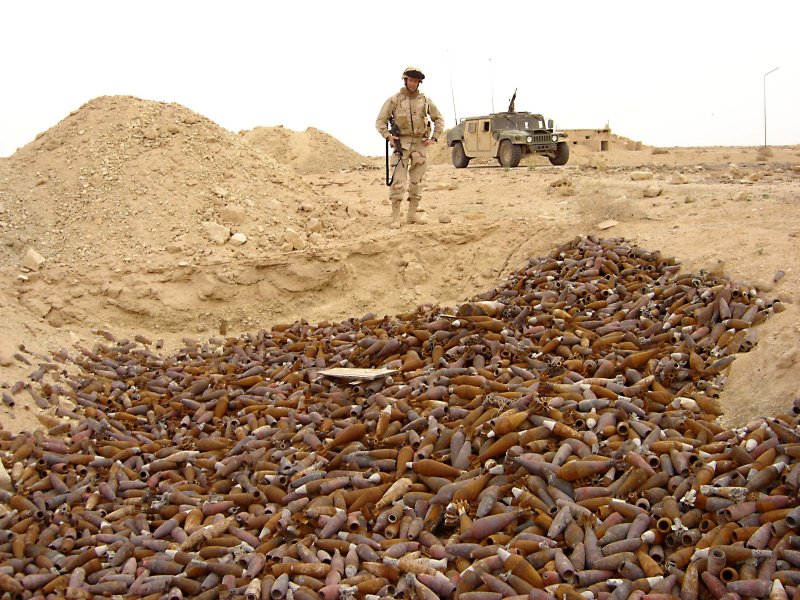
    I wrote back in January of SGT William J. Hartmann, my dear friend and former tank commander who was on his way to Iraq. In that post, I pointed out that my buddy, in typical Billy-boy fashion, was getting an inordinate amount of print space and face time in stories concerning the deployment of a large portion of the Texas Army National Guard.

    Well, the trend continues, courtesy of the home page of the 56th Brigade Combat Team (click for larger version of photo):

    SGT Hartmann on guard

    Sgt. William J. Hartman [sic] of the 3rd Battalion, 112th Armored Regiment, 56th Brigade Combat Team, 36th Infantry Division, stand [sic] watch over a pit full of Iraqi mortar rounds waiting to be destroyed by a civilian explosive ordnance disposal team at the Akudar Ammunition Depot located in central Iraq.

    Thanks for serving for our independence, Bill. Hope you had a happy Fourth, and keep safe, bro.

  • Quote of the Week, 4 JUL 05

    One man with courage is a majority.

    —Thomas Jefferson