Month: April 2006

  • Osama Tape: Reactions and Rejections

    A new tape from terrorist-mastermind-in-hiding, Osama bin Laden, surfaced yesterday.

    Al-Qaeda leader Osama bin Laden urged his followers to prepare for a drawn-out conflict with the Western world in a new audiotape broadcast Sunday, blaming what he called “a Crusader-Zionist war” for a long list of attacks on Islam in places from Darfur to Denmark.

    “Your aircraft and tanks are destroying houses over the heads of our kinfolk and children in Palestine, Iraq, Afghanistan, Chechnya and Pakistan. Meanwhile, you smile in our faces, saying: ‘We are not hostile to Islam; we are hostile to terrorists,’ ” bin Laden said, according to excerpts of the audiotape attributed to him and broadcast by the al-Jazeera network.

    It was the first time bin Laden had been heard from since Jan. 19, when he offered “a long-term truce” if the United States and its allies withdrew their forces from Iraq and Afghanistan and allowed Islamic fundamentalists to rebuild those countries instead.

    Before that, the 49-year-old Saudi had been publicly silent for more than a year. His face has not been seen since he appeared in a video recording broadcast a few days before the 2004 U.S. presidential election.

    The Counterterrorism Blog‘s Walid Phares does a solid job of narrowing Osama’s ramblings down to ten key bullet points. Of course the overblown Islamist talking point of the Danish Mohammed cartoons is on the list, as are the following:

    1. Hamas: Despite the fact that we (including Ayman Zawahiri) warned (Muslim Palestinians) not to take part in elections in general, the victory of Hamas shows that there is a “Crusader Zionist War against Islam.” Cutting foreign aid to the Palestinians because of Hamas victory proves that war.

    […]

    3. Sudan: The Bashir Government is failing in stopping the Crusader War in Sudan. The Crusaders (Britain) has pushed the southerners (Blacks) to separate. The US has armed them and is supporting them. And now, because of tribal tensions in Darfour, the Crusaders are planning on intervening there. We are calling on the Jihadists to fight them in Darfour and Southern Sudan.

    Today, Sudan and Hamas rejected Osama’s accusations.

    The Sudanese Government and Hamas have rejected Osama bin Laden’s criticism of the West for waging war against Islam.

    In a tape broadcast on al-Jazeera TV, which US intelligence believes is authentic, bin Laden criticised the Sudanese Government for agreeing to a US-backed peace deal for the troubled south of the country.

    He also inveighed against the Palestinians’ Hamas-led Government for breaking what he said was a taboo against “joining infidel assemblies” and entering Parliament.

    Despite moves taken by Sudan and Hamas that might be seen as in step with Washington’s stated goal of peace and democracy for the region, bin Laden said the US was planning to send troops to southern Sudan “to steal its oil”.

    The West’s rejection of Hamas showed it was waging “a Crusader-Zionist war” against Muslims.

    […]

    A Hamas spokesman said: “We are interested in good relations with the West.” In Sudan, a Foreign Ministry spokesman said Sudan was not concerned with mujahideen or any crusade.

    Polimom, Too‘s Daryl Hooper looks at these and other negative reactions from the world of Islam after making the following observation:

    Perhaps Polimom’s missing something (won’t be the first time), but from where I’m sitting this morning, the biggest reaction to Osama bin Laden’s latest tape is from the West. Polimom wonders whether Osama has spent just a tad too long in his cave – because he’s looking somewhat out of step.

    Besides the obligatory Crusader references and unsurprising cartoon squawking, Osama had to mention Israel. I mean, he just had to — it’s in the radical Islamist handbook. This time, though, Chad Evans over at In the Bullpen fears there may be more than just hot air and checking off an Osama-tape requirement behind this Israel reference.

    This latest audio tape is in a long line of Al Qaida communications that speak about Israel, but the group has always treated the Israeli situation like a red headed step-child only pulling it out when it needs support. As I have stated in regards to previous communications pertaining to the increased rhetoric over Israel, I think Al Qaida is making inroads into attack Israel and I think their first real hit will be a large one. We already know Al Qaida is in Gaza, and AQ in Iraq did launch a rocket into Northern Israel. Because the Hamas-run government won’t do anything about it, AQ will likely hit Israel. The group needs the support such an attack would garner.

    Here’s hoping Chad is wrong about this, though unfortunately it does pass the sniff test. And that dovetails in nicely with my initial reaction to the tape — Osama has seen the focus in the war against radical Islamist expansionism shift away from him as events of late have elevated the stories of Hamas’ attempt to take the political reins of the Palestinian Authority and Iran’s nuclear ambitions. Iraq recently appears to have been a break-even, as the terrorists, Saddamites and insurgent Sunnis plod along (hat tip to the western media who have facilitated this appearance) against the fledgling Iraqi government, its Coalition military allies, a determined American president and an majority of the Iraqi people growing sick of the bloodshed.

    As I have often stated, our war is against far more than Osama bin Laden; rather, it is against the twisted aspects of his civilization that allowed his likes to fester. Osama, however, needs the concentration to be on him, meaning the both attentions of the West and the world of Islam, for the war to be the brand of jihad he desires. Of late, his organization has been unable to pull off anything of substance, and even the lesser accomplishments have only been small but bloody strikes by affiliates such as Abu Musab al-Zarqawi that, while effective in many western news reports, may be actually backfiring locally. No, bin Laden built his biography on fighting the great fights, be they as part of the efforts against the Soviets in Afghanistan or dramatic strikes against the United States. A large stab at Israel might suffice to rekindle Osama’s importance in the Islamist world and return the war to the jihad of his choice … until Iran counters.
  • April 21

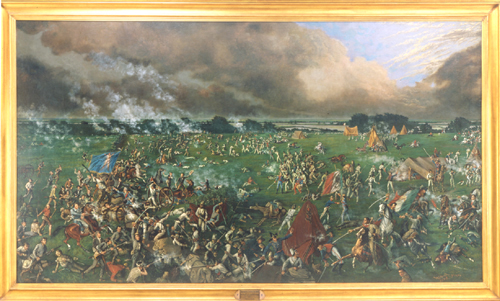
    Painting of Battle of San Jacinto by Henry Arthur McArdle, 1895, from Texas State Preservation Board

    That’s an important date in Texas. On this day in 1836, Texans won their independence from Mexico at the battle of San Jacinto.

    About 3:30 in the afternoon, during the Mexican siesta period, Houston distributed his troops in battle array, bracketing the line with the “Twin Sisters” cannon. Shielded by trees and a rise in the terrain, the Texans were able to advance with some security. Then with the cries “Remember the Alamo” and “Remember La Bahia” or “Remember Goliad” ringing along their lines, the Texans swooped down on the dismayed Mexican army, pursuing and butchering them long after the battle itself had ended.

    630 Mexicans were killed and 730 taken prisoner. Texans lost only 9 killed or mortally wounded; thirty were less seriously wounded. Among the latter was General Houston, whose ankle was shattered.

    The date is also marked by Aggie Muster, the most moving of the many traditions at Texas A&M.

    Aggies gathered together on June 26,1883 to live over again their college days, the victories and defeats won and lost upon the drill field and in the classroom. By April 21, 1903, this annual gathering evolved into a celebration of Texas’ Independence on San Jacinto Day. These early meetings included field games and banquets for Aggies to reflect and celebrate their memories of Aggieland. ‘Let every alumni answer a roll call’ wrote the former students. It was not until 1922, however, that April 21 became the official day of events for all Aggies, thus, the annual tradition of Muster was born. The March 1923 Texas Aggie urged, ‘If there is an A&M man in one-hundred miles of you, you are expected to get together, eat a little, and live over the days you spent at the A&M College of Texas.

    […] Twenty-five men, led by General George Moore ’08, mustered during the Japanese Siege of the Philippine island of Corregidor. Knowing that Muster might soon be called for them, these Aggies embodied the essence of commitment, dedication, and friendship- the Aggie Spirit. They risked their lives to honor their beliefs and values. That small group of Aggies on an outpost during World War II inspired what has developed into one of our greatest traditions.

    Muster is celebrated in more than four-hundred places world wide, with the largest ceremony on the Texas A&M campus in College Station. The ceremony brings together more Aggies, worldwide, on one occasion than any other event.

    […] The Campus Muster involves an entire day of activities for students both present and past. Alumni enjoy a special program including tours of the ever-changing campus. At noon, all Aggies congregate at the Academic Plaza for the Camaraderie Barbecue that rekindles the tradition of the original Muster celebration. That night, the Muster ceremony consists of an address by a keynote speaker, the reading of poems, followed by the Roll Call for the Absent. The Roll Call honors Aggies that have fallen since the last Muster roll was read. As the names are read, a friend or family member answers ‘Here’, and a candle is lit to symbolize that while those Aggies are not present in body, they will forever remain with us in Aggie Spirit.

    Aggie Muster
  • 2034

    Just a little political blogosphere satire, courtesy the Commissar.

    Enjoy, comrades.

  • Iran’s Enemy Lies Within

    The Guardian brings us a viewpoint opposing American military reaction against Iran and its nuclear ambitions, a view with some valid points.

    Internal political divisions and economic weaknesses may present a bigger threat to the longevity of the Iranian government of Mahmoud Ahmadinejad than the US and Israeli air forces combined, a report published yesterday suggests.

    The study, entitled Understanding Iran and produced by the Foreign Policy Centre, warns that military action against Iran’s suspect nuclear facilities could have disastrous consequences. “The only chance of modifying Iran’s behaviour in the short term will come from a serious effort to engage with the current leadership,” it says.

    While the work contains much validity and I have often in the past pointed towards the seething popular desire for democracy among a large portion of the Iranian population, the article trips up slightly here with it’s vague reference to the “short term.” More on that in a bit.

    Echoing calls for direct US-Iran talks made by Germany, the UN’s nuclear agency, and US politicians, the European thinktank’s report urges the creation of a Middle East security organisation similar to the Organisation for Security and Cooperation in Europe. It proposes mechanisms for facilitating dialogue to end the nuclear impasse and address other friction points. But in suggesting increased “economic, cultural, educational and social exchanges as a way of empowering the Iranian people and ultimately forcing the regime to loosen its restrictive practices” it also highlights the potentially fatal schisms and vulnerabilities of a government often portrayed as united in defiance of the west.

    “Behind the scenes a fierce struggle is under way. In one camp is President Ahmadinejad, his supporters in the Revolutionary Guards and the paramilitary force known as the Basijis, and messianic fundamentalists inspired by the teachings of Ayatollah Mohammad Taqi Mesbah-Yazdi. In the other camp is Iran’s embattled democratic movement [and] an array of forces that benefited from the status quo before Ahmadinejad came to power, including former president Ali Akbar Hashemi Rafsanjani.”

    The outcome of this battle was uncertain, but what was clear was that direct US intervention would play into the hands of the hardliners. “A strategy that gambles on a popular uprising to bring down the current regime runs the risk of undermining those very forces it purports to want to help.”

    Back to that short-term matter. The article makes no effort to define the short term in length of years but does obliquely mention the messianic fundamentalism of the current leader (much more on that here). Does the short term that this article suggests bearing out fall inside the barrier of nuclear capability and will to use it that a deranged, messianic Iranian leader needs? If so, great for all. If not, the article is pretty much worthless. Also, the article doesn’t imply but clearly states that American military intervention against an Iranian nuclear program would clearly play to the favor of the ruling Iranian radicals. I simply don’t accept that as a certainty — there are far too many variables. What if the assaults were relatively clean? What if they were timed with popular riots that were assisted? The article errs, in my opinion, by speaking with a claimed clairvoyance that the author cannot possess.

    The piece goes on to show some of the domestic factors accumulating against the current radical Iranian government.

    The report looks at other pressures on the government: a population of over 70 million, of whom 65% are younger than 25; a largely state-dominated economy prone to corruption; an energy industry starved of investment that is producing steadily less oil for export, and a youth culture increasingly circumventing controls on foreign media and internet access.

    ‘According to the government’s own estimates some 900,000 new jobs are needed annually to accommodate the burgeoning labour force and prevent an increase in unemployment, officially at 16%, unofficially at over 20%,” the report says. It also focuses on gender discrimination, human rights abuses (including executions of minors and repression of minorities), and attempts to suppress free speech and independent media.

    All these contentious issues, it suggests, carry the seeds of change from within and in the longer term could be catalysts for ending Iran’s post-1979 theocracy. But if the west was to understand Iran, it had to understand itself – and recognise that clumsy outside attempts to jump-start reform were likely to be counterproductive.

    While all valid, the use of these points to support an argument for inaction by the West in the vaguely-declared “short term” actually need to be considered as a reason for possible action — and most assuredly current planning — by the West. While these points may eventually completely undermine the current tyrants of Iran, they very well may be the same factors that force those radical rulers into immediate bloody, fiery action against Israel, Iraq, Europe or other allies within their range … or even possibly on our shores in the form of terror activity.

    While I believe a large chunk of Iranians ache for freedom and democracy, this does not assure that the nation will become friendly before it produces tragedy. Also, American intervention does not guarantee a nationalistic arrousal by the Iranian people for their current government, though that would be a possibility depending on circumstances. Simply put, there are too many alternatives available that undermine the occasional, though possibly deadly if accepted, certainties of this article.

  • Pentagon Releases Extensive Gitmo List

    Forty-freakin’-one different nationalities in da house.

    The U.S. government released the first list of detainees held at the Guantanamo Bay prison on Wednesday _ the most extensive accounting yet of the hundreds of people held there, nearly all of them labeled enemy combatants.

    In all, 558 people were named in the list provided by the Pentagon in response to a Freedom of Information lawsuit by The Associated Press. They were among the first swept up in the U.S. global war on terrorism for suspected links to al-Qaida or the Taliban.

    The list is the first official roster of Guantanamo detainees who passed through the Combatant Status Review Tribunal process in 2004 and 2005 to determine whether they should be deemed “enemy combatants.”

    Gitmo — putting the “global” in Global War on Terror.

    Admittedly, GWoT is a poor name for the current conflict; though the “G” and the “W” portions are accurate, the “T’ refers only to a particular tactic employed by our enemy. Personally, I feel that the name World War IV is more accurate, leaving the oft-dreaded III to the collection of hot engagements and steamy standoffs that comprised the more commonly-dubbed Cold War.

  • Light the BlogCandles

    Preston Taylor Holmes and the gang over at Six Meat Buffet are celebrating their second blogiversary. Feel free to pay them a visit and offer congrats on another entertaining whirl around the sun.

  • Study: Couples in Austria, U.S., Spain Have Best Sex Lives

    As a 38-year-old American facing marriage less than three weeks away, I find this research to be very heartening news.

    Middle-aged and older people in Austria, the U.S., Spain and Canada are more satisfied with their sex lives than counterparts in East Asia and the Middle East, a study released today showed.

    Equality between men and women plays an important role in attitudes about sex, according to research by the University of Chicago. The study of 27,500 adults aged between 40 and 80 in 29 countries also showed that Japanese and Taiwanese people were the least satisfied with sex, while residents of Turkey, Egypt and Algeria were in the middle.

    The research is the first of its kind to compare sexual behavior and attitudes among middle-aged and older people worldwide, the authors said. A majority of people over 40 remain sexually active in all countries. Societies in East Asia and the Middle East, where men have a more dominant status over women, showed the lowest marks for sexual satisfaction, the authors said.

    Alright, America, we made the medal stand!

    USA! USA! USA!

  • Tonight’s Good Read

    Gates of Vienna brings us “The Fall of France and the Multicultural World War,” a lengthy look at the prospects of Europe in the face of expansionist Islam. There’s a lot of food for thought here, but understandably not a lot of cheer.

    Hat tip to CDR Salamander, who ties it to another similar piece before posting his two cents worth.

  • Fatah-loyal Media Taking Hamas to Task

    It seems that common ground may actually exist between Hamas, the terrorists and newly-elected leaders of the Palestinian Authority, and the administration of President Bush, as Hamas now finds itself facing an antagonistic domestic media.

    Never mind the icy winds blowing from the West. The Hamas government’s toughest detractors have popped up at home, criticizing the Islamic militant rulers in Palestinian newspaper cartoons, TV commentaries and radio talk shows.

    Most of the Palestinian media are loyal to the Fatah Party, defeated in January parliament elections, and Hamas is getting increasingly upset about the unflattering coverage. Such friction between the government and the media is rare for the Arab world.

    The Hamas government has proven an easy target. It’s broke and internationally isolated because of its refusal to moderate its hard-line views, and has been unable to pay the salaries of tens of thousands of government employees.

    Hamas remains defiant, claiming it’ll be able to govern without Western aid by persuading Arab and Muslim countries to step in – an assertion ridiculed in the Palestinian media.

    A cartoon in the Al Ayyam daily lampooned Prime Minister Ismail Haniyeh, who told a rally Palestinians would rather live on bread with olives, hyssop and salt than bow to Western demands. The cartoon showed a Palestinian with an empty shopping basket standing before bank cash machines labeled olives, salt and hyssop. He called his wife and, waving his bank card, asked what she wanted for dinner.

    Bassem Abu Somayeh, head of the Palestinian Broadcasting Corp., wrote in a recent newspaper commentary that the Hamas government must step down.

    And on the private Hurriyeh radio station, commentator Muafaq Mattar suggested sarcastically that Hamas officials who headed to Iran to plead for money bring back Iranian caviar.

    “The Palestinian media is clearly biased against Hamas,” complained Mahmoud Ramahi of Hamas, secretary-general of the Palestinian parliament. “What they are doing is not monitoring or criticizing. What they are doing is inciting against Hamas, in the interest of Fatah.”

    Pro-Fatah journalists say they are giving equal treatment to all politicians and that Hamas is simply frustrated because it cannot control the media.

    “It’s only because they (Hamas) can’t impose their agenda on us, they say we are inciting,” said Mohammed al-Dawoudi, a senior official in the Broadcasting Corp., which runs the Voice of Palestine radio, Palestine TV and the official Wafa news agency.

    For now, Fatah and its moderate leader, Palestinian President Mahmoud Abbas, seem to have the upper hand – in part because Abbas took control of the Broadcasting Corp. by decree after the election.

    […]

    “The Palestinian media is dominated by Fatah and the main writers are either Fatah or leftists, so it is natural to see the media opposing Hamas,” said Nashat al-Aqtash, a communications professor at Bir Zeit University. “The Palestinian media is now launching a campaign against the Hamas government.”

    Ramahi, the Hamas politician, said he no longer grants interviews to the Voice of Palestine morning news show. “The presenters are biased against us,” he said. “They talk to us in order to trap us, bringing someone from Fatah afterward to criticize us without giving us a chance to respond.”

    Like Bush, Hamas does have some friendly elements in the media. Unfortunately, whether by fear or shared perceived enemies, Hamas would seem to have a greater chance of improving its coverage. I have little faith in a very large portion of the American media to actually realize where our enemies truly reside in the time remaining for the Bush administration. Or any time soon after that.

  • Carnival of Liberty XLI

    This week’s installment of the Life, Liberty, Property community’s Carnival of Liberty is up over at Left Brain Female. Go read another fine collection of posts from a libertarian slant.