Author: Gunner

  • Debate Starts on Boosting Mil Death Benefit

    A move by the Bush administration to greatly enhance cash payouts to those lost in the campaign against Islamic terror has led to a counter-proposal asking for even more.

    Democrats argued today that President George W. Bush’s proposal to boost government payments to families of U.S. troops killed in Iraq, Afghanistan and future war zones should extend to all military personnel who die on active duty.

    Sen. Carl Levin of Michigan, ranking Democrat on the Armed Services Committee, said that while he agreed with Bush’s plan to give those families an extra $250,000, the money also should “apply to all service members on active duty” who die and not just those who die in Pentagon-designated combat zones.

    Officials with the Army, Navy, Air Force and Marines told the committee that the Department of Defense should not give benefits to surviving spouses and children simply based on the geography of where a death occurs.

    “They can’t make a distinction. I don’t think we should either,” said Adm. John Nathman, vice chief of naval operations for the Navy. Added Gen. Michael Moseley, the Air Force’s vice chief of staff: “I believe a death is a death, and I believe this should be treated that way.”

    Under questioning from Levin, David Chu, the undersecretary of defense for personnel and readiness, said the administration would work with Congress to determine the exact objective of the increased benefits.

    Look, folks, the objective is simple — reduce the possibilities or strength of a virtual parade of embittered widows, widowers and orphans on our TV sets, being used as a knife in the back against our efforts to conduct the needed war for our children’s sake. Sound melodramatic? The media and the left have turned victory into defeat before (see the Tet offensive) and emotionalism is a powerful tool.

    The proposal, the subject of the panel’s hearing, includes retroactive payments to the spouses or surviving relatives of the more than 1,500 who have died in Iraq and Afghanistan since October 2001. It will be in the fiscal 2006 budget proposal that Bush submits to Congress next week, a Pentagon official said.

    A tax-free “death gratuity,” now $12,420, would grow to $100,000. The government also would pay for $150,000 in life insurance for troops. Veterans groups and many in Congress have been pushing for such increases.

    Sen. Jeff Sessions, R-Ala., who is sponsoring a bill with the same provisions, said yesterday that the first-year cost of the increased benefits would be $459 million, including more than $280 million in retroactive payments of the higher gratuity and the extra life insurance payouts. “The American people want to be generous to the families of service people who give their lives for their country,” he said.

    I actually back Sen. Levin’s proposed increase here, though I would go it one further. Why limit it to only deaths on active-duty service? Is a death on a National Guardman’s weekend duty less important? Put it at any deaths occurring while serving a duty period (i.e. reservist has an accident in his private vehicle during the week = no benefit beyond insurance; reservist dies in Humvee wreck on weekend drill = benefit).

    That’s just my view. Those in a combat theater deserve supplemental pay, a death is a death, the families suffer equally and the sacrifices of all should be recognized.


  • U.N. Expert Calls Iraq Election Moving

    Two days later and after time to reflect, the Iraqi elections are still being hailed as triumphs.

    Abandoning diplomatic circumspection, the top U.N. electoral expert on Tuesday praised the vote in Iraq as one of the most moving she had ever seen.

    Carina Perelli, who has helped advise on dozens of elections from East Timor to the Palestinian territories, called the Jan. 30 election a “dignified, peaceful demonstration” of Iraqis’ will.

    About 40 people were killed but she told a news conference it had been a feat that no polling station was closed for the day because of security fears.

    “I have participated in many elections in my life and I usually say that the day you lose your ability to be moved by people going to vote, you should change your career,” said Perelli, who had insisted for months that U.N. advisers would leave pronouncements on the election to Iraq’s electoral commission. “This was probably one of the most moving elections I have ever seen.”

    Perelli said she knew the process was going well when she was given a report on election day that there were long lines at polling stations in Mosul, a city that has seen some of the worst violence in Iraq recently.

    “It is, I think, a message for all of us that beyond our discussions, beyond our diagnosis, beyond our expertise, normal people have something to say about their destiny,” she said of the vote. “In that sense, I think it was an extremely moving and good election.”

    I remember how I felt the first time I voted. It must truly inspire awe in one who was blessed to witness a nation share that feeling.

  • Iraq Insurgents’ Failure Raises Questions

    The Associated Press, in this piece on Yahoo! News, takes a look at the failure of the insurgents in Iraq to live up to their threats. The piece is authored by one Sally Buzbee, credited as an AP writer but actually apparently the AP’s chief of Middle East News. Let’s take a look at her look.

    They sent nine suicide bombers, killed more than 40 people, claimed to have shot down a British military plane and threatened to wash the streets with blood.

    Insurgents’ threats against Iraq’s historic election appeared to have some impact, keeping Sunni Arab turnout low in certain areas when Iraqis voted Sunday. Yet the rebels did not stop the balloting altogether, raising questions of just how much ability and influence they have.

    Yes, it does raise questions. However, the article will go on later to effectively not pursue those questions in any significant depth.

    “There will still be some acts of violence,” Iraqi Prime Minister Ayad Allawi said Monday, claiming the elections had dealt the insurgency a major blow. “But the terrorists now know that they cannot win.”

    The elections were hailed as a success around the world, including in Sunni Arab countries like Jordan.

    The elections may have been hailed world-wide as a success, but this article will instead turn it’s aim to undermining this assessment, as I will show later.

    British Foreign Secretary Jack Straw suggested the elections dealt a psychological setback to the insurgents because it demonstrated Iraqis were committed to democracy.

    “Yesterday’s elections represent a real blow to this disgusting campaign of violence and intimidation,” Straw said in London. “These elections were a moving demonstration that democracy and freedom are universal values, to which people everywhere aspire.”

    […]

    Jordanian terror mastermind Abu Musab al-Zarqawi’s militant group also pledged Monday to continue its attacks in Iraq despite the election. In a statement published on the Internet, the al-Qaida group in Iraq said the elections “will increase our strength and intention to get rid of injustice.”

    “Let Bush, Blair … know that we are the enemies of democracy,” the group said of the American president and British prime minister.

    Taking the focus off the article, let’s look at al-Zarqawi’s spin. His insurgency, the self-acclaimed enemies of rule by the people, finds itself facing the overwhelming desire of the people and thinks that its strength will increase? Who believes that, especially immediately after the elections themselves show al-Zarqawi to be a lying braggart? Yes, they are still dangerous and, yes, they still have some internal and much external support. However, they failed to show the world, especially the Arab and Iraqi world, that they had the strength to affect the tide of history when the spotlight on them was never brighter.

    Nevertheless, the insurgents’ failure to launch a catastrophic attack on election day may be a sign their power “has been more localized than thought previously,” said Paul Sullivan, an Iraq expert at the U.S.-funded National Defense University in Washington.

    Question to Buzbee: why does this seem surprising? I seem to recall a great many statements by the president, members of his administration and representatives of the DoD pointing out repeatedly that the terrorist activities have been generally focused in a very limited number of provinces.

    It’s possible insurgency leaders will lay low for a while. Or they may try for a quick, big attack to prove they are still potent, Sullivan said.

    Another quick question: this is worth including? The terrorists may do nothing soon or they may do something soon. Are you trying to reach a word count for a class assignment?

    Quick, let’s look for excuses for the terrorists’ impotence and try to find reasons it may be an aberration.

    A higher-than-usual U.S. troop presence and extremely tight security may have helped tamp down the violence.

    But many of the most extreme security measures — like a ban on most private driving and the closing of the country’s borders and airport — are only temporary, said Jeremy Binnie, a London-based analyst for Jane’s Terrorism and Insurgency Center.

    The number of U.S. troops, now at 150,000 because of rotation overlap, already is scheduled to drop soon to 138,000.

    C’mon, one more reason. Please.

    It’s also possible the insurgents simply chose not to strike, worried they would get caught, Binnie said.

    Look, you cannot excuse a failure to live up to a promise to make the streets run with blood simply because the terrorists chose not to do so. You can say they couldn’t. You can say they were cowards. But you can’t imply that they chose to order a pizza and kick back with the PlayStation2.

    They threatened. They failed. There is simply no “choosing not to strike” in this game if the terrorists want to maintain a substantial air of fear among the now-jubilant populace.

    Now, I said earlier that the piece will try to cut into the success of the election. Let’s see how it does so over the final roughly one-fifth of the story.

    But a U.S. diplomat in Baghdad, speaking on condition of anonymity, said Iraqi troops’ success on election day doesn’t necessarily mean they can defeat the insurgency going forward. The official predicted some insurgents may decide to ratchet up attacks.

    He also noted that “anecdotal evidence” indicates Sunni participation was “considerably lower” than other groups.

    That means the insurgents may have largely succeeded at their main election day goal — suppressing Sunni turnout, said Ken Katzman, an Iraq expert at the Congressional Research Service in Washington.

    The main Shiite faction is likely to win the most votes and take the biggest role in the new government. Because of that, Sunnis “now feel certain that they are at the mercy of the Shiites,” who comprise 60 percent of the population, Katzman said.

    And that means the election, despite relatively low violence, probably will not “produce the factional reconciliation” hoped for, he said.

    Get that? Despite the terrorists’ failed threats, despite the fact that, at worst, the elections went as thought in some Sunni areas and better than could be imagined everywhere else, despite the hope and self-determination the overwhelming bulk of Iraq is embracing, the terrorists “may have largely succeeded.”

    My ass they may have, Sally Buzbee. That is, unless you and you like-minded colleagues get your way, unless y’all can dim the shining city on the hill that is being built in the Arab world.

  • Reciprocity X

    Just wanted to thank two blogs for their attention to Target Centermass:

    Also, Target Centermass has recently joined the Homespun Bloggers, a “group of family-friendly bloggers who blog for no financial gain. (Note: A blogger may gain some financial benefit from his or her blog, but that compensation should not be a ‘major’ source of income (you be the judge).)” It seems to be quite a varied group of blogs — go give them a look.

    As posted recently, I wanted to acknowledge once again two links for Texas bloggers:

    TexasBlogfest 2005

    As always, if you’ve linked or blogrolled Target Centermass and I haven’t found you, please send an email or post a comment. No good deed should go unrewarded.

  • Iraqi Elections: Some Notes and Quotes

    Looking through a collection of anecdotal stories from the Associated Press, the following statements from Iraqi voters jump out at me:

    “Am I scared? Or course I’m not scared. This is my country,” said 50-year-old Fathiya Mohammed, heading to a nearby polling station alone, but moving quickly.

    In the “triangle of death,” where voting is a life-threatening experience, Karfia Abbasi held up her ink-stained finger, elated that for the first time she has been able to cast a ballot for someone besides Saddam Hussein.

    “This is democracy,” Abbasi said. “This is the first day I feel freedom.”

    Crowds burst into impromptu demonstrations, shouting, “No to dictatorship. Yes to democracy,” and “Long live freedom.”

    Abed Hunni, a stooped, whiskered man walked an hour with his wife to reach a polling site in Musayyib. “God is generous to give us this day,” he said.

    Well, maybe God, but most assuredly the militaries of the Americans and their allies. And, of course, the Iraqis’ own security forces, slowly growing in size, proficiency and confidence.

    Speaking of those Iraqi forces, repeatedly slammed in the media for their unwillingness to fight, what was their performance?

    “It has been a long and hard assignment for me,” said policeman Abbas Saedi, a veteran of 23 years in the force who earns $190 a month.

    “We fought terrorists who took shelter in a cemetery behind the polling center, we captured some and found weapons hidden in graves. It was all worth it. This is great.”

    Eight suicide bombers unleashed blasts throughout the day, killing themselves and at least 19 other people. An Iraqi policeman who spotted one of the attackers approaching a polling site leapt on the man as the blast ripped them both apart.

    Please realize that the Army of the Republic of Viet Nam (ARVN) carried the same reputation of cowardice and low regard. Thanks to the media, this reputation lasted until the end of the ARVN and the fall of South Viet Nam, despite the fact that ARVN units had become equal to or superior to their North Vietnamese counterparts for years (with the exception of external support, which disappointedly shriveled to nothingness for the ARVN in the post-Watergate days). Hopefully, history and the leftists’ propaganda success will not repeat for the improving Iraqi forces.

    What does this election mean going forward? Eric at Eric’s Random Musings muses at length about this, examining the impact on the American Left and the future of Iraq and American involvement.

    It’s too late to go back. The Left in the United States is focused on what was, which can’t be changed. Regardless of the reality of Iraqi nuclear weapons programs, chemical weapons stockpiles, support for terrorism or lack thereof what’s done is done. It’s time to go forward the best way possible. And abandoning the Iraqis (the Left’s cherished “exit strategy” [From Gunner: I’ve blogged in the past about my view on this pathetic phrase]) is absolutely the wrong path forward. What we need is a strategy to win. Winning means defeating the Ba’athist insurgents, marginalizing the al-Qaeda terrorists (and yes, they are two different groups, although they have similar goals and appear to work together), giving the Iraqi’s some room to establish a workable government and then slowly transitioning the security of the country to the Iraqi government.

    Are matters settled in Iraq? Of course not. From this vote, a slate of representatives will step forth to help shape a future Iraqi government, a government that will have a long row to hoe. However, two things must be noted. First, the so-called insurgency of terrorists and Saddamists does not have the strength it claimed. Second, and perhaps most important for the nation of Iraq, is that the Iraqi people can embrace the following feeling:

    And in heavily Shiite areas in the far south and mostly Kurdish regions in the north, some saw the vote as settling a score with the former dictator, Saddam.

    Now I feel that Saddam is really gone,” said Fatima Ibrahim, smiling as she headed home after voting in Irbil. She was 14 and a bride of just three months when her husband, father and brother were rounded up in a campaign of ethnic cleansing under Saddam. None have ever been found.

    Closure. And a new beginning.

  • Quote of the Week, 30 JAN 05

    Men love war because it allows them to look serious, because it’s the only thing that stops women from laughing at them.

    —John Fowles

  • History in the Making

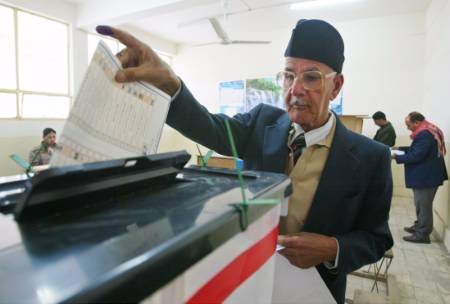
    The Iraqis are voting.

    Interim Iraqi President Ghazi al-Yawer holds up an ink-stained finger as evidence that he voted.

    Iraqis, mostly women, wait to vote in Shiite Sadr City.

    Another Baghdad voter casts his first free ballot.

    As for the bloodbath promised by the terrorists? Well, it has yet to develop. At this time, it is almost noon in Iraq and the news is of three suicide bombings and a small handful of mortar attacks. With over 5,000 pollings sites, that’s pretty meek compared to the threats, though the day is young.

  • Israel Eyes Iran Nuke Threat

    Israel, obviously facing the greatest threat from a nuclear-armed Iran, is on the verge of drawing a line in the sand.

    Israeli Defense Minister Shaul Mofaz has told French lawmakers that Iran is at “the point of no-return” on building nuclear weapons, according to a transcript of his remarks to the National Assembly.

    Mofaz, who warned openly in London this week that Iran would not be permitted to build a nuclear bomb, has in the past said that Israel has operational plans in place for a strike against Iranian targets.

    Mofaz told the French National Assembly’s defense commission that “he ardently hoped that a recourse to military action would not be necessary” in Iran, according the transcript of the Tuesday meeting.

    But he said that to avoid this, there would have to be careful inspections aimed at removing any ambiguity about the existence of a military nuclear project.

    Even if Iran recognized Israel’s existence, Mofaz said “the possession of a nuclear weapon by an extremist regime is not acceptable.”

    “The danger is great,” he said. “The possession of non-conventional weapons could allow Iran to carry out terrorist actions with complete impunity and destabilize the free world.”

    Iran’s Revolutionary Guards warned earlier this week that any attack against the country would be met with an “astonishing” retaliation.

    The last portion about retaliation against a possible Israeli strike is not just idle bluster. That Iran has missiles that can reach Israel and could wage a vicious terrorism campaign against the Jewish state are a certainty; Israel would have to weigh these against the level of danger based on Iran’s feared nuclear capabilities. Desperation would indeed have to be the decisive factor. This is multiplied by the complexity and difficulty behind any Israeli move — this would be no raid on Osiraq. The Iranian nuclear facilities are said to be dispersed and would be assuredly better protected.

  • Remembering the Horror: Auschwitz

    Today is the sixtieth anniversary of the liberation of Auschwitz. I’ll bow to Guy at Snugg Harbor to honor the date and examine the horror here and here. WARNING: Guy posts that images in the second link are not safe for work, though I disagree. I put it at PG-13, and a must-see and a must-remember for all older.

  • Italy To Return Ethiopian Obelisk

    In post-9/11 America, much has been made of the appeasement that preceded World War II, especially the case of the Sudetenland and the Munich Agreement. Somewhat lost in the sands of time are the military conflicts in the years leading up to the outbreak of the war. Chief among these are the Sino-Japanese War, with the Japanese occupation of Manchuria and a wealth of atrocities that make Abu Graib look like a four-year-old’s birthday party, and the Spanish Civil War, the proving ground for the troops, equipment and tactics of the Soviets, Germans and Italians. Even more obscure is the invasion of Ethiopia (then Abyssinia) by Benito Mussolini’s Italy in 1935. That aggression may finally be finding a closure.

    An Ethiopian national treasure, the ancient Axum Obelisk that was plundered by Italian fascist invaders in 1937, will be returned by Rome in April, Italy’s Foreign Ministry said on Thursday.

    The 24-meter obelisk, believed to be at least 1,700 years old, was split in three and hauled off when Italy under Fascist dictator Benito Mussolini invaded Ethiopia in 1937.

    Italy promised in 1947 to return the 200-tongranite column, a symbol of the dawn of Ethiopian civilization, but arguments and logistical problems delayed it until November last year when the two countries finally agreed to fly it home.

    […]

    Returning the segments of the monument and the machinery to put it back together is a gargantuan logistical task.

    Landlocked Ethiopia has had to build a special runway for the only aircraft big enough to carry the pieces, the U.S.-built C-5 Galaxy and Russian-made Antonov 124. The Antonov was the plane finally chosen to bring the obelisk home.

    It’s surprising that the massive artifact took around a year to remove and over a half-century to return. For no reason at all, I blame the recent resurgence of trucker hats.