If you’re in a fair fight, you didn’t plan it properly.
—Nick Lappos
If you’re in a fair fight, you didn’t plan it properly.
—Nick Lappos
As the storied Black Watch Regiment rolled north to take up position near Baghdad, I blogged about the British hope to replace the Americans’ heavy-handed approach towards the insurgents with a softer, gentler approach. Once they reached their destination, the soldiers of the Black Watch met a different kind of enemy than they had faced around Basra.
The much-hyped conceit about Britain’s soft military touch in Iraq had a hard landing on a road south of Baghdad one November morning, when an Iraqi car accelerated toward a British checkpoint and a young gunner fired a blizzard of bullets through its windshield.
The soldiers from Scotland’s Black Watch regiment didn’t stick around to determine whether the dead driver was an aspiring suicide bomber or just a man impatient to get through the backup of traffic. But the myth might have died along with him.
The troops of the regiment also met cold, hard reality about American tactics.
In postwar Iraq, contrasting images have percolated through media coverage of the alliance: the martial Americans on one hand, looking to crush the insurgency through force, the world-weary British on the other, choosing accommodation over provocation. The implication was that something in their tactics or temperament made British soldiers better suited than Americans to cope with the insurgency here.
But the October deployment of the Black Watch to these badlands controlled by Sunni extremists provided the first chance to compare the two countries’ operating styles under the same level of danger.
Until the Black Watch moved north, the British military had been operating exclusively in southern Iraq, where the violence, while simmering, has not matched the mayhem in the American sector around Baghdad, the capital. The relative calm allowed the British to adopt a less bristling posture on patrol, to wear their soft regimental berets instead of Kevlar helmets and to keep their weapons lowered rather than peering at Iraqis through gun sights.
It also gave rise to a certain smugness among British officers and media, which cast the contrast as one between the “heavy-handed” Americans and the less hostile tactics of “the lads.” There were jokes over beers in Basra that, to an American, the concept of winning Iraqi hearts and minds meant one bullet to the heart, one to the head. And the British media even coined a phrase to describe the British style, dubbing the less robust approach “softly, softly.”
The Black Watch tried to bring that culture north with them when they merged operations with the 24th Marine Expeditionary Unit based south of Baghdad in a deployment that ended Saturday. The British began the assignment patrolling in their berets. They handed out leaflets in Arabic explaining they were a “Scottish” regiment in case Iraqis mistook them for Americans, and proclaimed they had come only to help build a safe and free Iraq.
Insurgents responded with two suicide car bombings and a roadside bomb in the first week of operations, killing four British soldiers and gravely injuring two others.
The shooting of the Iraqi driver at the checkpoint came just an hour after the second car bomb had blown the legs off two of the gunner’s colleagues.
“The threat here is at the other end of the spectrum from what we faced in Basra,” said Black Watch Capt. Stuart MacAulay, sitting on the edge of a bunker at Camp Dogwood. “After the suicide bombings against us, I went to an American soldier I know here and put my hands up. I said, ‘I confess, I was one of those who sat around in Basra criticizing your approach.’ And I’m embarrassed that I criticized American tactics without ever being here and without having met them.”
People lie all the time, especially in sentences that begin with the phrase “I hate to say I told you so, but ….” In this case, I cannot say I told you so. I doubted, but held out enough hope that I restrained.
I should’ve known better. Our British allies certainly know better now. The Islamists and Saddamists know only one language. Luckily, it is one in which our weapons are already fluent.
Origami? Ori-freaking-gami?!!
Suffice it to say, “paper for peace” will not surpass “land for peace” in effectiveness.
More than 50 military aircraft dropped 120 million origami birds over southern Thailand yesterday in a gesture of peace towards three largely Muslim provinces where 540 people have died in violent clashes this year.
The extraordinary idea was proposed by Thaksin Shinawatra, the Prime Minister of Thailand, who has been criticised for using force rather than negotiation to counter Islamic unrest in the south of his predominantly Buddhist country.
It was the biggest paper drop in the region since the Allies had to convince thousands of Japanese troops that the Second World War had ended.
But the paper-bird exercise failed to quell the unrest. A retired prosecutor was shot dead at his shrimp farm in one of the rebellious provinces. The Pattani United Liberation Organisation, an outlawed group, said: “Even if you used 500 baht (£7) banknotes to fold 100 million birds . . . it would not stop the suffering of those who have been severely oppressed.”
Air force planes trailing coloured smoke started dropping the origami cranes at 9.09am yesterday: nine is regarded as a lucky number in Thailand.
The birds had been folded by volunteers including cabinet ministers and convicts during the past two weeks, and were dropped on the 77th birthday of Thailand’s revered King Bumiphol Adulyadej, the world’s longest-serving monarch. One signed by the Prime Minister offered an educational scholarship or job to whoever found it. Others offered rewards in an apparent attempt to prevent a problem with litter — 50,000 birds secured a bicycle, 10,000 a table fan, and 250 a bag of sugar.
Children in the provinces of Narathiwat, Yala and Pattani rushed out eagerly to greet the falling birds, but the air drop was regarded by many Islamic leaders as propaganda and received a lukewarm reception. Moreover, many of the birds carried the inscription “No separatism for south Thailand.”
“The majority of people in the south do not see any significance in origami cranes,” Abdulraman Abdulsamad, chairman of the Islamic Council of Narathiwat, said. “The idea is not totally bad. At least we could remind ourselves that violence is not a good thing. But the people need more than paper gestures.”
The birds also came with a warning from Mr Thaksin. At a press conference the day before the drop he said that he would try to win back the south with “love and warmth,” but added: “If they don’t stop we’re justified to do what’s required to sustain unity.”
The three restive provinces have been part of Thailand for just over 100 years. An insurgency that has rumbled on there for decades flared in January.
The idea of using an origami crane as a peace symbol originated in Japan after the atomic bombing of Hiroshima.
In what is obviously a clash of vastly different cultures, any hope vested in this maneuver shows a lack of understanding of the Islamic opposition that would make Neville Chamberlain cringe.
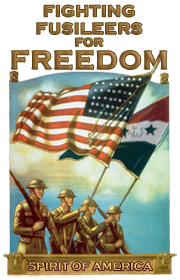
As if such a wonderful cause as the Spirit of America wasn’t enough, the Fighting Fusileers want you to know that no kittens will be harmed by donations through us. This may not be true for other blogger groups.
The U.S. released a surprise statement to the international landmine summit in Nairobi, promising to ban its usage of anti-personnel mines by 2010 … almost.
The world will have to wait until 2010 before the United States of America bans the use of anti-personnel landmines.
This is the message the military superpower sent to the delegates attending the first review conference of the anti-personnel Mine Ban Treaty held in Nairobi.
In an unsigned press release distributed to the delegates, the US statement said between now and 2010, the possible use of persistent anti-personnel landmines will be restricted only to “our security treaty obligations in South Korea and any possible use outside that country will require presidential authorisation”.
The US announced it had increased its mine action budget by 50 percent over the 2003 levels for a new total of $70 million per year.
This is a wise maneuver, showing a willingness to cooperate against an international menace, yet still both retaining an out in case of need and maintaining a realistic view of the weapon’s current role as a deterrence on the Korean peninsula.
According to officials at the U.S. Department of Defense, China has launched its first submarine designed to carry an intercontinental nuclear payload.
The submarine is, at a minimum, months away from having missiles installed and going on a cruise, one official said, discussing foreign weapons developments only on condition of anonymity. Still, it is further evidence of China’s intentions to expand both its nuclear weapons and submarine forces, officials say.
It was widely known China was building the new class of nuclear-missile submarine, called the Type 094 but the launch is far ahead of what U.S. intelligence expected, one official said.
The launch was first reported in the Washington Times newspaper. The newspaper reported U.S. intelligence spotted the sub at a shipyard 400 kilometres from Beijing.
It would be China’s first submarine capable of launching nuclear weapons that could reach the United States from the country’s home waters, officials said.
The Chinese military has also been developing a new class of submarine-launched ballistic missile, called the JL-2, that is expected to have a range in excess of 7,400 kilometres. The Type 094 submarine would carry these missiles but it is not clear whether the missiles are ready for deployment.
Previously, China has had only one submarine capable of launching nuclear missiles, called the Type 092, or Xia, class. In 2001, a Pentagon report said the Xia was not operational. Its missiles were of an older class that could fly only 1,000 kilometres.
Successful cruises by the Type 094 would give China a new strategic deterrent against the United States, no longer limited to land-based ICBMs and weapons carried on aircraft. But U.S. defence officials said China lags behind the United States in its ability to hide submarines from sophisticated sonars and other sensors.
By all accounts, China severely lags behind the U.S. in practically every aspect of naval technology, and this class should be easily trackable by American attack submarines.
The Chinese will have a potential impact in three important areas with this launch. First, they are placing an added burden for the American navy to monitor and possibly counter. Second, they will add to the importance of a viable missile defense for the U.S. and an additional stressor on matters concerning Tiawan. Third, they just gave Tom Clancy another storyline.
And all the circus clowns pile out of the car.
Ten candidates will run in the Palestinian Authority’s presidential election to replace Yasser Arafat, officials said on Thursday after finalizing the list of contenders for the Jan. 9 race.
Heading the list was Mahmoud Abbas, Arafat’s successor as the head of the Palestine Liberation Organization, as well as Marwan Barghouthi, a leader of the Palestinian uprising, who is serving five life sentences in an Israeli jail.
Abbas, a moderate who will be representing the mainstream Fatah faction, had been seen as the frontrunner in the election until Barghouthi’s candidacy was submitted shortly before a deadline on Wednesday night. Barghouthi, the most popular choice among Palestinians to succeed Arafat, told his wife during a prison visit that he wanted to run in the election as an independent candidate.
His candidacy has upset Abbas’s chances and thrown the Palestinian political arena into turmoil. Palestinian officials have called on Barghouthi to withdraw his candidacy to maintain unity among Palestinian ranks. “Candidates have until midnight on Dec. 15 to withdraw their candidacy,” Rami Hamdullah, Secretary-General of the Central Elections Committee (CEC), told a news conference in the West Bank city of Ramallah.
….
The snap election was called to replace Arafat as head of the Palestinian Authority after he died of an undisclosed illness at a French hospital.
Hopefully I’m wrong in my characterization of these clowns. The AP gives a brief bio here of all ten. Please note the following phrases:
Still leaning towards the clowns statement.

Target Centermass has taken up the challenge from Castle Argghhh! to join up with the Fighting Fusileers for Freedom for a very good cause. I can only encourage you to do the same.
I have been remiss to date in adding a link to the Spirit of America. That will be corrected shortly.
Thanks to Ben at Ben’s World for helping me pick a team. Just remember, Ben, never take a knife to a fusil fight.
The AP is reporting on a small trickle of effort to actually begin increasing security in the homeland. Using Israel as a model for both the anticipated type of attacks and the means to prevent them, mall security personnel are slowly getting anti-terror training.
In a shopping mall outside Hartford, past the Abercrombie & Fitch and the cell phone kiosks, tucked away by the Barnes & Noble, a conference room full of security guards is learning how to spot suicide bombers.
They are being taught blast patterns and behavior profiles, how a bomb is packaged and how a bomber is recruited.
Suburban shopping mall security guards — whose jobs usually consist of watching for shoplifters and shooing away loitering teenagers — are receiving the type of training that just a few years ago was reserved for the Israeli police and the U.S. military.
“If they’re carrying a bag, look for that white-knuckle grip. … They’re carrying that package and they’re holding onto it for dear life,” Patrick Chagnon, a Connecticut State Police detective and national counterterrorism instructor, tells his class of 10 students as the Shoppes at Buckland Hills mall bustles with holiday shoppers carrying bags and boxes of all sizes.
Chagnon’s students are also told to watch for people wearing oversized clothes, and are instructed to make eye contact with shoppers and look for either extremely focused people or those who won’t return a look. Another tip-off: Terrorists often ritualistically shave their bodies before carrying out a suicide bombing, he says.
Around the country, enrollment in these suicide bombing classes has increased in the past year, and the students include not just elite SWAT team members, but also local patrol officers and private security forces.
“Everyone has an obligation to be a soldier in this war,” Connecticut Homeland Security Director John Buturla says.
In Israel, mall security guards, bus drivers and hotel managers are added eyes and ears for the police. That is what state and federal officials are trying to build in the United States.
In New York City, for example, apartment doormen and supers are being trained to be on the lookout for cars or trucks that are parked outside for a long time; for anyone who takes pictures of the building or lingers too long outside; and for new tenants who move in with little or no furniture.
The International Council of Shopping Centers held about 20 anti-terrorism classes this year and plans dozens more next year, says Malachy Kavanagh, who helps organize training for the organization. A class of mall security directors recently received training at the FBI Academy in Quantico, Va., he says.
….
Such training frequently is met with skeptical questions: Is al-Qaida really going to attack a Connecticut shopping mall? Anti-terrorism instructors say a bombing is nearly twice as likely at a commercial establishment than at a government building or military installation.
“A mall is packed with people. Government buildings usually are not,” says Uri Mendelberg, a former Israeli military official whose company, ISDS International, teaches a three-day, $1,300 course on suicide attacks in Springfield, Mass. Mendelberg says about 60 people, including security agents for major U.S. corporations, have taken his class since it started last year.
Chagnon’s lectures for mall security officials on how to prevent suicide bombings are paid for by the state and run about four hours.
“It will happen. You just need to make sure it doesn’t happen here,” he tells the security guards. “If terrorists know that `Mall A’ has good security and `Mall B’ doesn’t, where are they going to go?”
Of course it will happen. I fully believe that we will see jihadist terrorism against our citizenry, apart from the planes-into-buildings obvious. I’m truly surprised it hasn’t already began, considering the state of our borders and the seemingly lax nature of our neighbors.
The numbers in this story that have gone through anti-terror training are rather depressing. These are the sort of numbers we should’ve seen in spring of 2002.
In their attempt to become a civilized democracy, the Palestinians are holding an election to replace dead-but-not-soon-enough terrorist-in-chief Yasser Arafat. Unfortunately but expectedly, it’s on the verge of becoming a circus.
Jailed Palestinian uprising leader Marwan Barghouti declared his candidacy for president Wednesday, a stunning last-minute reversal that shook up Palestinian politics ahead of the Jan. 9 vote for Yasser Arafat’s replacement.
Adding to the uncertainty, the militant group Hamas said it would boycott the election. It was the first sign of open divisions between the interim Palestinian leadership and the Islamic opposition group since Arafat’s death Nov. 11.
The moves injected drama into what has been a smooth transition of power. Before Wednesday, interim leader Mahmoud Abbas managed to win pledges of unity — if not outright support — from the disparate Palestinian factions and seemed a shoo-in to win the presidency.
The fiery, charismatic Barghouti, who is serving five life terms in an Israeli prison for his role in deadly attacks, is far more popular among young Palestinians than the staid Abbas.
Last week, Barghouti sent a message from his prison cell saying that he would not pursue the presidency for the sake of unity in the ruling Fatah movement. But Wednesday, he abruptly changed his mind.
Cheered by supporters who shouted “With our blood and souls, we will redeem you, Marwan,” Barghouti’s wife, Fadwa, dropped off his registration documents at the Palestinian election headquarters ahead of a midnight deadline. “I officially registered Marwan,” she told reporters. Earlier, the campaign paid a $3,000 deposit, associates said.
Abbas already has been nominated as Fatah’s presidential candidate, so Barghouti must run as an independent. But as a leading Fatah member, he would likely undermine Abbas’ prospects.
Barghouti, 45, represents the younger generation of Fatah that grew up in the West Bank and Gaza, while Abbas, 69, comes from the “old guard” of leaders who returned from exile with Arafat a decade ago.
Barghouti became a political activist in the 1970s, joining Arafat’s Fatah movement. He spent six years in Israeli jails — where he learned Hebrew — for his membership in Fatah, and was deported in 1987.
He was one of the first exiles to return seven years later under interim peace deals with Israel. Barghouti supported those accords, advocated a Palestinian state alongside Israel and had close ties to Israeli peace activists.
But when the Palestinian uprising broke out in September 2000, Barghouti used Arab satellite television to turn himself into the most prominent voice of the Palestinian resistance. Though he said he still supported a peaceful solution, Barghouti said force — including shooting attacks on Israelis — was justified to end Israel’s occupation of the West Bank and Gaza Strip.
Israeli arrested Barghouti in 2002, accusing him of funneling money to militants and being involved in attacks that killed 26 Israelis. He was convicted of attacks leading to five deaths.
While Abbas and Barghouti both favor a negotiated settlement with Israel, an election victory for Barghouti would complicate matters. Israel has quietly embraced Abbas, whom it considers a pragmatist, and has ruled out freeing Barghouti.
However, because of his popularity, it might be easier for Barghouti to make the concessions needed to reach a peace deal with Israel.
That the Palestinian president could be a criminal would be nothing new. The potential for change would be that he would actually be behind bars for his crimes.
And is Hamas, having claimed in the past that it was ready to step in and govern the Palestinian people, shooting itself in the foot with its boycott threats? Or is the gambit to de-legitimize any resulting president going to elevate Hamas as a viable alternative to the Palestinian Authority? Interesting days ahead, folks.