Category: Military

  • Badass Tank Video

    Courtesy of an Israeli friend, I give you this video of the Merkava 4 (broadband recommended).

    As an old DAT (dumbass tanker), I find the looks inside the turret most interesting because I can quickly compare them to the M1. No other major tank can match the Merkava’s rear exit, but those dismounting infantry will be useful for the maintenance required on the tanks in some of the shots in this clip.

  • Debate Starts on Boosting Mil Death Benefit

    A move by the Bush administration to greatly enhance cash payouts to those lost in the campaign against Islamic terror has led to a counter-proposal asking for even more.

    Democrats argued today that President George W. Bush’s proposal to boost government payments to families of U.S. troops killed in Iraq, Afghanistan and future war zones should extend to all military personnel who die on active duty.

    Sen. Carl Levin of Michigan, ranking Democrat on the Armed Services Committee, said that while he agreed with Bush’s plan to give those families an extra $250,000, the money also should “apply to all service members on active duty” who die and not just those who die in Pentagon-designated combat zones.

    Officials with the Army, Navy, Air Force and Marines told the committee that the Department of Defense should not give benefits to surviving spouses and children simply based on the geography of where a death occurs.

    “They can’t make a distinction. I don’t think we should either,” said Adm. John Nathman, vice chief of naval operations for the Navy. Added Gen. Michael Moseley, the Air Force’s vice chief of staff: “I believe a death is a death, and I believe this should be treated that way.”

    Under questioning from Levin, David Chu, the undersecretary of defense for personnel and readiness, said the administration would work with Congress to determine the exact objective of the increased benefits.

    Look, folks, the objective is simple — reduce the possibilities or strength of a virtual parade of embittered widows, widowers and orphans on our TV sets, being used as a knife in the back against our efforts to conduct the needed war for our children’s sake. Sound melodramatic? The media and the left have turned victory into defeat before (see the Tet offensive) and emotionalism is a powerful tool.

    The proposal, the subject of the panel’s hearing, includes retroactive payments to the spouses or surviving relatives of the more than 1,500 who have died in Iraq and Afghanistan since October 2001. It will be in the fiscal 2006 budget proposal that Bush submits to Congress next week, a Pentagon official said.

    A tax-free “death gratuity,” now $12,420, would grow to $100,000. The government also would pay for $150,000 in life insurance for troops. Veterans groups and many in Congress have been pushing for such increases.

    Sen. Jeff Sessions, R-Ala., who is sponsoring a bill with the same provisions, said yesterday that the first-year cost of the increased benefits would be $459 million, including more than $280 million in retroactive payments of the higher gratuity and the extra life insurance payouts. “The American people want to be generous to the families of service people who give their lives for their country,” he said.

    I actually back Sen. Levin’s proposed increase here, though I would go it one further. Why limit it to only deaths on active-duty service? Is a death on a National Guardman’s weekend duty less important? Put it at any deaths occurring while serving a duty period (i.e. reservist has an accident in his private vehicle during the week = no benefit beyond insurance; reservist dies in Humvee wreck on weekend drill = benefit).

    That’s just my view. Those in a combat theater deserve supplemental pay, a death is a death, the families suffer equally and the sacrifices of all should be recognized.

  • Bloody Day for Military Helicopters

    Weather Suspected in Deadly Marines Crash

    A top U.S. general said Wednesday there was severe weather at the site of a U.S. Marine helicopter crash in of western Iraq and that he had no reports of enemy fire in the area. President Bush expressed sorrow at the loss of life and said he knew Americans would find the new deaths discouraging.

    […]

    Lt. Gen. John Sattler, the top Marine commander in Iraq, said in a videotaped statement from his headquarters in Fallujah, west of Baghdad, that 30 Marines and one Navy sailor were killed. He made no mention of a possible cause and said a recovery team was at the crash site.

    Sattler identified the aircraft as a CH-53E Super Stallion, which is the largest helicopter in the American military. He provided no details about the circumstances of the crash; he said the victims were members of the 3rd Marine Aircract Wing and 1st Marine Division but was not more specific.

    Vietnamese Helicopter Crashes; 16 Dead

    A Vietnamese military helicopter crashed in northern Vietnam shortly after takeoff, killing all 16 people aboard, officials said Thursday.

    A loud explosion was heard just minutes after the Russian-made helicopter took off from Me Island off the coast of Thanh Hoa province Wednesday afternoon, officials of Nghe An province said.

    The bodies of three crew members and 13 military officers, including the commander of Military Zone 4 based in Nghe An and his deputy, have been recovered.

    The military is investigating the cause of the crash.

    The military is a dangerous business, even when bullets aren’t flying. My best wishes to the families.

  • Military May Face Reservist Shortage

    The Associated Press paints a grim picture of the toll the war against Islamist terror is taking on the U.S. reserve components.

    The strain of fighting a longer, bloodier war in Iraq than U.S. commanders originally foresaw brings forth a question that most would have dismissed only a year ago: Is the military in danger of running out of reserve troops?

    At first glance the answer would appear to be a clear no. There are nearly 1.2 million men and women on the reserve rolls, and only about 70,000 are now in Iraq to supplement the regulars.

    But a deeper look inside the Army National Guard, Army Reserve and Marine Corps Reserve suggests a grimmer picture: At the current pace and size of American troop deployments to Iraq, the availability of suitable reserve combat troops could become a problem as early as next year.

    The National Guard says it has about 86,000 citizen soldiers available for future deployments to Iraq, fewer than it has sent there over the past two years. And it has used up virtually all of its most readily deployable combat brigades.

    In an indication of the concern about a thinning of its ranks, last month the National Guard tripled the re-enlistment bonuses offered to soldiers in Iraq who can fill critical skill shortages.

    Similarly, the Army Reserve has about 37,500 deployable soldiers left — about 18 percent of its total troop strength.

    The Marine Corps Reserve appears to be in a comparable position, because most of its 40,000 troops have been mobilized at least once already. Officials said they have no figures available on how many are available for future deployments to Iraq.

    Both the Army and the Marines are soliciting reservists to volunteer for duty in Iraq.

    “The reserves are pretty well shot” after the Pentagon makes the next troop rotation, starting this summer, said Robert Goldich, a defense analyst at the Congressional Research Service.

    The story goes on to further detail the deployments and their inherent strain on the Guard and Reserve. It does, however, include a positive note about how the citizen-soldiers have carried out their missions.

    In some respects, the use of Army and Marine reservists in Iraq has been a success story. Goldich, the defense analyst, said their performance has generally been excellent. Commanders sing their praise.

    Hooahhh, troops, and thank you.

  • Incentives Target Special Ops Troops

    Keep ’em if you’ve got ’em. Consider it an investment.

    The Pentagon has approved an incentives package designed to retain special operations troops in the military, Pentagon officials said Friday.

    The package — approved December 22 for $168 million over three years — is aimed at keeping Navy SEALs, Army Green Berets and other troops trained to fight terrorists from taking lucrative positions with security contractors or other government agencies, the officials said.

    The incentives are directed at troops with a good deal of wartime experience and highly specialized skills that take considerable time and money to replace.

    Only “operators” — troops on the ground conducting missions — are targeted, not everybody in the 49,000-person special ops community, the officials said.

    Depending on how long special ops troops commit to stay with the military, they could receive an additional $8,000 to $150,000 beyond their regular salaries.

    […]

    “This is not about a need to increase the size of the [special ops] community,” said Pentagon spokesman Lt. Col. Joe Richard.

    “It is about keeping the ones we already have and keeping that experience and skill level without having to continually train large numbers to replace the ones that left.”

    The package is not that unusual. In the past, the Pentagon has offered incentives to pilots to try to keep them from leaving for higher-paying jobs in the commercial airline business.

    I whole-heartedly agree with this. We’re not talking about dumbass tankers (DATs) such as I used to be. We’re talking about elite, skilled and highly-trained troops who offer more value to our defense than we’ve often been willing to compensate financially.

  • Pentagon Rejected Gay Weapon Proposal

    This is good for a chuckle.

    The U.S. military rejected a 1994 proposal to develop an “aphrodisiac” to spur homosexual activity among enemy troops but is hard at work on other less-than-lethal weapons, defense officials said Sunday.

    The idea of fostering homosexuality among the enemy figured in a declassified six-year, $7.5 million request from a laboratory at Wright Patterson Air Force Base in Ohio for funding of non-lethal chemical weapon research.

    The proposal, disclosed in response to a Freedom of Information request, called for developing chemicals affecting human behavior “so that discipline and morale in enemy units is adversely affected.”

    “One distasteful but completely non-lethal example would be strong aphrodisiacs, especially if the chemical also caused homosexual behavior,” said the document, obtained by the Sunshine Project. The watchdog group posted the partly blacked-out, three-page document on its Web site.

    Lt. Col. Barry Venable of the Army, a Defense Department spokesman, said: “This suggestion arose essentially from a brainstorming session, and it was rejected out of hand.”

    The Air Force Research Laboratory also suggested using chemicals that could be sprayed on enemy positions to attract stinging and biting bugs, rodents and larger animals.

    Another idea involved creating “severe and lasting halitosis” to help sniff out fighters trying to blend with civilians.

    The U.S. military remains committed to developing less-than-lethal weapons that pass stringent legal reviews and are consistent with international treaties, said Captain Dan McSweeny of the Marine Corps, a spokesman for the Pentagon unit spearheading their introduction.

    “We feel it’s very important to offer our deployed service members and their commanders a greater range of options in dealing with increasingly complex operational environments,” said McSweeny, of the Joint Non-Lethal Weapons Directorate.

    It all seems rather silly, but it’s good to know the folks in defense are putting some creative skullsweat into their efforts.

    I wonder, however, had we developed the homosexual aphrodisiac weapon, what would the ramifications be on Don’t Ask-Don’t Tell in a friendly-fire incident?

  • Soldier Gets 10 Years in Iraq Prison Abuse

    Abu Ghraib continues to take its toll. This time, however, the cost is finally being borne by one actually responsible.

    Army Spc. Charles Graner Jr., who grinned in photos of Iraqi prisoners being sexually humiliated but told jurors, “I didn’t enjoy what I did there,” was sentenced Saturday to 10 years behind bars in the first court-martial stemming from the Abu Ghraib prison scandal.

    Graner, labeled the leader of a band of rogue guards at the Baghdad prison in late 2003, could have received 15 years.

    Asked if he felt remorse after the sentence was handed down, Graner said, “There’s a war on. Bad things happen.”

    Graner will be dishonorably discharged when his sentence is completed. He also was demoted to private and ordered to forfeit all pay and benefits.

    A day after convicting him, the jury of four Army officers and six senior enlisted men deliberated about two hours to determine Graner’s sentence. He could have received 15 years.

    Graner, who had been free prior to trial, was taken into custody after the sentence was read. He gave his mother, Irma, a big hug and his father, Charles Sr., a firm handshake before the jury foreman read the sentence.

    “He’s scared to death,” Irma Graner said later.

    Graner was accused of stacking naked prisoners in a human pyramid and later ordering them to masturbate while other soldiers took photographs. He also allegedly punched one man in the head hard enough to knock him out, and struck an injured prisoner with a collapsible metal stick.

    Defense lawyer Guy Womack said his client and the six other Abu Ghraib guards charged with abuses were being scapegoated, but added that he thought the jury did its job well.

    “I firmly believe there should have been reasonable doubt, but we respect their decision,” he said outside the courthouse. He added that he had feared Graner could have received a harsher sentence than the 10-year term.

    Prosecutors Maj. Michael Holley and Capt. Chris Graveline would not speak to reporters, but they said in a joint statement, “We think it is important that the world was able to observe this court-martial.”

    The exact scope of the abuse scandal has been hyped to hyperbole by those thirsting for ratings or with an axe to grind or on a political headhunt. Screams for heads to roll, no matter how distant and uninvolved those heads were, echoed loudly but luckily to no avail.

    What happened at the prison was a crime, actually a fairly minor one in relation to the harm it was allowed to wreak on U.S. efforts, and now the criminals are beginning to find justice. That is as it should be; however, when all the dust settles, will those who contributed to the international circus ever look back and realize the damage they willfully perpetrated against the U.S. and the harm done to fighting Islamist terror?

  • Good Luck, Billy-boy

    I mentioned back in July that a good old buddy of mine had gone back in the Guard. Now he’s about to get his boots dusty.

    I first met William Hartman in the fall of 1990. He was fresh off of three years of active duty as an infantryman and starting at Texas A&M when he enlisted in my unit. We’ve been friends ever since.

    Here’s a pic of us in transition training at Ft. Hood in May 1993 as the Texas Guard moved from the M60-A3 to the M1. Bill, by then an ROTC cadet and SMP (Simultaneous Military Personnel, or “Dot” for their cirle rank insignia), is on the right and yours truly is on the left.
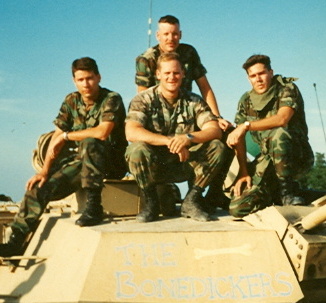
    On an M1 at Hood in May 93

    Since those days, Bill graduated and received his commission. After becoming a tank platoon leader, he talked me into transferring into his new unit and serving as his gunner. We crewed together until I left the Guard in ’99. Shortly after that, Bill moved laterally to a scout platoon leader position.

    A few years later, I crewed with him once again as one of his groomsmen. Not long afterward, 1LT Hartman resigned his commission, devoting himself to his civilian life and family and, to be honest, bored with the idea of the eventual staff-officer position that was looming. Staff work just isn’t his style.

    Civilian Bill, doing well in sales and enjoying family life with a beautiful wife and three young children. But there’s always the news.

    The stories can eat at a former soldier. The guilt can gnaw. Believe me, I know.

    Last May, Bill informed me that he was back in the Guard. Rather than go through all the hoops required to get his commission back, he went in as a sergeant based on his last enlisted rank of E-5 as a cadet.

    A voicemail from Germany this week told me where he is now headed.

    My friend Bill, along with a large contingent of the Texas Army National Guard, is going to Iraq.

    But Bill isn’t going quietly into that sandy night. A quick search found this story about the deployment, and SGT Hartman is mentioned and quoted extensively. No real surprise, knowing ol’ Billy-boy.

    For any athletes, constant practice and teamwork can make the difference between winning and losing a big game. But for the soldiers of the 36th Infantry Division’s 56th Brigade Combat Team, the intense combat training that they are performing here in preparation for their deployment to Iraq is no game, because losing can mean the difference between life and death.

    The call-up of about 3,000 Texas citizen-soldiers for duty in southwest Asia to support Operation Iraqi Freedom is the largest mobilization in the state’s history since World War II.

    After half a century, the 36th Infantry Division, formally the 49th Armored Division, was reactivated to help transform the Texas Army National Guard into a more mobile and lethal fighting force that will see a new generation of soldiers wearing the “T-Patch” committed to helping fight the global war on terrorism and carry on the proud legacy established by their predecessors.

    ….

    Some of the Guardsmen had to learn to re-think how to perform their mission and adapt to fighting the guerilla-style tactics the insurgents use.

    Sgt. William J. Hartman, an M1A1 Abrams main battle tank crewman, said that he and his fellow soldiers have a steep learning curve that they must overcome in just a few short months before they are sent overseas.

    Hartman explained that tankers are trained in armored warfare and are accustomed to fighting fast and striking the enemy from a distance in their tank. He said that reverting from an armored role to an infantry role presented a challenge in a number of different areas.

    “We as tankers have a comfort zone in that we are used to operating as a team inside a 63-ton vehicle that is our own little protective capsule,” Hartman explained.

    Hartman emphasized that they will have to think outside of the box and learn to adapt to infantry tactics because they are going to operate in an urban environment. That places a greater emphasis on the level of focus into the training that they perform.

    “We all believe in what we are doing and why we are here,” Hartman said. “When it comes to the training, our Soldiers know the importance of it and they want to get damn good at it, because we have a real-world mission ahead of us. Our lives and the lives of others depend on how well we learn our jobs and how we execute it.”

    But that’s not enough for Bill. The story can also be found here. And here. And here. And here. He even got face time, specifically the picture below (Bill is the one on the left), in the last two links, including this ridiculously large version.
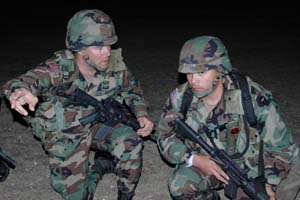
    SGT Billy-boy -- still acting the officer

    My friend Bill is going to Iraq. I can’t believe he’s going to war without me.

    Good luck, Billy-boy, and be sharp — it’s a younger man’s game. Happy hunting, my dear friend.

  • Nuclear Submarine Accident Kills 1 Sailor

    The military, even during peacetime exercises and operations, is a dangerous business. This fact has tragically demonstrated again.

    A nuclear submarine that ran aground about 350 miles south of Guam, killing one crewman and injuring 23 others, was due back at its home port in Guam on Monday, according to a Navy spokesman.

    There were no reports of damage to the USS San Francisco’s reactor plant, but the extent of damage to the 360-foot submarine would be determined when it gets to port, said Jon Yoshishige, spokesman for the U.S. Pacific Fleet. The vessel was moving under its own power.

    Officials said they still don’t know what the Los Angeles-class submarine hit Saturday, but Lt. j.g. Adam Clampitt of the Pacific Fleet said it had been conducting operations underwater at the time.

    The incident is under investigation, said Yoshishige.

    Navy medical personnel from Guam have been brought aboard the submarine to treat the injuries, which included broken bones, lacerations, bruises and a back injury, the Navy said. The submarine has a crew of 137.

    The name of the sailor who died was being withheld pending a mandatory 24-hour waiting period, the Navy said. The sailor’s next of kin had been notified.

    Located west of the international date line, Guam is a U.S. territory about 3,700 miles southwest of Hawaii.

    During the Cold War, this could very well have been a game of cat and mouse between an attack sub and a missile boat that went awry. Who knows? That may still be the a case.

  • Pentagon Orders Iraq Troop Review

    Old soldiers never die, they just get called back to review operations in Iraq.

    The Pentagon has confirmed that retired Gen Gary Luck has been asked to review overall operations in Iraq.

    The news comes as a senior official revealed that the US army is likely to ask for a permanent increase of 30,000 in its strength [blogged here yesterday].

    US defence officials have sought to play this down as just part of an ongoing review process.

    But Defence Secretary Donald Rumsfeld has asked the general to look at the training of the Iraqi security forces.

    That is critical, because handing over security to the Iraqis is key to the Pentagon’s exit strategy – and this new review does seem to reflect the concern about how the security strategy is unfolding.

    US military commanders acknowledge that the performance of the Iraqis is mixed, and far from being able to cut US troop numbers as it had hoped, the Pentagon now has more personnel in Iraq than ever – more than 150,000.

    To argue that operations in Iraq and the training of Iraqi security forces should not be reviewed for possible improvements would be silly. I wish Gen. Luck … well … good luck on his mission.