Category: War on Terror

  • Tonight’s Reading: Steyn on Demographics

    Okay, so I’m running behind. I’m muddling through the lengthy latest from Mark Steyn, in which he pegs the key weapons the radical Islamist movement hopes will bring about the downfall of the West — our own obsession with multiculturalism, misplaced tolerance and diminishing birthrates — while watching Florida State and Penn State slug it out in the Orange Bowl and doing laundry.

    So far, I’d have to say the piece is certainly a must-read and I’d like to discuss it further, though that probably won’t happen tonight. For now, I’ll recommend Protein Wisdom‘s Jeff Goldstein’s commentary on Steyn’s effort.

  • Iraqi Leaders Agree in Principle to Enlarge Cabinet

    The key phrase in that headline has to be the “in principle” hedging. Still, this is a promising development for those who saw the worst in the recent Iraqi parliamentary elections.

    Iraq’s Shiite and Kurdish leaders said on Thursday that they agree in principle to enlarge the next government’s cabinet to include representatives of other communities in a bid to push for a national unity government.

    “The Kurdish coalition and the Shiite alliance agree in principle on a government of national unity,” Kurdish leader and Iraqi President Jalal Talabani told reporters after a meeting with Shiite leader Abdul Aziz al-Hakim in Dokhan, a mountain resort 400km north of Baghdad.

    However, Talabani specified that there would be some restrictions in the forming of an enlarged cabinet, saying, “the other parties must believe in certain principles,” including “rejection of terrorism.”

    While the move is obviously intended to allay concerns about election irregularities or the lack of support for secular entities, it is still a move in the right direction. Democracy is a series of missteps heading in the right general direction … hopefully; this is no different for the fledgling attempt in Iraq. Every effort toward inclusion should be considered a welcome one.

  • U.S. to Investigate Leak on Spying Program

    As anticipated, the media has wasted nary a moment clamoring for the identities of those responsible for the leak of the Bush administration’s policy of monitoring domestic communications with suspected international terrorists without warrants. No, it seems their concerns about leaks go only so far as to hurt the Bush administration and not to defend national security.

    Luckily, there’ll be an investigation anyway.

    The Justice Department said Friday that it had opened a criminal investigation into the disclosure of classified information about a secret National Security Agency program under which President George W. Bush authorized eavesdropping on people in the United States without a court warrant.

    The investigation apparently began in recent days following a formal referral from the spy agency regarding the leak, officials said on condition of anonymity.

    The program, whose existence was revealed in an article in The New York Times on Dec. 16, has provoked sharp criticism from civil liberties groups, some members of Congress and some former intelligence officials who believe it circumvents the law governing national security eavesdropping.

    Bush and Attorney General Alberto Gonzales have vigorously defended the program as a legal, critical defense against terrorism that has helped prevent attacks in the United States. They say the president’s executive order authorizing the program is constitutional as part of his powers as commander in chief and under the resolution passed by Congress days after the Sept. 11, 2001, attacks authorizing the use of force against terrorists.

    Trent Duffy, a White House spokesman, told reporters in Crawford, Texas, where the president is on vacation, that Bush did not request the investigation.

    “The leaking of classified information is a serious issue,” Duffy said. “The fact is that Al Qaeda’s playbook is not printed on Page 1, and when America’s is, it has serious ramifications.”

    To be quite honest, we’re fighting this war with one hand tied behind our backs. It is no understatement to say I find it disgusting that we must struggle so mightily to keep our other hand free, as the media, war critics and political partisans seek to constrain all of our efforts.

    Michelle Malkin has links, updates and thoughts on the matter.

    Look for the Plamegate apologists to argue that the NSA leaks were “good” leaks, justified in the name of safeguarding civil liberties and the national interest, and should therefore be exempt from criminal prosecution.

    By contrast, they argue that disclosures about Valerie Plame were “bad” leaks worthy of pulling out all prosecutorial stops–though no one has been charged with leaking classified info, and even if they did, the adverse effects on national security are infinitesimal compared to the damage done by the NYT/NSA leaks.

    Actually, I expect a relative silence compared to the Plame leak cacophony. I would think rather that the apologists Malkin refers to will work instead to keep the focus on the Bush administration’s policy and ignore the leaking as much as possible.

  • Poland Keeping Troops in Iraq Another Year

    Bully for the Poles, among our staunchest of allies.

    Poland’s president on Thursday approved extending the country’s military mission in Iraq for another year, the prime minister said.

    “The president made such a decision on the government’s request,” Prime Minister Kazimierz Marcinkiewicz said on TVN24 television during a ski trip at a mountain resort. “The issue is closed and taken care of.”

    Marcinkiewicz’s government requested Tuesday that President Lech Kaczynski, the commander in chief of Poland’s armed forces, reverse plans by the previous government to bring home troops serving with the U.S.-led coalition in early 2006.

    […]

    Marcinkiewicz’s announcement offers some relief to President Bush, who has seen the U.S.-led coalition in Iraq dwindle and faced withering criticism at home and abroad over his handling of the war.

    Ukraine and Bulgaria announced this week that their remaining soldiers had pulled out of Iraq.

    In calling for an extension Tuesday, Marcinkiewicz called the move “a very difficult decision” but said that it was a step meant to help maintain stability as Iraq progresses toward democracy.

    Though the mission will be prolonged, the number of Poles serving in Iraq will be cut from about 1,500 to 900 by March, officials have said. The Poles are based at Camp Echo in the central city of Diwaniyah, one of the nation’s more stable areas, where they mainly train Iraqi security forces.

    Poland has been a staunch U.S. ally in Iraq. It sent combat troops to the country and in September 2003 took command of an international force that now numbers some 3,000 troops from 12 countries.

    However, the deployment is unpopular, and some in Poland have complained that they have not seen sufficient rewards such as easier access to U.S. visas or more rebuilding contracts for Polish companies. Seventeen Poland solders have died in Iraq.

    I feel that there is much merit to the idea of insufficient rewards to date, not only for Poland’s sacrifice but also for the growing importance the country seems willing to accept on the world’s stage.

    Four months ago, a resident fellow at the American Enterprise Institute – a Washington-based think tank known for neo-conservative ideas – wrote a treatise urging US financial backing for further deployments of eastern European troops in Iraq, citing Poland as a particularly attractive candidate.

    “The Polish military, unlike the public, is upbeat about its service in Iraq, recognising that the mission has done wonders for the army’s preparedness,” the AEI scholar wrote. “Does it always make sense to hire private contractors, with all their legal and political baggage, when you could have real soldiers for less money?”

    It was a prescient suggestion. The writer, Radoslaw Sikorski, has since traded Washington for Warsaw, and in October became defence minister in Poland’s new centre-right government, which on Tuesday recommended extending the country’s deployment in Iraq for another year.

    […]

    “What Poland has done is decided it wants to be a strategic player,” said Kurt Volker, the number two official in the State Department’s European bureau. “People always make the assumption a country does this to please the US . . . Poland sees this as valuable in itself for the role it can play globally.”

    Poland, along with the UK and Australia, were the only international partners to provide combat troops for the invasion of Iraq. It has since commanded a multinational division based in the south-central city of Diwaniya, now one of the most stable regions in the country. In that role, it has overseen the troops of at least a dozen countries and trained the Iraqi army’s 8th Division.

    The deployment has cost Poland money and personnel, however, with 17 soldiers killed, 45 seriously wounded, and financial costs of about $600m – a high price for a country with a $6bn (€5bn, £3.5bn) defence budget.

    And while the deployment has given Poland international prominence, Mr Sikorski has also attempted to use the decision to win more US military aid, making the push most recently in meetings at the Pentagon this month.

    The US has already spent about $300m assisting the Polish mission. Because Poland does not have its own long-range military transports, the US helped fly Polish troops and ship equipment to Iraq. In theatre, the US has supplied fuel, food and occasionally trucks and other vehicles.

    I have long argued for military assistance for Poland, not only as a reward for the nation’s willingness to sacrifice but also as an investment for the betterment of a friend that can be trusted in time of need. In February I blogged the following:

    Military assistance is entirely appropriate for a country with a backbone and a willingness to stand along side its allies. Certainly, Poland and other coalition nations, particularly those whose militaries were shaped and equipped during the days of the Warsaw Pact, could stand to have some martial modernization.

    In many ways, Poland was the first crack in the Iron Curtain. They are now placing themselves towards the forefront of nations to which America can turn to and see a true ally, along with the steadfast friends we have in the U.K. and Australia.

  • Surveillance: Mainstream Media Amaze Me

    … if only for their inanity.

    I realize we’re currently riding out the latest media- and Democrat-driven tempest — location likely to be in a teacup, but let’s let the story play out as it may — about electronic surveillance without judicial warrants of international communications with suspected terrorists. But honestly, how much are you scraping the story barrel to come up with the following headline?

    U.S. secret surveillance up sharply since Sept. 11

    Well, I should freakin’ hope surveillance, both covert and overt, is sharply way the hell up since Islamist terror was brought to our shores! We slept too long, snug in the comfort of the ’90s while the radical Islamist bastards bared their fangs and drew American blood abroad. It is this headline that leads me to believe that the surveillance issue will either fizzle or possibly backfire in the 2006 Congressional elections for the Dems, as the Captain shows us some centrist Democrats already fear.

  • Having Your Ass in a Sling

    … is generally considered to be a bad thing. Still, sometimes there’s a way to make the best of a bad situation. In the particular case I’m about to discuss, making the best would be a matter of improving the sling.

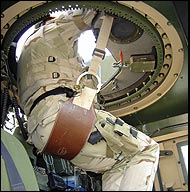
    I present to you the Cooper Sling, a privately-supplied improvement for gunners on humvees and a collection of other military vehicles and a great improvement on the standard-issue, seat-belt-narrow nylon strap.

    How did such an innovation come about? Mix one part each soldier-with-complaint and friend-who-can-help.

    It started out as a simple gift made of leather for an Army friend with orders to Operation Iraqi Freedom. But in a flash, Kyle Greenwood’s Cooper Sling Gunner Seat has become a hot item with hundreds of Humvee crews in Iraq, Afganistan and stateside.

    “The idea behind the new Cooper Sling Gunner Seat is simple,” says Greenwood, 34, owner of Black Mountain Industries in Bryan, Texas. “It helps make gunners in Humvees and other tactical vehicles more effective soldiers and improves their chances of coming home alive.”

    Greenwood designed the Cooper Sling for a close friend, SGT William Hartmann. His invention replaces current standard issue nylon strap seats intended to help turret gunners maintain a combat-ready posture.

    “However, those straps are as uncomfortable as they are unsafe,” says Greenwood. “Gunners say they cause severe pain in their lower backs and buttocks on long patrols and make their legs go to sleep. They also do nothing to prevent the two leading causes of injury and death to Humvee gunners in Iraq—ejection from the vehicle due to the violent impact of mines and roadside explosives, and rollovers.”

    Greenwood and Hartmann became close friends while selling office equipment in Bryan, Texas, several years ago.

    “In late 2004, William was serving as a Humvee gunner and knew his unit would be sent to Iraq before long,” says Greenwood. “He called to ask if I knew anyone who could make something out of leather, since I have horses. That’s when he told me about the problem Humvee gunners have trying to sit on the standard issue straps—if I could make something to improve on them. He also said, ‘While you’re at it, find some way to tie me into this thing so I don’t get thrown out or crushed in a rollover.’

    “I thought, ‘Sure, glad to do it,’” recalls Greenwood. “William’s a good friend and I have been looking for a way to help him while he’s in Iraq defending our country.”

    Greenwood’s first problem was attaching an improved gunner seat in the Humvee turret. Once he solved that, he set out to meet four basic requirements for the gunner seat: durability, comfort, easy to move and safer than the standard issue straps.

    “That’s how I came up with the original design of the Cooper Sling, with its 7×24-inch web seat made of saddle leather,” says Greenwood. “From there, I started thinking about a safety restraint to keep these guys from getting ejected or crushed.”

    […]

    In November, Greenwood took the gunner seat he’d designed for Hartmann to Fort Hood, Texas, to see how well it fit a Humvee gun turret.

    “As I was demonstrating it to William a lot of G.I.s saw us and started asking questions,” recalls Greenwood. “Before I knew it, there was a crowd around the Humvee wanting to know where they could get a Cooper Sling. At that point I realized there was a need for this product that extended way beyond my friend.”

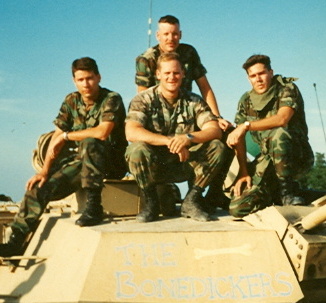
    In the interest of full disclosure, that SGT Hartmann from the article is none other than my dear friend and former tank crewmate Billy-boy, whose Iraq deployment I’ve blogged about here, here and here.

    On an M1 at Hood in May 93

    I’m not getting a single shiny cent for conveying the news of the Cooper Sling. Bill, a.k.a. SGT William Hartmann, may or may not be in for a cut, but I do know that my dear friend (above on the far right from a 1993 Ft. Hood photo) is now home safe from Iraq and can stand up front with me (above on the far left, much younger then) at my wedding in May. If he believes in the value of the product, I will.

    Besides, how could I resist an entrepreneurial endeavor meant to help American military personnel and whose site includes an Adopt-a-Gunner program?

  • Links and Blogroll Updates

    Long overdue, I’ve finally thrown in some additions to my links section and my blogroll. I encourage the reader to visit all of these fine sites.

    Links added are as follows:

    Blogs added — some relatively new and some glaring oversights and all excellent in their own way — are as follows:

    As always, I’m always open to suggestions for other blogs to consider.

    UPDATE: While your checking out my new blogroll additions, be sure to look at this tank porn over at the Officers’ Club. Ever wonder what the spawn of a cross between a tank and a battleship would look like? Well, apparently the Russkies did during WWII. I’m surprised I hadn’t heard of this intriguing vehicle before now.

  • Islamic Troubles Link Dump, 19 DEC 05

    So many stories, so little time on my accursed dial-up connection.

    Man Accused of al-Qaida Link Admits Gun Buy

    A Canadian terror suspect confessed to buying guns and rocket launchers for al-Qaida to use against U.S. forces in Afghanistan, according to a court filing Monday.

    In an affidavit submitted to the Superior Court of Justice in Toronto, where Abdullah Khadr appeared at a preliminary hearing, Royal Canadian Mounted Police Sgt. Konrad Shourie said Khadr admitted ties to senior al-Qaida members and confessed to buying guns and rocket launchers for them in Afghanistan or Pakistan. Khadr also admitted to a role in an unspecified plot to assassinate Pakistan’s prime minister, Shourie wrote.

    Khadr, 24, who entered no plea at the hearing, faces extradition to the United States on charges of possessing, and conspiracy to possess, a destructive device in furtherance of a crime of violence, according to the U.S. attorney’s office in Boston, where the charges were filed. He faces a maximum of life in prison if convicted.

    Khadr was arrested Saturday. A bail hearing could come as soon as Wednesday.

    He is alleged to have bought AK-47 and mortar rounds, rocket-propelled grenades and containers of mine components for al-Qaida. The weapons purchases were made at the request of his father, Ahmed Said Khadr, an Egyptian-born Canadian who was killed in 2003 when a Pakistani Cobra helicopter fired on a house where he was staying with senior al-Qaida operatives, authorities said.

    Abdullah Khadr was born in Canada in 1981 and settled with his family in Pakistan in 1997.

    The U.S. attorney in Boston said he received military training at a camp in Afghanistan for four months in the mid-1990s. Pakistani intelligence officers picked him up in a car in Islamabad on Oct. 12, 2004, and he was returned to Canada in early December.

    Some may ask Abdullah why he deals with terrorists. Well, it’s a family tradition.

    All three of Khadr’s brothers have been detained at various times and linked to terrorism.

    One brother, 19-year-old Omar Khadr, is the only Canadian detainee at the U.S. camp for terror suspects at Guantanamo Bay. He faces trial on charges of murder and attempted murder for allegedly throwing a grenade that killed a U.S. army medic.

    Spain arrests 15 suspects involved in Iraqi insurgency

    Spanish police arrested early Monday 15 people suspected of recruiting fighters for Iraqi terrorist groups, the Interior Ministry said in a statement.

    The suspects, arrested in coordinated police raids in several provinces across Spain, were accused of belonging to a group which recruit, train and send fighters for Iraq to fuel the insurgency.

    Police also seized a great amount of documents, fake credentials, cash and components for explosive devices in the raids.

    According to the statement, eight of the 15 are Moroccans, and the seven others include an Iraqi, a Saudi Arabian, an Egyptian, a Belarussian, a French, a Spaniard and a Ghanaian.

    The group, led by a 25-year-old Iraqi who had close contact with al-Qaida’s leader in Iraq, Abu Musab al-Zarqawi, was well-organized, the statement said.

    Police intelligence showed that the suspects themselves had also been engaged in terrorist activities in Iraq and other Islamic countries, but there was no sign they had any plans to launch terrorist attacks in Spain.

    This is not a new thing, as Spain has earlier claimed to have cut terrorist pipelines to Iraq. After an earlier Spanish round-up, I blogged the following:

    I would like to point out, however, that the success probably is not nearly grand as it sounds — the country is merely treating symptoms of the Islamist movement within its borders, having already run away from the attempt in Iraq to provide an alternative to the Arab world, a possible last ditch to salvage a huge chunk of the world’s population from falling hopelessly into sheer barbarism and madness.

    This kind of success, while dramatic and helpful, is fleeting. Al Queda will find other ways to move its jihadists, much as the human nervous system can sometimes find alternate routes when nerve pathways are severed. Unfortunately for Spain and the rest of Europe, other paths already exist and this one will be replaced, thus making it obvious that simply treating local symptoms of radical Islam while ignoring the global disease is not enough.

    The Spanish have yet to heed my warning.

    Video ‘shows cold-blooded killing of kidnapped US contractor’

    A barabaric video believed to show the killing of Ronald Schulz, an American security contractor kidnapped in Iraq two weeks ago, was released on the internet yesterday.

    It depicts a man with his hands handcuffed behind his back and blindfolded by an Arab headdress kneeling in an empty, open area of dirt.

    A gunman standing two yards behind him then shoots him in the back of the head, toppling the figure to the ground, before his body is then shot repeatedly.

    Although the victim cannot be identified, any hope that the former US marine may still be alive appears extinguished by a picture of him alive that appears on a split screen as the footage is aired. His identity card is shown briefly.

    The Islamic Army in Iraq claimed responsibility for his death.

    For those still ignorant of the bloody, cowardly nature of our enemy, the Jawa Report is always a good place to find such videos. As for me, I don’t need them and see no need to host them. Those who are blind will still refuse to see and continue to shriek “Abu Ghraib” as they try to demonize any allegation of atrocities thrown against American soldiers.

    ‘Dr. Germ,’ Others Released From Iraq Jail

    About 24 top former officials in Saddam Hussein’s regime, including a biological weapons expert known as “Dr. Germ,” have been released from jail, while a militant group released a video Monday of what it said was the killing of an American hostage.

    […]

    An Iraqi lawyer said the 24 or 25 officials from Saddam’s government were released from jail without charges, and some have already left the country.

    “The release was an American-Iraqi decision and in line with an Iraqi government ruling made in December 2004, but hasn’t been enforced until after the elections in an attempt to ease the political pressure in Iraq,” said the lawyer, Badee Izzat Aref.

    Among them were Rihab Taha, a British-educated biological weapons expert, who was known as “Dr. Germ” for her role in making bio-weapons in the 1980s, and Huda Salih Mahdi Ammash, known as “Mrs. Anthrax,” a former top Baath Party official and biotech researcher, Aref said.

    “Because of security reasons, some of them want to leave the country,” he said. He declined to elaborate, but noted “some have already left Iraq today.”

    Lt. Col. Barry Johnson, a U.S. military spokesman in Baghdad, would say only that eight individuals formerly designated as high-value detainees were released Saturday after a board process found they were no longer a security threat and no charges would be filed against them.

    It may take years to correctly judge the wisdom of these releases. Because of that, I’ll refrain.

    EU May Cut Aid if Hamas Wins at Polls

    Europe’s top diplomat warned Sunday the European Union might cut off aid to the Palestinian Authority if Hamas militants win next month’s parliamentary election, reflecting international alarm over the Islamic group’s strong showing in West Bank local voting.

    Javier Solana, the EU’s foreign policy chief, said during a tour of the region that European taxpayers would have a hard time supporting the Palestinian government if it included a party that supports violence and advocates Israel’s destruction.

    The U.S. House of Representatives approved a similar declaration Friday. The Palestinian Authority counts on foreign aid for half its budget.

    […]

    The main challenge facing the Palestinian Authority now is the Jan. 25 election for parliament, where Hamas is fielding legislative candidates for the first time to challenge Fatah, which has ruled Palestinian politics for decades.

    Last week, the younger generation of Fatah leaders split from the party and formed their own group, Future, leaving Palestinian leader Mahmoud Abbas and other Fatah old-timers with a candidate list filled with Fatah veterans that many Palestinians consider corrupt.

    The split was expected to weaken Fatah just as Hamas got a large boost its string of victories last week in West Bank local elections.

    Hey, why foot the medical bills when the lunatics are running the asylum? Still, I have little faith in Europe to actually enforce such a strong stance at this time.
  • Bush: Surveillance Program Legal and Essential

    President George Bush is at the heart of a media and political storm since the revelation that he authorized warrantless monitoring of communications between people in the U.S. and people overseas suspected to have ties to Islamist terror. Today, Bush defended the program.

    President Bush offered a vigorous and detailed defense of his previously secret electronic-surveillance program today, calling it a legal and essential tool in the battle against terrorism and saying that whoever disclosed it had committed a “shameful act.”

    Mr. Bush said the surveillance would continue, that it was being conducted under appropriate safeguards and that Congress had been kept informed about it. He rejected any suggestion that the surveillance program was symptomatic of unchecked power in the presidency.

    […]

    Surveillance dominated Mr. Bush’s hourlong news conference at the White House, and Mr. Bush said he fully understood the concerns of some lawmakers that civil liberties might be infringed upon. But those concerns are simply not justified, the president said.

    “Leaders in the United States Congress have been briefed more than a dozen times on this program,” Mr. Bush said. “And it has been effective in disrupting the enemy while safeguarding our personal liberties. This program has targeted those with known links to Al Qaeda.”

    The program, which Mr. Bush authorized the National Security Agency to carry out, is consistent both with Article II of the Constitution, which outlines presidential authority and responsibility, and the laws of the United States, he said, and is reviewed every 45 days or so to prevent abuses.

    Mr. Bush said he had determined early on that he was on sound footing. “Do I have the legal authority to do this?” he asked rhetorically. “And the answer is, absolutely.”

    So, according to Bush, congressional leaders knew of the program. That, of course, is no reason for the Democrats not to on the attack.

    Democrats quickly rejected the president’s rationale. “Where does he find in the Constitution the authority to tap the wires and the phones of American citizens without any court oversight?” Senator Carl Levin of Michigan said at a Capitol news conference.

    Sen. Levin is quite right; I’ve searched my own personal copy of the Constitution and I find no such authority. In fact, I find not mention at all of wires or telephones.

    Jeff Goldstein at Protein Wisdom points his readers to a couple of interesting postings from other bloggers on the matter before he puts in his two cents.

    As I’ve maintained all along, the President went through legal channels and was counseled as to the legality of his authorization of the NSA domestic surveillance, which means his good faith shouldn’t be questioned. And so at best, one can argue that the legality of the program is in dispute—but that the President was forthcoming about it and that he followed the proper procedures for legal review. How that is an “impeachable offense,” as Barbar [sic] Boxer and John Dean maintain, is a question best left to the progressive Democrats to explain.

    But what interests me most is Phares argument (via Yoo, et al) that the authority is dependent upon whether or not we believe the President to be acting under war time conditions. Clearly, Usama bin Laden and al Qaeda declared war on the US. And so the question then becomes, are we actively at war?

    As I noted previously, that the Dems don’t feel like we’re actually at war doesn’t mean we aren’t.

    As this will continue to play out, and it will play out for quite a while as we’ve already seen time and time again the sickening but tenacious behaviour of the media and Democrats when they think they smell Bush administration blood in the water, one can only anticipate the twisting arguments to come on constitutionality, legality, authority and need. I feel that, in the end, two things are certain: first, should they be doing their job (HA!), the media should demand an investigation into the identities of those involved in the leaking of the program (don’t hold your breath); and second, the effectiveness of the program has been greatly impaired or ended. Should the program be stopped, the terrorists can only feel more secure in their communications from within the U.S. Should the program continue, the terrorists have been tipped off that a portion of their communication capabilities is no longer safe.

    Net result no matter the course of the story: the ability of our government to defend the safety of Americans has been damaged, by choice and by our own citizenry.

  • Iran, Iran, Iran

    A real quick link dump about a brewing topic that should cause everyone much concern.

    Fear of Iranian nuclear arms high on Gulf states’ agenda

    Fearful of a nuclear-armed state on their borders, leaders of the six-nation Gulf Cooperation Council (GCC) states meeting in Abu Dhabi contemplated Sunday declaring the Persian Gulf a nuclear weapons-free zone in the hope that their neighbor Iran would join.

    “None of the GCC states support any country having nuclear power,” said Mona Mohammed al-Hashemi of the Emirates Center For Strategic Studies and Research in a telephone interview with The Jerusalem Post. “As you know, Iran is a very strong country, but the GCC can say something about this issue. They can discuss and see how they should stand on this issue and see what they can do that won’t harm them,” he added

    If only in terms of being caught up in a nuclear maelstrom not of their own making, the Gulf states should have a very real concern about a nuke-armed and radical Iran. Beyond that, they bear a geopolitical concern, as such an Iran would force a huge shift in recognized power in the Moslem world at the expense of the Gulf states.

    According to GCC secretary-general Abdul Rahman Hamad al-Attiyah, quoted on the United Arab Emirates’ official Emirates News Agency, the summit will not issue any statements condemning Iran’s controversial nuclear program. That reflected Gulf nations’ reluctance to provoke Iran and to be seen as siding with the West in the confrontation over Teheran’s nuclear plans.

    […]

    But what worries the GCC most is Iran’s nuclear potential. Many in the West and in Arab countries believe Iran will use its nuclear energy program to develop nuclear weapons. The Arab countries fear such weapons would make Iran a superpower in the region. Iran denies the charge, saying its program is intended only to produce electricity.

    “We have confidence in Iran, but we don’t want to see an Iranian nuclear reactor that is closer to our territorial waters than it is to Teheran. This causes danger and harm to us,” the Emirates News Agency quoted Attiyah as saying.

    The issue has become even more important to the GCC as tensions have risen in the region following the recent anti-Israel statements by Iranian President Mahmoud Ahmadinejad.

    Not even a statement? Despite their stake in the matter, the Gulf states are currently ranking slightly behind the Europeans in the role of an almost being a speed bump for Iranian endeavors.

    Iran tells West to be tolerant of Holocaust views

    Iranian President Mahmoud Ahmadinejad’s denial of the Holocaust is a matter for academic discussion and the West should be more tolerant of his views, Iran’s foreign ministry spokesman said on Sunday.

    Ahmadinejad last week called the Holocaust a myth and suggested Israel be moved to Germany or Alaska, remarks that sparked international uproar and threaten diplomatic talks with Europe over Iran’s nuclear programme.

    Foreign Ministry spokesman Hamid Reza Asefi defended the president’s remarks, which also drew a rebuke from the U.N. Security Council.

    “What the president said is an academic issue. The West’s reaction shows their continued support for Zionists,” Asefi told a weekly news conference.

    “Westerners are used to leading a monologue but they should learn to listen to different views,” he added.

    Some 6 million Jews were killed by the Nazis and their allies between 1933 and 1945.

    Ahmadinejad, a former Revolutionary Guardsman who was elected president, also said in October Israel was a “tumour” that must be “wiped off the map”.

    A statement drafted by European Union leaders described last week’s Holocaust comment as “wholly unacceptable”. The White House termed the remarks “outrageous”.

    Asefi denounced international condemnation as emotional and illogical.

    “The EU statement is not based on international diplomatic norms. They should avoid illogical methods,” he said.

    You see, when the radical president of a bloody Iranian government seeking nukes says that Israel should be destroyed and the history of the Holocaust is a hoax, he’s merely embracing a diverse view and others should be more tolerant. Geez, with those buzzwords, how could the left fail to embrace this man?

    Meanwhile, Ace at Ace of Spades begins to embrace what he perceives as a need for a new version of an old policy, mutually-assured destruction (MAD).

    Nuking Iran

    Iran is such a depressing topic for me I haven’t blogged about it much. Iran is mere months away from developing a bomb, their hardline lunatic leadership is quite forthright about their desire to wipe Israel off the map, and they would have few qualms about delivering a bomb to Al Qaeda.

    I’d like to do the military-bluster thing and start advocating airstrikes on all their nuclear facilities, command and control sites, even their oil wells. But I don’t think that will actually solve things. Their uranium enrichment program is hidden, probably underground, and almost certainly well-dispersed. We could not end their atomic ambitions through mere airstrikes.

    For those of you counting on Israel to end this problem for us– forget it. The comparison to Iraq’s reactor is inapposite. That was a big identifiable target. The Iranian sites are largely unknown, even by the vaunted Israeli intelligence organizations.

    We’re not going to invade. We don’t have the troops and the nation doesn’t have the stomach.

    Which means that Iran will have a bomb soon.

    […]

    It is time for Bush to spell out clearly what our nuclear policy is in regard to nuclear-armed rogue states. And this is not the time for diplomatic nicety. Bush must announce, clearly and solemnly, that any nuclear-armed nation invites a nuclear attack, and that a nuclear attack by such a nation will be met with the complete destruction of that nation by nuclear fire.

    The fundamentalist religious crazies thuggishly ruling Iran may have little fear of that. They will consider giving up their own lives to strike a mighty nuclear blow for Allah a small sacrifice for greater Islamist glory.

    We have to put the fear of God Himself into those who value life more than seventy-two viriginal whores in the afterlife. The Iranian citizens, the generals, the scientists building the doomsday devices.

    We have to be clear on our response to such an attack, and we have to be resolved about carrying it out with clinical, murderous deadliness.

    And we need to inform the world, and Iran of course, of all of this in advance. We need to be quite clear on our policy, so that the world will know that Iran was forewarned.

    Ace goes on to explain his unfortunately lucid reasoning behind a devastating policy, one that could be termed as MADOIB, mutually-assured destruction on Israel’s behalf. A nuke-capable Iran could not dream to destroy the U.S. in any short- or mid-term scenario, but they could play a role in a long-term nightmare. They could, however, destroy Israel, and Ace looks at how different responses to an Iranian attack on Israel could proceed. As Ace points out, MAD is a policy that only carries weight among the rational, thus the need for the clear publication of such a policy so that external and internal pressures may be brought to bear on the history-denying, blood-craving Iranian government.

    WunderKraut also gives his thoughts on the eventuality of an Iranian nuke. That’s twice I’ve linked WunderKraut in recent weeks. I really need to update my blogroll.