Category: War on Terror

  • U.S. Considers Dropping Two-war Doctrine

    The reality of the impact of actual warfare has left the post-Cold War planning for two simultaneous campaigns shaken, not stirred.

    The Pentagon, stretched by the war in Iraq, is considering dropping a linchpin of American military strategy, the doctrine that requires it to be prepared to fight two major wars at the same time.

    Since the end of the Cold War the need to be able to fight two “near-simultaneous” wars in different theatres has dominated military thinking, with Iraq and North Korea seen as the most likely battlefields.

    Now, with military resources under increasing strain from commitments in Iraq, the Pentagon is considering a new doctrine to take into account the post-September 11 world.

    The mission in Iraq has overturned previous military thinking. While it is not officially seen as a “war” it has clearly taken one of the slots from the two-war doctrine, as it continues to absorb the manpower required for a medium-sized war.

    Officials said yesterday that among the options for the quadrennial defence review, due early next year, was preparing the military to fight just one major war while setting aside more resources for fighting terrorism and defending the homeland.

    Ryan Henry, the principal deputy undersecretary of defence for policy, suggested the “two-war doctrine” may be near the end of its shelf life. The two-war doctrine was born out of the rubble of the Pentagon’s Cold War strategy, which for 40 years had envisaged the Third World War being fought on the plains of Germany.

    It was formalised in the wake of the 1991 Gulf war, when the first President George Bush and then his successor, Bill Clinton, were slashing military budgets and the Pentagon saw it as a way of setting a limit to the cuts.

    Donald Rumsfeld, the defence secretary, has long promoted an overhaul of military thinking and, when he came to office in 2000, floated the idea that the two-war strategy was on its way out. But it survived the previous review.

    I have long held that the cuts of the 1990s were too sharp, too fast. But hey, who am I to judge? I remember in 1996 taking my tank into the field for a weekend field exercise. Because of budget constraints, each and every tank was limited to a whopping twenty gallons of fuel Sunday morning for the return to the motor pool. Here’s a newsflash: twenty gallons doesn’t go very far in a vehicle whose fuel efficiency is calculated in gallons per mile. As per the norm, we were a sweaty bunch at the end of the weekend, but I attribute the stench to more than just the heat of the turret in the late Ft. Hood springtime — no, there was the additional stress of watching the fuel guage on the roadmarch home. Nobody wanted to be on the track that sputtered to a halt and had to be towed.

    Obviously, I digress.

    Just as obvious, though, is the problem posed by the two-war doctrine, its shift of pressure onto the reserve components, the drag of a decade-long high rate of deployment for policing and peace-keeping, and the strain of the Afghani and Iraqi theaters of operations. The possibilities? First, deny the issue and maintain the present course of pretending. Second, expand the military to actually be to handle the requirements of the two-war doctrine. Third, revise the doctrine to face the current needs of the war against Islamist terror by streamlining forces and planning for a capability of one war and defensive postures elsewhere. McQ at QandO points out a key deficiency in the latter.

    OK. That means going back to a one conventional conflict army which may, may I say, be seen as a weakness by various players out there (such as China, North Korea and Iran).

    Tie the US up with a conventional confrontation (maybe via proxy) and then have your way (many have seen that as something China might consider in regards to taking Taiwan)on a second front.

    Yes, there is always the threat of a truly bloody and involved ground campaign to be considered.

    How you loving that peace dividend now?
  • Happy Fourth of July

    Here’s wishing a happy Independence Day to all, but especially to my friend Bill.

    I wrote back in January of SGT William J. Hartmann, my dear friend and former tank commander who was on his way to Iraq. In that post, I pointed out that my buddy, in typical Billy-boy fashion, was getting an inordinate amount of print space and face time in stories concerning the deployment of a large portion of the Texas Army National Guard.

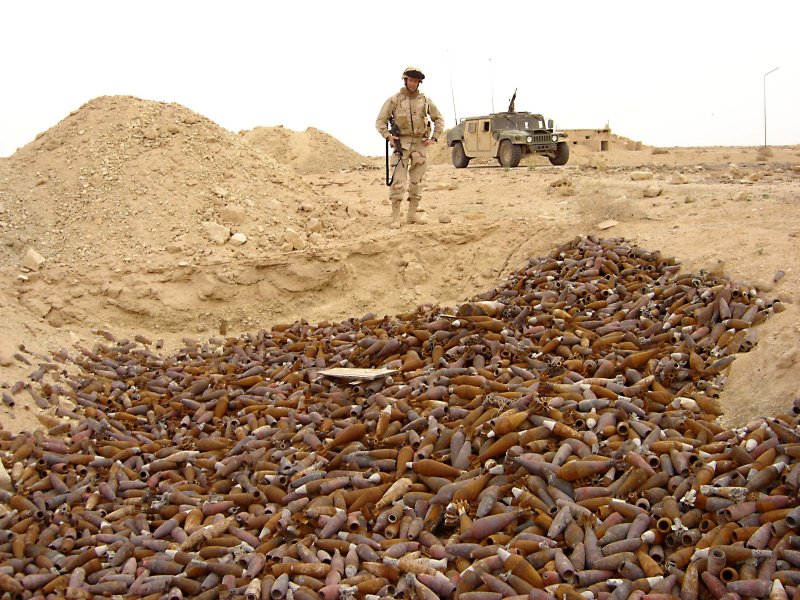
    Well, the trend continues, courtesy of the home page of the 56th Brigade Combat Team (click for larger version of photo):

    SGT Hartmann on guard

    Sgt. William J. Hartman [sic] of the 3rd Battalion, 112th Armored Regiment, 56th Brigade Combat Team, 36th Infantry Division, stand [sic] watch over a pit full of Iraqi mortar rounds waiting to be destroyed by a civilian explosive ordnance disposal team at the Akudar Ammunition Depot located in central Iraq.

    Thanks for serving for our independence, Bill. Hope you had a happy Fourth, and keep safe, bro.

  • Looking Around the News

    Army recruiting up for June but still down for year

    The Army cut into its recruiting deficit slightly in June but still faces a daunting battle to meet its annual goal of 80,000 new enlistees.

    Army recruiters enlisted 6,157 new soldiers this month, 507 more than its goal, Army officials said Wednesday.

    The June surplus breaks a string of four straight months in which the Army missed it goals by wide margins.

    A big Hooah! to those who have recently answered the call.

    Arroyo sends her husband into exile

    Gloria Arroyo, the president of the Philippines, yesterday announced that her husband was being sent into exile, amid growing pressure on her leadership. She did not say how long Jose Miguel Arroyo would remain abroad or where he was going.

    Keep treading water, Gloria. You’re heading towards a well-deserved reckoning.

    Storms hamper US chopper rescue efforts

    US military officials say they fear all 17 troops aboard a special operations helicopter are dead after hostile fire downed the craft in a rugged mountain ravine in eastern Afghanistan.

    If those aboard were confirmed killed, the crash would be the deadliest blow yet to American forces in Afghanistan, already grappling with an insurgency that is widening rather than winding down.

    The officials said they knew of no communications from the crash site, accessible only by foot.

    Stormy weather hampered rescue efforts after the MH-47 helicopter crashed on Thursday while ferrying in reinforcements for troops already on the ground pursuing al-Qaeda militants near the border with Pakistan.

    My eternal gratitude to those aboard in uniform, and my best wishes to their loved ones for closure and my sorrow for their losses.

    US signs formal defence pact with India

    India and the US have signed their first formal defence pact since the US imposed sanctions on India following its 1998 nuclear tests.

    The 10-year agreement promises enhanced military co-operation, including joint weapons production, technology transfer, patrols of Asian sea-lanes and collaboration on missile defence.

    Signing the “strategic framework on defence” in Washington, Pranab Mukherjee, Indian defence minister and Donald Rumsfeld, his US counterpart, said the two countries, whose military ties had been negligible until the terrorist attacks of 2001, had “entered a new era”.

    This is one I really need to give a more in-depth look.

    Biggio makes his mark as Astros rip Rockies

    Craig Biggio homered and set the modern record for being hit by pitches, and Roy Oswalt pitched seven scoreless innings for his fourth straight win to lift the Houston Astros over the Colorado Rockies 7-1 Wednesday.

    Biggio was hit on the right elbow in the fourth inning by Byung-Hyun Kim, breaking Don Baylor’s post-1900 record of 267 times hit by pitches. Biggio calmly turned and trotted to first as he had so many other times, but this time he pointed to the ball and asked the ball boy to send it back to the Astros’ dugout as a keepsake for his years of pain.

    267? That’s taking “taking one for the team” well past its limit.

  • Hearings Planned on Calif. Guard Intel Unit

    And the drumbeat continues.

    Rat-a-tat-tat. Make it Viet Nam again. Rat-a-tat-tat.

    A California congresswoman and a state senator are planning plan [sic] separate hearings into whether a California National Guard unit was established as a spy agency.

    Guard spokesmen denied that was the unit’s intent but declined to make the unit’s commander available for an interview to fully explain its function.

    State Sen. Joseph Dunn, D-Garden Grove, whose budget subcommittee oversees funding for the California National Guard, said Tuesday he has ordered the Guard to turn over all documents about the unit, formally called the Information Synchronization, Knowledge Management and Intelligence Fusion program. That would include any information collected about citizens.

    That last request will be easy, because no such information has been collected, Guard spokesman Lt. Col. Douglas Hart said.

    He said the new unit includes nine soldiers and airmen, two of whom monitor the military’s classified e-mail system and seven who work with the State Terrorism Threat Assessment Center. That center is the successor to a terrorism-information unit created after the 2001 attacks and operated by the state Department of Justice.

    The seven help gauge terrorist threats to bridges, buildings and other structures, said Tom Dresslar, spokesman for Attorney General Bill Lockyer.

    “They don’t monitor the activities of groups that are engaged in anti-war protests or the like,” Dresslar said.

    Seems like a straightforward answer, especially considering we’re talking about a unit of nine in our nation’s most populous state. Just how did we get to this point?

    The National Guard intelligence unit came to public attention after a story published Sunday in the San Jose Mercury News. The story referred to the unit’s monitoring of a Mother’s Day anti-war demonstration at the state Capitol that was organized by several peace groups — the Gold Star Families for Peace, Raging Grannies and CodePink.

    An e-mail chain that began in Gov. Arnold Schwarzenegger’s press office culminated in an advisory a few days before the protest from Col. Jeff Davis, who oversees the National Guard unit: “our Intell. folks … continue to monitor” the event.

    Hart said the monitoring amounted to recording television coverage and reading newspaper articles about the protest. He said the unit did not infiltrate the groups or observe the rally.

    “That’s all there was to it. That was the extent of our ‘surveillance’,” Hart said.

    A unit tasked to monitor threats to infrastructure damned well better be concerned about protests and rallies. Should they be tracking the individuals involved, investigating and delving through records? No, that is not their role. The job, as described, is to know of opportunities for threats, then evaluate and monitor the overall situation. There is no evidence in this story to suggest that anything else was done.

    Margita Thompson, spokeswoman for Schwarzenegger, said, “The administration is concerned, and we are looking into it.”

    U.S. Rep. Zoe Lofgren, D-San Jose, plans to question California National Guard officials at a House of Representatives Homeland Security Committee hearing.

    Peninsula Raging Grannies co-chair Ruth Robertson said she suspects the government has a greater interest, perhaps because of her group’s efforts to dissuade people from enlisting in the military.

    “Our median age is 72 — we are not threatening,” Robertson said. “We are all about peace.”

    Well, if one wants to play the age card, I would suggest that a 72-year-old grandmother is far more likely to be a traitor than a 12-year-old Little Leaguer. That said, I see no problem with a group whose aim is to dissuade people from entering the service. After all, we are talking about an all-volunteer force; each potential soldier should have any information he or she desires during the decision-making process. As long as that is all these Grannies are doing, then more power to them. As long as that’s all they’re doing.

    Gold Star Families member Cindy Sheehan said she’s not bothered: “If they’re monitoring what we’re doing, we must be scaring them, and I think that’s great.” The group is composed of people whose sons or daughters have died in military conflicts.

    Group composition be damned, if they are so smug about and proud of being monitored then so be it, let them be monitored. However, that is the realm of the FBI rather than the military.

    What? No Viet Nam yet? Are the leftists, peaceniks and Dems slipping?

    Dunn said he was not reassured by the unit’s denials.

    “History has not been kind to such assertions by government and military officials,” Dunn said.

    He referred to the Vietnam War era, when the military collected information on more than 100,000 Americans during the 1960s and 1970s.

    Thank you. That took long enough.

    Questions about the state’s anti-terrorism center also arose two years ago, when Lockyer’s Criminal Intelligence Bureau warned Oakland police about “potential violence” during a protest there.

    Police, firing wooden dowels and beanbag projectiles, ultimately injured at least two dozen protesters. Lockyer subsequently disavowed the tracking of groups or individuals that avoid violence or other illegal acts, even if they engage in otherwise harmless civil disobedience.

    In a statement this week about the National Guard unit, Lockyer said, “You have to wonder how monitoring the activities of soldiers’ widows and orphans advances the anti-terrorism effort.”

    Well, this section certainly has negative overtones to it. Did you notice that the man questioning the National Guard in the third paragraph is the man whose own bureau was involved in the warning painted so negatively in the two preceding paragraphs? Is that a scent of sweat of a man straining to shift attention? By the way, the story lacks context, but on the surface it appears that warnings of potential violence were indeed accurate.

    Dunn said that even if the National Guard unit formed last year isn’t spying, the Guard should have cleared the unit with legislators because “perception could put a cloud over these activities,” Dunn said. “Spying on United States citizens is a radioactive topic.”

    The Guard on Tuesday abruptly canceled an interview The Associated Press had scheduled with Col. Robert J. O’Neill, director of the new program, citing Dunn’s planned hearings.

    “I would respectfully suggest the Guard is taking absolutely the wrong approach to shut down information to the public or media about this unit,” Dunn said. “It only raises the suspicions of the public and the media when the Guard retreats into a bunker mentality.”

    Dunn demands hearings. Guard cancels an interview because of those hearings. Dunn claims Guard is shutting up and casts a shadow on the military. Listen, Dunn, the Guard is not hiding from you; rather, they’re heeding your beck and call. Must you smear them with suspicion and questions of perception before they even sit before you at your hearing?

    My prediction: tempest in a teapot. But the useful idiots will play it for all it’s worth. Disclaimer: I was in the military. I distrust the anti-war movement. Here’s just one very good example why I feel that way.

    Any input from a local in Cali, Eric?

  • Bush Asks for Nation’s Patience

    I must say that I missed the tonight’s speech because of work so I’m writing this off of a news report.

    President Bush on Tuesday rejected calls for a timetable for withdrawal from Iraq or sending more troops, counseling patience for Americans who question the war’s painful costs.

    “Is the sacrifice worth it? It is worth it,” Bush told a nation increasingly doubtful about the toll of the 27-month-old war that has taken the lives of more than 1,740 U.S. troops.

    Bush spoke in an evening address for a half-hour from an Army base that has 9,300 troops in Iraq, hoping to persuade the public that his strategy for victory needed only time not any changes to be successful.

    I will catch a rebroadcast or read over the speech later but, frankly, I doubt I’ll hear anything that will strike me as news. Hopefully, some who are fostering doubts about our nation’s direction against the radical Islamist threat will. I’ve argued repeatedly for the need to continue our efforts because the impact of failure would be unrepairably horrendous and will haunt our nation for generations.

    For this post, however, I’ll leave the argument to a MilBlogger currently serving. Chris Short at Conservative Thinking argues against those working to undermine national morale, particularly those doing so for purely political purposes. He does so from a political angle but then shifts his attack, bringing it from a different direction — the hopes of the soldiers involved.

    I’m sure every soldier, sailor, Airmen, and Marine wants the MC (mission complete) in the final block in section 15, column d of their DD Form 1351-2 (travel voucher) to mean more than, “Our politicians told us to tuck tail and run.”

    We, as a nation, certainly failed not only an ally but also a generation of our nation’s military in the past. For the sake of those in uniform today, like Chris Short and his comrades in arms, we cannot fail our military again in a winnable effort. The risk is theirs, and they face it bravely as they work to reduce the risk that is our society’s.

  • The Will to Fight

    One of my primary motivations to begin blogging was to provide another voice, however meek or hushed, as a counter to the defeatism and anti-military nature I saw in our mainstream media. Few may hear me and, of those that do, some may dismiss me as a paranoid hawk. I’ll accept the hawk title, though you can keep the oft-attached neocon garbage — the history of that word does not apply to my beliefs. I sharply renounce the paranoid aspect, however, as history is on my side. The media have snatched defeat from the jaws of victory before, specifically during and after the Tet offensive of early 1968. My study of Tet and the subsequent media fallout sickened me back in college during a survey-level military history course, and that feeling has certainly continued and seeped over into this blog. One might say Tet has almost become a central theme here at Target Centermass.

    It’s my continued hope that the blogosphere, through such efforts as Chrenkoff‘s regular “Good News from Iraq” features and especially the MilBloggers, can provide enough of a counterweight against the media to allow American efforts to prevail. Sometimes, that hope is bouyed.

    Greyhawk: Americans Dissatisfied With Press Coverage of the Military.

    In his very next post, Greyhawk points us to two other MilBloggers, one of which previously unknown to me, who clearly demonstrate why sometimes my hopes wane.

    Blackfive: How To Lose A War

    Neptunus Lex: Could We Lose?

    I’ll be honest: I understand what the media, as a whole, is trying to do but, for the life of me, I cannot understand why. There is no way that a victory for the jihadists currently carrying much of the weight of the onslaught against a free Iraq, a defeat for America, and a dooming of a fledgling Arab democracy could spell a better world. Such a result could only lead us down one of two paths — either the resulting next war is fought by us in a far less humane manner or the next war isn’t fought at all, much to our future detriment. And we retreat. And the radical Islamists spread. I really don’t understand the hopes of the members of today’s media when, truly, the lives and freedoms of their grandchildren hang in the balance.

    As for me, I’ll keep working and hoping to add to the chorus of counter-voices. Or maybe I’ll go back to work another way. Hey, I hope to have grandchildren, too.

  • News from the Brussels Conference

    Representatives of over 80 nations attended yesterday’s international conference on Iraq in Brussels. Here are three stories coming out of the gathering, co-hosted by the U.S. and the European Union, that I found interesting or significant.

    Iraq Begs the World for A Marshall Plan

    The staid conference room in Brussels could not have seemed further from the bloodstained streets of Baghdad. There, Iraqi leaders pleaded with the world to focus on the human costs of the conflict engulfing their homeland, and to do more to bring peace

    “The children of Iraq are just like yours – they don’t want to lose their fathers” Iraqi Prime Minister Ibrahim al-Jaafari said in opening remarks to an international conference that concluded with calls for not just cash, but a Marshall Plan-style commitment to help those most vulnerable among Iraq’s citizens.

    The UN, the European Union, the US and more than 80 other nations pledged their support – while saying Iraq could also do more to help itself. No new money was offered at a meeting that was never intended as a donors’ conference, but the gathering was applauded as proof that sharp differences over the US-led invasion of Iraq could be put aside to help Iraqis.

    High price to pay if Iraq democracy fails: Fischer

    Speaking at a conference on Iraq being co-hosted in Brussels by the U.S. and the European Union, German Foreign Minister Joschka Fischer warned there would be a “high price to pay” if the democratisation process in Iraq fails.

    The conference is focusing on international support for the Iraqi transitional government on political reform, economic reconstruction and strengthening security through the rule of law. No new aid pledges or troop contributions are expected.

    […]

    Whether countries were for or against the U.S.- led Iraq war, the focus now was on stabilising the country, German Foreign Minister Joschka Fischer told reporters. “If the democratisation process fails, there will be a high price to pay…we cannot allow that to happen,” Fischer underlined.

    The meeting emphasised that “the international community, having been deeply divided over Iraq, has now come together actively,” said British Foreign Secretary Jack Straw.

    Syria to discuss cross-border infiltration claims

    Syria will ask the Baghdad government to provide evidence of would-be insurgents infiltrating across the Syrian-Iraqi border, Syrian Foreign Minister Farouk al-Sharaa said Thursday.

    Speaking to reporters, al-Sharaa indicated his government’s concern about charges that it is allowing infiltration into Iraq – accusations that were repeated by US and Iraqi envoys at the international conference on Iraq in Brussels on Wednesday.

    […]

    “The delegation will ask for documents and evidence about the accusations (of infiltration), because we want to know the source and truth,” al-Sharaa said.

    “Any border in the world, including the United States’ borders, is prone to infiltration,” Sharaa added.

    Unfortunately, there is much truth in that last statement, far too much when considering the U.S. borders. Still, one would be quite foolish to state that Syria is doing all it can to assist the establishment of a stable, democratic Iraq, something that Syria does not want as a neighbor.

    Another donors conference is planned in mid-July in Amman, Jordan. The mind boggles at the security precautions that will have to be in place and how tempting such a target will have to be to the radical Islamists.

  • Colors. And a Break in Iraq?

    Colors — such a simple thing, yet so many meanings.

    In politics, we have red states and blue states. The Greens? Yawn.

    In gangs, color of clothing can mean life and death. Just ask Hollywood about Colors.

    In military jargon, colors take on a shifting meaning. In an armored company, at least in my day, the colors red, white and blue represented the call-sign of first, second and third platoon, respectively. In an exercise against an opposing force (OPFOR), the exercising units are designated blue and the OPFOR are called red.

    In the unfortunate case of friendly fire, such as the well-publicized loss of ranger Pat Tillman, occurrences are called blue-on-blue. These have historically been accidents caused by the infamous fog of war. Red-on-red stories would often carry the same accidental meaning.

    But sometimes red-on-red is not accidental. When the accidental enemy fraticide happens, that is fortuitous. When it’s intentional … well, that begs attention. Bill Roggio does just that (hat tip Ace):

    Red-on-Red

    The brutal acts of violence directed at civilians and Iraqi police is losing favor among some of the members of the Iraqi insurgency. During Operation Matador, we saw examples of the local tribes, some of whom are sympathetic or even participating in the insurgency, rise up to fight the foreign jihadis after their attempts to impose a Taliban-like rule of law in Western Anbar.

    Go, read it. It’s somewhat lengthy but worth every moment.

  • General: No Drawdown in Iraq Likely Soon

    Do we want the troops to be brought back from Iraq? Of course, everybody does. Some just know that there’s work yet to be done, and reductions aren’t wise now.

    The top U.S. combat commander in Iraq says American troop levels likely will remain steady through early next year and that drawdowns likely will not depend on political developments in the nascent Iraqi government.

    Army Lt. Gen. John Vines told Pentagon reporters Tuesday that the violent insurgency likely will continue through this autumn’s constitutional referendum.

    “We don’t see the insurgency contracting or expanding right now,” Vines said.

    Vines also said he would prefer not to have a timeline for troop withdrawals imposed by Congress and that there is a possibility the insurgency will evaporate following successful national elections this December.

    Feel free to peruse my thoughts on the cowardice of timelines and “exit strategies.”

    About 135,000 U.S. troops now serve in Iraq, with tens of thousands more in supporting roles outside that nation’s borders.

    Earlier this year, during the relative calm that followed the January election, senior commanders told Congress they expected to be prepared to recommend troop cuts by this summer. However, following a post-election lull, deadly attacks aimed at both Iraqis and U.S. troops have again become commonplace.

    “We’re not at that point yet,” Vines told reporters when asked whether he would recommend U.S. troop cuts soon.

    Troop levels are “conditions-based,” Vines said. “Currently we know that insurgents will do everything they can do disrupt ratification of a constitution. To them, that’s a terrifying event.”

    Iraq’s interim government is drafting a new constitution, scheduled to be ratified by national election in October. If that happens, national elections for a permanent government would take place in December.

    “At this point, I would not be prepared to recommend a drawdown prior to the election — certainly not in any significant numbers,” Vines said.

    I deem this a rational assessment based on pending political events and the shape of things on the ground. Vines does not rule out flexibility in the matter, though.

    He held out the possibility that he might not ask for replacements for some units currently deployed.

    “We continue to assess that,” he said. “We’re not at the point where we make that decision yet.”

    Is this another Viet Nam? Is history repeating itself? Are we tied to years of expanding deployment numbers and constant calls from the military for yet more troops?

    Conversely, Vines said he also does not expect to recommend a troop increase for the autumn referendum and winter elections. This past January, U.S. troop levels in Iraq were temporarily beefed up to nearly 160,000 — the peak for this mission — to help protect polls from insurgent attacks.

    “I would not be in a position to recommend any spike” in U.S. troop levels this autumn, Vines said. “I don’t see that. Is it possible? Yes, if we think he conditions have changed. But right now I don’t foresee a spike to support that referendum.”

    Well, how long until we can put the Viet Nam analogies to bed? My guess is a long, long while, as the left in America has absolutely tied itself to its skewed view of the American military, its Hollywood-taught-me-about-Nam mentality. So much of their worldview is built on those slanted foundations. Unfortunately, the same is true for the bulk of the “American” media.

  • Judge to Pick Parent to Bury Marine

    Want to add courtroom drama to wartime family tragedy? Enter the perfect storm of a fallen soldier, cemetery delays and well-intentioned but divorced parents.

    The divorced parents of a Marine killed in the U.S. military’s deadliest air crash of the Iraq war are fighting in court over where to bury their son.

    The Detroit-area judge who will decide the case scheduled a July 15 hearing on Monday and said she does not want it to turn into a “three-ring circus.”

    The parents are arguing over the choice of cemeteries – a new national cemetery that has yet to open or a paternal family plot.

    Lance Cpl. Allan Klein, 34, died in January along with 29 other Marine infantrymen and a medic in a helicopter crash. His remains are being kept in a Roseville crypt.

    “We should be talking about the wonderful things he did for his country, his family and friends instead of … where we’re going to bury him,” Judge Diane Druzinski said.

    Klein’s mother, Rae Oldaugh, wants her son buried in the new Great Lakes National Cemetery. Groundbreaking was held in October, but the cemetery is not expected to be ready for burials until August at the earliest.

    Klein’s father, Manfred Klein, apparently also wanted his son buried there but became frustrated by delays. The Klein family now wants to bury Allan in a private cemetery where one of his paternal grandparents is interred.

    Manfred Klein said his son never specifically talked about what should happen if he died.

    This is truly a pathetic situation, and I don’t mean that derisively towards anyone involved. The soldier should’ve made his wishes clear before going into harm’s way, but one is very reticent to speak ill of the fallen. One parent wants all deserved honors; the other wanted the same but has seemingly found a need for closure. From the available details, neither can really be faulted.

    I do not envy the judge in this matter.