Category: War on Terror

  • Links o’ the Day

    Link dumps — the I’m-watching-football-tonight way of blogging.

    Dean Esmay: Helping Us Through A Crisis
    Help this fine member of my blogroll out if you can.

    Iraq takes control of armed forces

    British and United States troops yesterday handed over control of Iraq’s armed forces to its own government – a move described by US officials as a crucial step, but which still leaves most of the country’s security under direct coalition control.

    […]

    The US-led multinational forces in Iraq, commanded by General George Casey, have been giving orders to the new Iraqi armed forces via a joint chain of command. But now the chain of command flows directly from the Iraqi prime minister in his role as commander-in-chief.

    The Iraqi army is made up of ten divisions, now numbering about 130,000 troops, and the Iraqis are expected to take over more divisions from the coalition in the coming months, although there is no exact timetable.

    Maj-Gen William Caldwell, a US military spokesman, has indicated that the prime minister, Nouri al-Maliki, will make the final decision on how quickly his military assumes control over new divisions.

    “They can move as rapidly … as they want. I know, conceptually, they’ve talked about perhaps two divisions a month,” he said.

    Mr Maliki described the move as a great step forward. “The Iraqi army now, by the courage of its people and its sons in the Iraqi army, rebuilds itself again,” he said.

    In a word, significant.

    U.S. Air Force officer goes missing in Kyrgyz capital

    A U.S. Air Force officer stationed at the air base near Bishkek disappeared while shopping in the Kyrgyz capital, the U.S. military said Wednesday.

    Maj. Jill Metzger, of the 376th Air Expeditionary Wing, was separated from a group of servicemen while visiting a department store on Tuesday afternoon and has not been seen since, officials at the Manas air base said in a statement.

    It said a group of 22 U.S. military investigators and logistics officers were searching for Metzger together with the U.S. Embassy and Kyrgyz security and law enforcement services.

    Op-For‘s John has more on the story, including an interesting cultural aspect of the country that could play an ominous, though I feel highly unlikely, role.

    Iraq Hawks: Getting “Outside the Narrative”

    Now that we’ve established the worldview and analytical tendencies of the “dead-end Iraq War supporter,” also known as “me,” an honest reassessment of the war requires stepping outside of comfortable narratives while avoiding seductive replacements. Without diminishing the value of the struts that support my established point of view – distrust of the media, patience, a belief in the subtlety of deep trends that come to dominate large historical changes, etc – the challenge is to establish an emotionless, rational framework for analysis; a framework that goes deeper than both the BIG philosophy and the splintered, conflicting snippets of war’s progress.

    Give it a read to see where he’s coming from and exactly where he hopes to reach. INDC Bill has just set himself to large task, and the road could be interesting to follow.

    Three Indicted for Sending U.S. Secrets, Equipment to Yemen

    Three naturalized U.S. citizens were indicted by a federal grand jury in California for allegedly acquiring secret U.S. defense information and stolen military equipment and conspiring to send them to Yemen.

    The four-count indictment for conspiracy to possess and transmit defense information, attempted unlawful export of defense articles and related charges was handed up Aug. 31 and unsealed today, U.S. Attorney McGregor Scott said.

    The men face five to 10 years in prison and fines of $250,000 to $1 million on each count.

    “We will use all appropriate legal means at our disposal to detect, disrupt, and hold accountable those who seek to do us harm, whether they act within or outside our borders,” Scott said in a statement.

    Ahmen Ahmed Ali, 56, of Bakersfield, California, allegedly received secret defense documents from a government undercover agent and transmitted them to Yemen by fax or courier between June 2005 and August 2006, according to the indictment.

    He allegedly conspired with Mohamed Al-Rahimi, 62, of Bakersfield, to receive stolen government property, and with Ibrahim A. Omer, of Fort Worth, Texas, to ship military items such as body armor and chemical protective suits to Yemen.

    Though the names might hint at something, as would the ties to Yemen, don’t think for a second that any particular religion will be mentioned in the story.

    After 5 Years, OBL Releases New Video with 9-11 Killers

    Maybe This Will Stop the 9-11 Conspiracy Theorists!…
    How many time does OBL have to take credit for these murderous attacks on innocent Americans before people get it?

    Gateway Pundit, though a fine blogger, obviously doesn’t understand conspiracy theorists. They only need a target; the route to that destination can be ever changing. Now it can be claimed that Osama was but a pawn. He was made better, stronger, faster by that evil and far-reaching New World Order comprised of Bush (either, any if one includes Jeb), Cheney, Halliburton, the famed military-industrial complex (the violent video game and car magnet industries included), and Pizza Hut. Hey, scoff if you will at that last one, but I’ll wager a lot of pizzas were ordered as America was generally glued to its TV sets in the days following 9/11. I don’t know, maybe it was Domino’s. Pizza Hut sucks too much to attain the level of evil required.

    Chafee Delays Vote on Bolton Nomination

    Sen. Lincoln Chafee has pulled the plug on a push by his fellow Republicans to confirm John Bolton as U.N. ambassador, saying he had more questions that needed to be answered.

    The Senate Foreign Relations Committee was expected to vote along party lines during a committee meeting Thursday to approve Bolton. But the panel postponed the vote after Chafee, R-R.I., expressed doubt.

    “Sen. Chafee said he still had questions that were not answered,” said the senator’s spokesman, Stephen Hourahan.

    Boo! Hiss! C’mon, confirm the man already. Despite earlier concerns, Bolton has represented U.S. interests well so far at the worthlessness that is the United Nations and has not yet, as previously feared, threatened other diplomats for their lunch money or gone on a well-deserved wedgie-spree. The man’s restraint has been remarkable.

    ‘Goat-free roads made me speed’

    A Swiss man caught speeding on a Canadian highway has blamed his actions on the absence of goats on the roads.

    The man was caught driving at 161 km/h (100mph) in a 100 km/h (60mph) zone.

    A traffic officer’s notes said the Swiss driver had said he was taking advantage “of the ability to go faster without risking hitting a goat”.

    Canadian police spokesman Joel Doiron said he had never found a goat on the highways of eastern Ontario in his 20 years of service.

    “Nobody’s ever used the lack of goats here as an excuse for speeding,” Mr Doiron told the AFP news agency.

    “I’ve never been to Switzerland, but I guess there must be a lot of goats there,” he said.

    Headline of the freakin’ day. That’s all I’ve got to say about that.

  • Terrorists Promise More Attacks Like 9/11

    Also predicted are the demise of the United States and a pending Islamist domination of Europe. Yes, folks, this is a know-your-enemy type of must-read.

    Last year, to mark the fourth anniversary of the attacks of September 11, 2001, this column included translated proclamations by Al Qaeda leaders promising the future killing of millions of Americans and the collapse of America, as well as statements by Arab writers calling the war on terror “a chapter in World War III.”

    Some pundits have chosen to reject such analogies. But, as Osama bin Laden wrote in his “Letter to the Muslims of Iraq and [Islamic] Nation” on December 27, 2004: “The conflict in the West is a fateful war between unbelief and Islam, between the army of Muhammad, the army of belief, and the people of the cross. … The important, tremendous, and dangerous issue today in the entire world is this Third World War.”

    Much has happened in the war on terror over the past year. The Arab press has been full of articles on the end of America. Walid Nouhad wrote in the Bahrain daily Al-Wasat on June 20 on the coming “breakup of the United States … in the same fashion as those empires that came before it.” America’s “destiny” is to be “just like the Soviet Union” when “it falls apart,” Saud Mokhtar wrote in the Saudi daily Al-Madinah on July 10.

    Other articles in the Arab press have featured interviews with religious and Islamist figures making crude calls for the West to convert to Islam.

    “Our aim is to put down roots in the European continent, and to act quietly and in accordance with the laws, so that one day we may see all of Europe Muslim!” the Turkish fundamentalist leader Nijmuddin Erbakan, a former Turkish prime minister who headed the Islamic Welfare Party, said, according to an April piece on the Arabic reformist Web site Elaph.com by a Germany-based Kurdish journalist, Tarek Hamo.

    Go read it all [hat tip to Dr. Rusty].

  • Bush Puts 9/11 Suspects in Gitmo, Congress on the Spot

    President Bush gave what seems to be an important speech today that may prove to be a key turning point in our nation’s policy against Islamist terrorists.

    Just a few days shy of the fifth anniversary of 9/11, President Bush invoked the shock of that day, and the fears it unleashed, to drop some eye-opening news Wednesday: 14 of the world’s most vile suspected terrorists have been transferred from secret CIA prisons abroad to Guatanamo Bay, Cuba.

    In a midday White House speech, the president acknowledged for the first time the existence of the CIA prisons, where the 14 suspects, including the alleged mastermind of the 9/11 plot, had been held. He said that under tough questioning, the suspects had given up information that helped stop several, mostly familiar, plots — from a plan to fly jetliners into London’s Heathrow Airport to one to blow up the U.S. consulate in Karachi, Pakistan. And he said the suspects were being transferred so they could be tried under the administration’s proposed military tribunal system, to be created by legislation he sent to Congress Wednesday and hoped lawmakers would approve this month.

    The speech was largely in part political theater, the opening act of the Republicans’ fall strategy of flexing their anti-terrorism muscles. It cast doubt on any and all who question Bush’s strategy, including the Supreme Court. Even so, there was much in Bush’s remarks on which all sides could agree: There should be clear guidelines for the treatment and questioning of detainees. If U.S. interrogators abide by those guidelines, they shouldn’t have to worry about being sued by terror suspects or prosecuted. And, most certainly, it is time to try suspected terrorists who plotted against the nation and bring them to justice.

    The hard part, as it has been always been, is finding a way to balance the need to protect the nation against terrorists without compromising its values. How can information be extracted from terror suspects without endangering American troops who become prisoners? How can terror suspects be put on trial fairly without giving them access to classified information that might reveal confidential informants?

    These are difficult questions over which well-intentioned people disagree. Sadly, many of the Bush administration’s policies on the treatment of prisoners, and its proposals to prosecute them, have hurt America’s image abroad and been of dubious legality — a fact now cemented in law.

    In June, the Supreme Court struck down the administration’s controversial system of military commissions, asserting that they violated U.S. military law and the Geneva Conventions for dealing with prisoners of war. The problem, the court found, was not just the tribunals but Bush’s insistence that he could go it alone, without the checks and balances the Constitution prescribes. If Bush wants to keep the commissions, the justices said, he’ll have to fix those problems and persuade Congress to go along.

    Of course, bringing the most notorious al-Qaeda prisoners to Guantanamo is designed to pressure Congress into approving the administration’s hard-line approach. But, at the same time, the administration is at least grudgingly expressing a new willingness to work with Congress to devise a new system.

    Dr. Rusty has the full transcript.

    Captain Ed has some excellent analysis, including the following:

    So why reveal the program now and transfer the detainees from the CIA to the DoD? For one thing, the CIA apparently feels that these plotters have been tapped out in terms of operational intelligence. Also, with the Hamdan decision, he cannot set up secret military commissions to try them. The court tasked Congress with establishing the tribunals for all non-POWs in custody — POWs don’t get trials or courts-martial except for crimes they commit while in custody — and Bush has to wait on Congress to act.

    He obviously does not want to wait long. He has already promulgated some rules of evidence and procedure to Congress, and the Hill has found much with which they disagree.

    Meanwhile, Ace live-blogged it and quickly seized on the true intent of the speech.

    Wants Congress To Repudiate Supreme Court Decision On Granting Geneva Protections For Terrorists: Congress must list the “specific, recognizable offenses” that will invoke a War Crimes prosecution against interrogators.

    Nice. Make Congress specifically say what is illegal — and, by their omission, what is legal.

    Congress dare not make belly-slapping illegal.

    Put up or shut up.

    Still, one must wonder just how much pressure Congress, and especially its democrat members, will actually endure if the media feels no need to press the issue. Already, the media seems to be congealing on a different aspect of the story, as the following headlines show:

    Question: if a gauntlet is thrown down and there’s no one around except those that refuse to hear it, does it really make a soundbite?

  • Pakistan Peace Deal: Back to Square One!

    Our efforts in against the Taliban and al Queda in the Afghan-Pakistani region just took a tremendous step backwards.

    History repeats itself but in Pakistan’s case, it perhaps repeats itself rather too often. And so the government and militants in the volatile North Waziristan tribal region have signed a peace agreement and quite understandably, Governor Ali Mohammad Jan Aurakzai, the chief architect of the accord, has hailed it as an unprecedented event.

    Unprecedented it is. Like a pendulum, the government policy has swung from one extreme to another, from the use of brute military force to what appears to be total capitulation to militants. Never did the government try to intelligently combine the use of force with pursuit of dialogue.

    Jirga parleys were conducted in extreme secrecy with Governor Aurakzai emerging as the focal person and President Musharraf’s pointsman on the government’s policy on Fata.

    This was good in that instead of operating multiple channels to negotiate with militants which often complicated matters, the government was speaking with one voice.

    So, if there is one man who can claim credit for the agreement, it should be Governor Aurakzai who single-mindedly cobbled the deal together; of course with the help of JUI-F leader Maulana Fazlur Rehman.

    It was Mr Aurakzai, who as the Peshawar Corps Commander had led the Pakistan Army into the tribal region in 2001. And being a native of the tribal region that straddle the Pakistan-Afghan border, the onus was again on him to pull the army out of what has proven to be a quagmire.

    Just to recap. Before signing the agreement, the government virtually agreed to meet all the demands of the militants. Captured militants were freed, their weapons were returned, all privileges were restored, 12 checkposts were abandoned and troops stationed there have been relocated to forts.

    Unlike the past agreements however, there are some new elements in the peace deal signed in Miramshah on Tuesday.

    The government has also undertaken not to launch any ground and air operation and to resolve the issue in accordance with local riwaj or customs.

    Foreign militants could either leave the tribal region or live there peacefully and abide by the law of the land. This is a major concession, considering the fact that the government had been insisting all along that all foreign militants must get themselves registered.

    Significantly however, barely an hour after the peace agreement had been signed, a spokesman for the militants insisted that there were no foreign militants in North Waziristan and that despite what the government had been saying it had not been able to produce any evidence of their presence in the tribal region.

    He also denied that militants were crossing over into Afghanistan to carry out attacks on Afghan and coalition forces.

    The denial is reminiscent of refusal by militants in the neighbouring South Waziristan Agency to admit to the presence of foreign militants there — an issue that led to the collapse of the famous Shakai agreement in 2004.

    On the face of it, the agreement does look good but as they say, the proof of the pudding is in the eating. What is important is not the three-page document itself but whether the two sides would be able to implement it.

    Will the foreigners leave? Unlikely. But why would they be here?

    They have nowhere to go. Their countries do not accept them and worse, they will be prosecuted there. Will foreign and local militants stop their ‘Jihad’? Not likely.

    Not likely indeed. In fact, with the recent bleeding of Taliban elements by NATO forces in Afghanistan, I would actually expect an influx of radical elements into Waziristan after another brutal failure of a Taliban spring offensive is greeted with the news of a safer-than-expected haven just across the line on the map.

    Although this is potentially a move that will extend instability in the Afghan theater, I understand the need of the Pakistani government, living on a volatile razor’s edge, to make occasional moves to mollify a fairly radical and militant populace while maintaining a degree of friendship with the U.S. and the West. I have long held, dating back to much contemplation following 9/11, that the stability of Pakistan’s government held the key in avoiding a global hot war, as its downfall replaced by radicals would almost certainly draw in India and create a domino effect of bloodshed.

    Even with that understanding and that need for Pakistani stability, I think this is the wrong move at the wrong time and will almost certainly cost American and NATO lives in the long term.

  • Danish Antiterror Police Seize 9 Men, Mostly Young Muslims

    Although it seems progress that the New York Times even included a mention of the suspects’ religion — you know, that peaceful one — in its headline, one must admit puzzlement at their “mostly” qualifier. Are they using it to draw a line on young or on Muslim? After all, the story that follows quickly points out the age range and religion of all the arrested men [emphasis added].

    The Danish security police arrested nine suspects on Tuesday on suspicion of plotting a terrorist attack after surveillance showed that several of the men had collected bomb-making material, Justice Minister Lene Espersen said.

    An antiterror squad carried out a raid in Vollsmose, a poor immigrant district in Odense, at 2 a.m. The suspects appeared at a closed hearing on Tuesday, where two were released and the others were charged with plotting acts of terrorism.

    No details of a plot were released. Investigators said it was too early to know how far the suspects’ plans had progressed. “With the general terror situation, the Danish Security Intelligence Service didn’t want to run any unnecessary risk,” said Lars Findsen, the service’s director general.

    Ms. Espersen said that nearly all nine were Danish citizens, and that Denmark was their likely target.

    “This is what is most alarming: these are Danish citizens living in Denmark that have been plotting a terror attack in Denmark,” she said. Danish intelligence officials said the men were between 18 and 35 and were Muslims who appeared to have been recently radicalized. Nearly all lived in Vollsmose, which has 10,000 residents representing more than a dozen nationalities, and has grappled with youth violence, high unemployment and difficulties integrating its large Muslim community.

    Politiken, a leading Danish newspaper, reported that of the nine arrested, five are of Palestinian origin, one is of Kurdish origin, one is a Danish convert to Islam and two are natives of Iraq.

    Many young Muslims here were alienated by the publication in a Danish newspaper of caricatures lampooning the Prophet Muhammad. In response, Danish embassies were set ablaze in Muslim countries and Danish goods were boycotted.

    Anti-Muslim sentiment has grown, as well, with the rise of the anti-immigrant Danish People’s Party, which holds 13 percent of the seats in Parliament. Its members have compared Muslims to “cancer cells.”

    Imam Abu Bashar, a Muslim cleric in Odense, told The Associated Press that he feared Denmark might become a terrorist target because Osama bin Laden said he would punish the countries that have troops in Iraq.

    “Denmark is on the list,” Imam Bashar said. “I am afraid of the message of Osama bin Laden, that he will do something against Denmark.”

    Of course Denmark is on the target list for the radical Islamist. As a tip to the reader, the list reads as follows: the Earth.

    As to the misleading headline, it may be a matter of a story evolving faster than a headline, or a case of sloppy headline writing that will soon be corrected. In any case, I elected to go ahead and grab a screen cap for kicks (click for larger version).

    Mostly(?) Young Muslims
  • DMN to Rumsfeld: Do As We Say

    … not as we do.

    The lead editorial in yesterday’s Dallas Morning News was a scathing admonition to Defense Secretary Donald Rumsfeld which accused him of playing politics with the war in Iraq.

    Trying to put wind into the flagging sails of their Iraq policy, President Bush and Defense Secretary Donald Rumsfeld played good cop-bad cop in speeches to the American Legion convention this week. Yesterday Mr. Bush said of war critics, “Many of these folks are sincere and they’re patriotic, but they could not be more wrong.” But two days before, Mr. Rumsfeld portrayed journalists as fifth columnists and compared the administration’s opponents to appeasers of Adolf Hitler.

    Given how badly the war is going and how even some leading conservatives are publicly questioning our mission in Iraq, the president has no choice but to go on the rhetorical offensive. But the defense secretary’s crude speech was, to put it with extreme delicacy, not helpful to the cause.

    Invoking Hitler is designed not to invite understanding but to obscure it for the sake of manipulation. If it really is 1938 all over again, then there’s only one thing we can do: Go to war with all we’ve got. The Hitler analogy is not necessarily wrong, but it is so freighted with historical memory that it compels the war conclusion. It puts those who invoke it in the Churchill position, and portrays those who disagree as jelly-spined Chamberlains.

    Mr. Rumsfeld also deployed a phalanx of straw men and allegations in an effort to discredit critics. Aside from the Cindy Sheehan crowd, who in this country is advocating that we should appease terrorists? What serious person is arguing that “America, not the enemy … is the source of the world’s troubles”?

    The secretary also accused the news media of being more interested in dividing America than in uniting it, accusing journalists of having a “Blame America First” attitude. Singling out the messenger is an old and often successful strategy, but the dismal facts on the ground are really responsible for a majority of Americans losing faith in the Iraq war.

    Mr. Bush is certainly correct that success in Iraq is vital to U.S. national security. Given the seriousness of the stakes, it is deeply dismaying to see the defense secretary playing partisan politics with a cause so critical.

    America really does need unity of purpose to do right by Iraq. Mr. Rumsfeld’s simple-minded rhetoric surely will stoke the shrinking pro-war base, but it will do nothing to help win this war.

    Never mind that the DMN editorial staff appears to be working from the Associated Press’ version of Rumsfeld’s speech.

    Never mind that the editorial does not bother to support its claim about how “badly the war in Iraq is going,” assuming that the reader must agree because the DMN’s coverage would give no reason to believe otherwise. After all, the paper did not tell its readers about progress in Iraq involving local assumption of responsibility for the Iraqi NCO academy, the large extent to which Iraqi forces now lead the security situations, or the recent and dramatic reduction in civilian deaths.

    No, never mind all of that. Let’s just take a look at the editorial’s headline:

    Keep Politics Out of Iraq

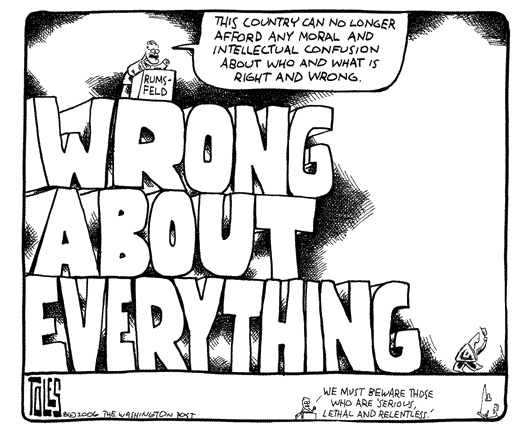
    What a great idea. It’s too bad that hypocrites at the DMN cannot keep up this standard. In fact, in the print edition, they couldn’t keep it up for one freakin’ inch as not even that far away from the headline was the following political cartoon by Tom Toles of the Washington Post.

    Toles' Attack on Rummy

    That is most assuredly a political attack on Rumsfeld based on the perception of Iraq that the media has created. And it most assuredly less than an inch from the headline telling Rumsfeld to leave politics out of Iraq.

    Less than an inch — that’s about how far the Dallas Morning News editorial board can be trusted to avoid hypocrisy.

  • September 1 Anniversaries

    Not moments in history to be celebrated but certainly to be remembered.

    67 years ago today, Germany invaded Poland and triggered the Second World War. I provided a little more thought and information in my post last year. More reading on the invasion can be found here and here. Also, don’t miss Case White Directive No. 1, Hitler’s orders for the invasion.

    Today also marks to two-year anniversary of the day when Chechen terrorists stormed a school in Beslan, taking more than 1200 hostages on a day Ralph Peters described as when the killers came for the kids. The Jawa Report marks the date and remembers the ensuing massacre that cost the lives of 344 civilians, including 186 children, here and graphically here.

  • Public Perceptions and Reality

    These days, the American public is pelted by story after story from “our” media about lack of progress, quagmire, pending doom and outright tragedy. Unsurprisingly, polls show that American attitudes have been negatively affected in several areas, but do these effects match reality or merely the impression that the media is spoonfeeding?

    Here are four postings I’d invite the reader to examine:

    All are good reads that present evidence that the predominant feelings of the American public are not grounded in reality or, in the global warming case, not based on solid scientific procedures.

    How can I explain any discrepancy between perception and reality? Well, that’s quite simple: the mainstream media, our information gatekeepers, are generally failing to bring us all the news thats fit to print, opting instead for all the news that fits their agenda or their mindset.

    Without alternative means to get information, I have to wonder how many times in the past that the will and attitude of the American people were shaped by shoddy reporting, misinformation, selective coverage and outright bias. Tet, of course, springs to mind — a huge victory that was painted as defeat and eventually was the trigger of our ultimate demise in Viet Nam.

  • Blood Borders: How a Better Middle East Would Look

    Well, at least it’s safe to say that putting the latest musings from Ralph Peters into practice would certainly make the recent Texas congressional redistricting brouhaha look like a fun-filled day at the state fair, complete with funnel cakes and corndogs for all.

    International borders are never completely just. But the degree of injustice they inflict upon those whom frontiers force together or separate makes an enormous difference — often the difference between freedom and oppression, tolerance and atrocity, the rule of law and terrorism, or even peace and war.

    The most arbitrary and distorted borders in the world are in Africa and the Middle East. Drawn by self-interested Europeans (who have had sufficient trouble defining their own frontiers), Africa’s borders continue to provoke the deaths of millions of local inhabitants. But the unjust borders in the Middle East — to borrow from Churchill — generate more trouble than can be consumed locally [my note: great freakin’ line].

    While the Middle East has far more problems than dysfunctional borders alone — from cultural stagnation through scandalous inequality to deadly religious extremism — the greatest taboo in striving to understand the region’s comprehensive failure isn’t Islam but the awful-but-sacrosanct international boundaries worshipped by our own diplomats.

    As I’ve repeatedly stated, I have long found the efforts of Mr. Peters to be worth highlighting, either for their thoughtful nature, actual value or intriguing look at possible futures. With the above intro, Mr. Peters launches into a bold area — a one-man redrawing of the national borders currently found in the cauldron that is the Middle East. Indeed, he even creates some new countries, though not with the arbitrary capriciousness that led to many of the current borders. Here are his before and after maps, though I do highly recommend reading the article for a wealth of reasoning and history.

    Is the plan realistically feasible? Quite possibly yes, with the hopes of a very positive global effect. Is the actual implementation of the plan realistically feasible? Probably not without a vast degree of bloodshed — and maybe even radiation — in the region, which would probably require an entirely new drawing of the map based on surviving populations.

    Hat tip to CDR Salamander, who rightly calls out Mr. Peters for cheesing out on the following tidbit:

    But the issue of the territories surrounding Jerusalem, a city stained with thousands of years of blood, may prove intractable beyond our lifetimes. Where all parties have turned their god into a real-estate tycoon, literal turf battles have a tenacity unrivaled by mere greed for oil wealth or ethnic squabbles. So let us set aside this single overstudied issue and turn to those that are studiously ignored.

    I’m going to have to side with Salamander here, as it is quite the cop-out when included in such a broad vision. After all, the West Bank and the Palestinians have historically been a wee bit of an issue, somewhat of a speedbump on the roadmap to peace. Tom Clancy had an idea: let the supposedly-neutral Swiss Guards handle the multi-religion holy ground juncture that is Jerusalem. I have another idea: let’s go really neutral. The Swiss Guards can monitor the transit points into and out of Jerusalem, a truly neutral party — like say a committee of Bhuddist monks — can administer the city, and the Brothers Earp and Doc Holliday can keep the Jerusalem clean of weapons.

    Hey, I’m just brainstorming.

  • Could This War Produce a Sunni-Israeli Alliance?

    My quick one-word answer to that headline’s question: no. Now, please allow me to elaborate on that answer: hell no.

    It’s not often — if ever — that I post an article that has so many points with which I disagree unless I’m dissecting it. Still, this interview with Martin Indyk raised enough interesting thoughts that I’d still recommend reading it. Please note that a political slant is made obvious early, as displayed in the following (emphasis added):

    Indyk currently heads the Saban Center for Middle East Policy at the Brookings Institution in Washington, D.C. He is waiting, though he will not admit this publicly, for another opportunity to try to make peace – an option that could be realized if a Democrat wins the U.S. presidential elections in 2008.

    Despite this wonderfully biased intro that a Democrat U.S. president is the course to possible peace, there are still some tasty tidbits in the interview, and I would like to highlight a couple of them.

    First, when asked who won the recent Israeli-Hezbollah conflict in southern Lebanon, Indyk gave the following response:

    “I think the verdict is still out. Militarily Hezbollah put on an impressive performance and was able to stand up to Israeli forces. Even if in the end it turns out that they lost every encounter, in the Middle East perception is reality, and the perception is that they gave as good as they got, and the perception is that they achieved more than Israel achieved. When the Israeli Chief of Staff says that ‘Israel won on points,’ that’s not a very reassuring verdict.

    “On the other hand, to paraphrase von Clausewitz, the question is who manages to turn the results on the battlefield into political gains, and there I’m a bit more optimistic. The campaign in Lebanon highlighted the dangers facing the Sunni Arab world from the Iranian-led Shia axis, from Iran to Iraq – which has a Shi’ite-dominated government – to the minority Alawite regime in Syria and Hezbollah in Lebanon. That actually provides a common interest to the Sunni Arab world and Israel.

    “And you can see that in interesting ways, including the fact that Egypt, Jordan and Saudi Arabia have now had a spat with Syria over their intent to relaunch Saudi King Abdullah’s peace initiative, which provided conditions for ending the conflict, recognition of Israel and normalization of relations.

    “And there is the fact that the Sunni Lebanese prime minister, while taking the world press on a tour of the rubble of southern Beirut and accusing Israel of war crimes – is nonetheless holding out an olive branch to Israel.[“]

    Secondly, when discussing his earlier contentions that Israel should focus on making peace with Syria, Indyk reversed his long-held stance as follows:

    “Look, I was personally involved in trying to achieve a peace treaty between Israel and Syria during eight years of the Clinton Administration. I personally argued throughout that period that the U.S. needed to give priority to a Syrian-Israeli deal, because it had obvious strategic benefits: breaking off Syria from Iran as well as the ability to disarm Hezbollah with the 15,000 troops that Syria had in Lebanon at the time, and to increase the pressure on the Palestinians to move forward and to break the logjam. There were lots of advantages then to doing a deal with ‘Syria first.’

    “But I don’t feel the same way now. There’s nothing wrong with talking about talking with Syria. Israel should always be interested in negotiating peace – but as a matter of strategy I think it’s a mistake.

    […]

    “Syria is allied with Iran, for good reasons of strategy, from their point of view. And the notion that you can somehow split them is, I think, fanciful. And to talk to Assad now would have the effect of inviting him back into Lebanon, because surely the purpose of talking to him is to get him to control Hezbollah, and I think that’s a mistake.

    “Israel should at least try to work with the Lebanese government, which is an anti-Syrian government. Because that government is signaling that it wants to deal with Israel, that it wants to return to the provisions of the 1949 Armistice Agreement between the two countries, and the Lebanese prime minister had made it even more explicit in recent days.[“]

    While I find much to disagree with in the interview, including especially the fundamental point that this war sets up a grand opportunity with the Sunnis for Israel, there is also much that is intriguing and still a good bit more to chew on and digest.