Category: War on Terror

  • How U.S. Assault Grabbed Global Attention

    Yesterday, I questioned a media description of Operation Swarmer as the “biggest attack since the Iraqi invasion.” Today, the media is questioning itself and finding its own coverage overblown because of a lack of understanding of American military terminology.

    It was billed by the US military as “the largest air assault operation” since the overthrow of Saddam Hussein in 2003, with attack and assault aircraft providing “aerial weapons support” for 1,500 US and Iraqi commandos moving in to clear “a suspected insurgent operating area north-east of Samarra.”

    The international news agencies immediately rang the urgent bells on the story.

    Around the world, programmes were interrupted as screens flashed the news, which dominated the global media agenda for the next 12 hours or more.

    […]

    By the middle of Day Two, the operation had already been scaled down to 900 men.

    Operation Swarmer clearly bore no comparison in scale to the initial attack which brought down Saddam Hussein’s regime, or to the massive assault on the insurgent stronghold in the city of Falluja in November 2004.

    Nor did it appear to match a series of counter-insurgency operations involving air strikes and ground forces in remote areas near the Syrian border in western Iraq last year.

    In one four-day campaign last May, the US military said it had killed 125 insurgents for the loss of nine of its own men killed and 40 injured.

    So how and why did this latest apparently routine combing operation, yielding a few arms caches and netting some low-grade suspects, manage to win stop-press coverage around the world?

    The use of the phrase “the largest air assault operation” was clearly crucial, raising visions of a massive bombing campaign.

    In fact, all the phrase meant is that more helicopters were deployed to airlift the troops into the area than in previous such operations.

    The 50 “aircraft” that had been deployed were not combat jets blasting insurgent targets, but helicopters ferrying in the forces. There was no rocketing or bombing from the sky.

    In US military parlance, “air assault” means transporting troops into a combat zone by air. It could include, but does not necessarily imply, air strikes.

    Ah yes, the media — get the story out, get it right later … maybe.

  • Coalition Launches Biggest Attack Since Iraq Invasion

    I’m not sold yet on the validity of that headline. Still, it it noticably the largest air assault since the end of major operations in the Iraqi theater.

    Combined American and Iraqi forces yesterday launched the largest air assault the country has seen since the US-led invasion, targeting insurgent strongholds near Baghdad.

    The US military said the offensive, dubbed Operation Swarmer, was aimed at clearing “a suspected insurgent operating area” north-east of Samarra and was expected to continue for several days.

    “More than 1,500 Iraqi and Coalition troops, over 200 tactical vehicles, and more than 50 aircraft participated in the operation,” the military statement said.

    Samarra, about 60 miles north of Baghdad, was the site of the massive bombing of a Shiite shrine on 22 February which touched off sectarian bloodshed that has killed more than 500 and injured hundreds more.

    It is a key city in Salahuddin province, a major part of the so-called Sunni triangle where insurgents have been active since shortly after the US-led invasion three years ago. Saddam Hussein was captured in the province, not far from his home town, Tikrit.

    Hoshyar Zebari, Iraq’s interim foreign minister, said the attack was necessary to prevent insurgents from forming a new stronghold such as they had established in Fallujah, west of Baghdad.

    “After Fallujah and some of the operations carried out successfully in the Euphrates and on the Syrian border, many of the insurgents moved to areas nearer to Baghdad,” Mr Zebari said. “They have to be pulled out by the roots.”

    Residents north of Samarra said there was a heavy US and Iraqi troop presence in the area and that large explosions could be heard in the distance.

    They said the operation appeared to be concentrated near four villages – Jillam, Mamlaha, Banat Hassan and Bukaddou – near the highway leading north from Samarra to the city of Adwar.

    Waqas al-Juwanya, a spokesman for the provincial government’s joint co-ordination centre in nearby Dowr, said: “Unknown gunmen exist in this area, killing and kidnapping policemen, soldiers and civilians.”

    The military said a number of weapons caches had been captured, containing shells, explosives, bomb-making materials and military uniforms.

    As expected, early reporting on this was sketchy. Bob Owens at Confederate Yankee gives CNN credit for getting the terminology of air assault correct, something that we both find somewhat surprising. Some early reporting (I’m too lazy too track down over dial-up) had talked of an air raid or an air attack or an air strike — all of which Mr. Owens points out graphically implies a completely different operation (as a side note, I got a little involved in the comments about the history of combat gliders).

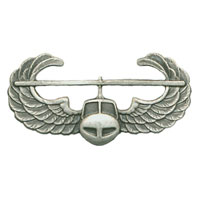
    Heck, maybe that’s why Air Assault has it’s own badge in the U.S. Army.

    Air Assault Badge

    Hooah for their success today.

  • Senator Puts Forward Motion to Censure Bush

    One man with courage is a majority.

    —Thomas Jefferson

    I’m pretty certain that when Jefferson came up with those words, he was hoping for some sort of righteousness in the majority-of-one’s endeavors. And then, sometimes, there’s the likes of Sen. Feingold and his one-man political assault on President Bush.

    A U.S. senator has put forward a resolution to censure President George W. Bush for ordering the wiretapping of some American phone conversations without a court warrant.

    Senator Russell Feingold, a Democrat from Wisconsin, accused Bush on Monday of breaking the law and misleading the American public.

    The resolution calls on the Senate to condemn Bush’s “unlawful authorization of wiretaps of Americans within the United States without obtaining the court orders required.”

    […]

    The five-page resolution accuses the president of violating the U.S. Constitution and the country’s Foreign Intelligence Surveillance Act.

    The only U.S. president ever censured by the Senate was Andrew Jackson in 1834.

    […]

    Last December, Americans learned of a secret domestic surveillance program conducted by the U.S. National Security Agency.

    The revelation caused an uproar and triggered questions about limiting Bush’s broad scope to govern.

    Bush defended the program as a “vital tool” and said the spying was only on known operatives of al-Qaeda and its affiliates and only on communications going in and out of the U.S., not within the country.

    “I re-authorized this program 30 times since 9/11 and I intend to do so as long as the nation faces the continuing threat of an enemy that wants to kill American citizens, Bush said.

    Feingold is considered a possible for the Democratic presidential nomination in 2008.

    Can this one man become the bedrock of a majority? Well, it seems highly unlikely as his fellow Democratic senators are rushing to not stand by his side.

    Feingold has responded by expressing dismay at the response, accusing his fellow Dems of reacting out of fear.

    Sen. Russell Feingold on Tuesday blamed fellow Democrats for inaction on his stalled resolution to censure President Bush for his authorizing the National Security Agency’s electronic terrorist surveillance program.

    I’m amazed at Democrats … cowering with this president’s numbers so low,” said Feingold, D-Wis. “The administration … just has to raise the specter of the War on Terror, and Democrats run and hide.”

    Well, that should rally the troops.

    It is my view that, rather than acting with righteousness, Feingold’s maneuver is one of erroneous self-righteous grandstanding. His own words make it clear — attack the president now, not for the sake of the nation or our security but rather because his numbers are low and it’s an opportunistic time.

    That doth not a majority make, nor should it.

  • Quietly, Controversially, Work Begins on WTC Memorial

    While seemingly slipping in under the scope of most American media, work on the memorial honoring the Twin Towers is beginning, despite the reservations of the families of several victims of the 9/11 terrorist devastation.

    Without political ceremony, construction began [today] on the memorial to the thousands of people who died in the 9/11 World Trade Centre attacks – even as relatives of some of the victims headed to court to fight plans to build at the site.

    Lorries [Edit: lorries? Hey, it’s the Scotsman, a damn fine paper that can call trucks lorries if it chooses] laden with timber and other equipment rolled down a ramp as construction workers began cleaning the memorial area of debris and installing protective wooden coverings over parts of the original foundations of the twin towers.

    After six to eight weeks of preliminary work, concrete will be poured to create supports for the “Reflecting Absence” design.

    George Pataki, the New York state governor, last week called the event “a very important milestone,” but no ground-breaking ceremony is planned for several weeks.

    Officials said they wanted to meet a schedule to build the memorial by 2009.

    Some families of 11 September victims who oppose the underground memorial design are trying to stop the construction before the memorial is set in concrete.

    The Coalition of 9/11 Families last week filed a lawsuit charging that the memorial would damage the historic “footprints” – the foundations of the two towers. Preservation groups have made similar arguments in letters to rebuilding officials. An initial court hearing was scheduled for yesterday.

    The Reflecting Absence design, by the architect Michael Arad, was chosen two years ago out of more than 5,200 competition entries.

    It marks the fallen towers with two stone reflecting pools at street level, surrounded by trees.

    The pools drop 70ft below ground, where visitors find surrounding each pool the names of the nearly 3,000 people killed in the 2001 attacks and the 1993 World Trade Centre bombing.

    Families have said the memorial would dishonour the dead by placing their names below street level and might be difficult to evacuate quickly.

    And what about those concerns of the families, both in terms of dignity and public safety?

    Stefan Pryor, the president of the Lower Manhattan Development Corporation, the agency in charge of rebuilding at Ground Zero, said the design would “fulfill the highest standards of both safety and beauty”.

    He said the agency would continue to listen to family members’ concerns.

    Apparently, Mr. Pryor’s definition of listening equals my definition of ignoring. At least that damned freedom center idea still appears to be dead.

  • Brits to Withdraw 800 Troops from Iraq

    Our British allies have announced a pending reduction in forces on the ground in the Sandbox.

    The number of British troops serving in Iraq is to be cut by 800 to just over 7,000, it was announced yesterday.

    John Reid, the Defence Secretary, told the Commons that the reduction would begin when the next brigade moves to Iraq in May. He insisted that the cut was not triggered by the increase in violence.

    “It is an operational decision not a political one,” he said.

    With more than 235,000 trained members of the Iraqi security forces and 5,000 recruits joining each month, the country now had enough resources to conduct independent operations, he said.

    The announcement came as many observers believe Iraq is descending into even greater chaos with the prospect of civil war.

    Well, this certainly doesn’t sound like the course of action one would choose were one to believe the doom-and-gloom media’s prognostications of a pending civil war. One would anticipate a variety of reactions to such a situation, among them an increase in forces, a constancy of troop levels or a large-scale withdrawal, depending upon expectations and dangers. Rather, a small reduction points towards a phased handover of responsibilities, as has been predicted by the coalition leaders and appears to be the case here.

    But despite the recent sectarian violence after the dome of the Shia shrine in Samarra was destroyed, the Ministry of Defence’s analysis was that civil war was “neither imminent nor inevitable”.

    Mr Reid hinted that some of Iraq’s 18 provinces could be entirely free of foreign troops after the Joint Committee to Transfer Security Responsibility meets this month.

    He said that the occupying forces were not about to “cut and run”, insisting that their commitment was “steadfast until the job is done”.

    No, historical instances of cutting and running, be it from Viet Nam, Beirut or Somalia, are what put us in the boat we’re in today — our enemies are expecting it, playing every twist for its media value in an attempt to undermine our resolve. Indeed, it is their only hope, as they cannot withstand us militarily, nor can they deny that the Iraqi people are slowly embracing democracy and the Iraqi security forces are slowly but surely growing in competency and numbers. Time is not on the side of our enemies in Iraq, unless the defeatists among us get their way.

  • Iraqis to Take Control of Abu Ghraib

    At long last, the possible shrugging off of a media nightmare by the American military.

    Abu Ghraib, the prison that served as a house of torture under Saddam Hussein and was latterly the scene of the US military’s worst prisoner abuse scandal, is to be handed over to the Iraqi government.

    The decision yesterday came as the Iraqi authorities announced they had hanged 13 insurgents, marking the first time militants have been executed in the country since Saddam Hussein was ousted.

    The US military said yesterday that its new facility near Baghdad airport to house security prisoners now held at Abu Ghraib prison should be ready within three months.

    Lt Col Kier-Kevin Curry, a spokesman for US military detainee operations, said completion of the new prison at Camp Cropper, where Saddam and his co-defendants have been held since their capture, would set the transfer in motion.

    “We will transfer operations from Abu Ghraib to the new Camp Cropper once construction is completed there. No precise dates have been set, but the plan is to accomplish this [completion of construction] within the next two to three months,” Lt Col Curry said.

    “Once we transfer operations from Abu Ghraib, the facility will be turned over to the Iraqi government.”

    The prison, which currently holds over 4,500 detainees, came to symbolise US mishandling of some prisoners captured in Iraq, both during the US-led invasion three years ago and in the fight to subdue the largely Sunni Muslim insurgency since then.

    Although I recognize that the prison is now sadly infamous for American military abuses, I have two key questions here. First, does anyone really believe that the Iraqi government and military is sufficiently mature yet to prevent worse abuses? Second, why are Saddam’s abuses, far worse than any chronicled against the American military, never carried in these stories as a frame of reference like the American abusese?

    Widely publicised photographs of prisoner abuse by US military guards and interrogators led to intense global criticism of the US war in Iraq and fuelled the insurgency.

    Photos showed one of the guards, Private Lynndie England, abusing naked Iraqi prisoners, including an image where she held a leash tied around an undressed male detainee’s neck. England was sentenced to three years in prison.

    She was among nine US soldiers who were charged in the Abu Ghraib scandal. Her ex-boyfriend, Specialist Charles Graner, with whom she had a child, was sentenced in January 2005 to ten years in prison.

    Yes, we abused. Yes, we prosecuted. I thank the author of this story for making the latter clear, though I feel a little more of the prison’s brutal history would have added some perspective. Hell, there would have been no shortage of ways to put the American Abu Ghraib abuse into perspective historically, but that never has been attempted in the handling of this tale.

    The hand-over of authority at Abu Ghraib will take place in phases, Lt Col Curry said, beginning with basic training for prison guards, followed by Iraqis working side by side with US forces at detention facilities. Iraqi guards will then start running detainee operations themselves with a transition team overseeing them before they assume complete control.

    Okay, here’s my predictions on how this story will be handled by the New York Times, the same Paper of Record that carried front-page coverage of American Abu Ghraib for some thirty-some-odd consecutive days: no front page coverage and any article will be accompanied by a tired old American-abuse photo. If I’m wrong about this, it will be on the absence of a photo — it would, after all, attract attention to a story best left buried.

  • Sheehan Bails on Protesting at American Post in Europe

    And now, the much ballyhooed appearance by Gold Star mom Cindy Sheehan at the gates of an American military base apparently has been axed.

    Cindy Sheehan says she will not be near Ramstein Air Base or participate in a protest march from Landstuhl to Ramstein on Saturday if she goes through with a planned trip to Europe.

    Sheehan, the mother of a soldier killed in Iraq and the woman who protested the war last summer outside President Bush’s ranch in Texas, said in an e-mail Wednesday to Stars and Stripes that “everything is up in the air at this point.”

    Sheehan is due to arrive in Frankfurt on Thursday. Despite uncertainty clouding Sheehan’s visit, protesters and counterprotesters still plan to gather outside Ramstein Air Base on Saturday afternoon.

    Sheehan was arrested Monday in New York City outside the U.S. mission to the United Nations when she and other protesters attempted to deliver a petition calling for the withdrawal of troops from Iraq. Her condition raises doubts as to whether she will make the trip to Germany and France.

    “If I am there, I won’t be anywhere near the air force base … or participate in the march,” wrote Sheehan on Wednesday. “I was brutalized in New York the other day by the NYPD (New York Police Department) and I need to go to the doctor today (Wednesday).”

    When asked why she would not protest near the air base, Sheehan replied: “I don’t want the soldiers to feel we don’t support them, and soldiers can’t redeploy themselves.”

    So, which is it, Gold Star mom Cindy Sheehan? The brutality you suffered through at the unmerciful hands of the NYPD or your support of the American military personnel who, surprisingly, are not at liberty to write their own orders?

    I think that this is a case where Gold Star mom Cindy Sheehan’s handlers — and that is what they are — have decided that it is best to continue to use her notoriety and name but not her presence.

    After all, Confederate Yankee‘s Bob Owens visually and clearly demonstrates that any police brutality accusations are a complete crock.

    Methinks instead that Gold Star mom Cindy Sheehan’s handlers think it’s best that her image not come up in blatant contrast with the military Gold Star mom Cindy Sheehan claims she supports — as will be the case in Germany.

    Please, Gold Star mom Cindy Sheehan, I beg and plead that you press charges of brutality against the NYPD. Please speak truth to power, Gold Star mom Cindy Sheehan, about how the New York coppers kept ya from standing up to the Man in Germany.

  • Ports Deal Crumbles, Dubai Firm to Sell U.S. Assets

    Well, so much for the United Arab Emirates ports story.

    With President Bush unable to contain a Republican congressional rebellion, a company owned by the United Arab Emirates vowed Thursday to turn over its just-acquired operations at six major U.S. port terminals to an American entity.

    The surprise move came after congressional leaders told Bush on Thursday morning that there was no way to stop lawmakers from blocking Dubai Ports World’s takeover of terminal operations at the ports.

    Republican and Democratic lawmakers reacted cautiously to the company’s apparent surrender, saying they needed to learn more about the details before abandoning their attempts to block DP World.

    DP World obtained the terminals as part of its acquisition of Peninsular and Oriental Steam Navigation Co., a British firm. That transaction, which the Bush administration approved in January, aroused a public furor that drove Congress into open conflict with the White House.

    The announcement was an extraordinary retreat that signaled a shift in the power relationship between the White House and Congress. Bush has been unused to losing. But this time, the Republican-led House of Representatives, which has been a rubber stamp for the president for the past five years, was the first to revolt.

    Republicans were furious when the president promised last month to veto any legislation that blocked the deal. Congress ignored Bush’s threat, and a 62-2 vote to block the deal by the House Appropriations Committee on Wednesday left no doubt that Congress would override a veto if the president dared to cast one.

    After Thursday’s meeting of congressional leaders with Bush at the White House, DP World’s chief operating officer, H. Edward Bilkey, surprised lawmakers when he issued a statement promising that the company would divest itself of its U.S. terminals.

    “Because of the strong relationship between the United Arab Emirates and the United States and to preserve this relationship, His Highness Sheikh Mohammed Bin Rashid Al Maktoum, vice president and prime minister of the UAE and rule of Dubai, has decided to transfer fully the U.S. operations of P&O Ports North America Inc. to a United States entity,” Bilkey’s statement said.

    Nevertheless, Senate Democrats pressed ahead with attempts to block DP World’s takeover, and House leaders weighed whether to proceed as well.

    Critics of the original deal weren’t backing away from congressional action.

    “I’m skeptical,” said Rep. Mark Foley, R-Fla. “I’d prefer (legislation) go through because it gives us a safeguard.”

    Likewise, Rep. Jerry Lewis, R-Calif., the chairman of the House Appropriations Committee, said he didn’t intend to remove the ports provision from an emergency spending bill for hurricane relief and the war in Iraq.

    Rep. Ileana Ros-Lehtinen, R-Fla., added: “Congressional plans are to move forward with the appropriations language next week which kills the transaction. Just to make sure.”

    DP World would have taken over terminals in Miami, Philadelphia, New York, New Jersey, Baltimore and New Orleans as well as some stevedoring operations at 15 others.

    […]

    The question that loomed late Thursday was who would buy the U.S. interests, and whether the firm would sell the assets in pieces.

    Eller & Co., whose Miami subsidiary Continental Stevedoring & Terminals sued to block the sale, said it might attempt to buy the terminals. “We are certainly encouraged by what the statement said,” Eller attorney Michael Kreitzer said. “We think we are one of the companies (that could buy it). We have been in the business for 70 years. We could do it.”

    Rep. Peter King, R-N.Y., an early opponent of the DP World deal and an influential one as the chairman of the House Homeland Security Committee, said Thursday’s announcement was encouraging. “I don’t think Dubai ports would have done this … if they didn’t think there was someone out there,” he said. “Hopefully they have more than one (bidder), otherwise they’re going to have to do a fire sale.”

    Michael Hopkins, the vice president of Crowley Liner Services at Port Everglades in Florida, said he expected DP World to sell its interests to several firms rather than one large operator.

    […]

    “To be honest, I have no idea,” said Steve Erb, who manages P&O ports operations in Miami. “I can just say that the five largest terminal operators in the world aren’t American.”

    I had not blogged on this brouhaha yet, though I had certainly intended to do so (damn you, oncall pager). I’ll admit that I initially balked when I heard the news that an Arab company was being handed the security responsibilities for six American ports. And that right there is why this deal is dead — horridly bombastic, sensationalistic and inaccurate journalism. The deal did not involve control of security. The fact that these six terminals are already managed by a foreign company was not reported. Still, weeks later, a large portion of the stories continued such inaccuracies and omissions. Remember when former Vice President Al Gore yelled that the Bush administration played upon our fears? Well, that is most assuredly what the media did with this story, at the sad expense of the truth. Politicians from both sides chose to capitalize upon these fears. Hey, after all, it’s an election year, and the media have already made clear how they will play this tale.

    Instead, the victim in this tale is an Arab ally, just the sort of friend we should be fostering. Protein Wisdom‘s Jeff Goldstein at expands greatly upon my concerns in this matter.

    Is this a national security question? My sense is that while it has been hyped as such—and that the majority of congress persons and the American public caved to their fears—it never really was. And from a free market perspective—which, along with the promotion of liberal democracy, is part of the memetic message we are trying to sell abroad—this is a set back.

    To win this war, we must insist that our way of life is worth defending. Congress has damaged our relationship with the Gulf states (and in the UAE, we have a very good working relationship), determined our economic policy, and show us to be unwilling to practice what we preach.

    I only hope that the UAE understands the vicissitudes of our political system in advance of elections and is willing to accept that the timing for the deal—moreso than any idea of xenophobia—is ultimately responsible for outcome. Which is strange, feeling like I have to rely on the pragmatism of the UAE in order not to take a giant ideological step backward in the war on terror.

    Similarly, we are going to be forced to rely on the pragmatism of the rank and file Muslim who, we must secretly hope, recognizes that we have security concerns that must be dealt with domestically—and so they are able to resist the spin our enemies are likely to put on this: that the US, as Al Gore already told them, is openly hostile to Muslims.

    […].

    A positive outcome from all this might be that we take a closer look at securing points of entry (and resistance to the deal by Democrats could potentially redound on them when it comes to the Mexican border, if certain Republicans play their rhetorical cards right)—but I hope we manage to do so in a way that is consistent with the free market system we profess to promote.

    Indeed, I hope every senator and representative that has played a part in attacking this business move by an ally will have the integrity to follow through with the rhetoric used to date — move immediately to stop foreign management of all points of entry. Otherwise, just come right out and say that you have essentially used racial profiling to shut down a business deal.

    These same six terminals were previously controlled by a British-owned company; are you saying that our terrorist enemies could penetrate a U.A.E. company but could never have been an issue with the U.K.? Really, I have little complaints about profiling, but there are places where I think it should be utilized first before this instance. I fully expect everyone in Congress who helped kill this deal that doesn’t immediately move against any foreign port management to explain why they will racially profile an ally-owned company but will not racially profile airline passengers that match those who have previously and repeatedly killed our fellow citizens.
  • The United States of Islam

    In my previous post, I mentioned the know-thy-cultural-enemy file. The Redhunter has another entry of a visual nature. Be certain to check the “After 100 Years” section in the lower right corner of the graphic.

  • What I’m Reading Tonight

    First, here’s a somewhat interesting, though rarely insightful, look at the friction between the American media and military.

    “There’s an irony here, because when you had embedding, there was a sense that the reporting was better than ever,” says Dan Goure, a military analyst with the Lexington Institute. “But since the end of major combat operations, the relationship has really gone to hell. There is a strongly held perception in the military – particularly the Army – that the media is doing the enemy’s work. You guys are seen as the Jane Fondas of the Iraq war. And so the military attitude is, ‘why should we level with you, because you’re going to screw us.’”

    That attitude apparently goes all the way to the top: Yesterday, Secretary of Defense Donald Rumsfeld said that “the steady stream of errors [by the media] all seem to be of a nature to inflame the situation and to give heart to the terrorists and to discourage those who hope for success in Iraq.”

    Goure says the relationship between the press and military has been bad since the time of the Vietnam War. In World War II and the Korean War, he says, the military had a sense that the press was on their side. But today, he argues, “both the military and the media have unrealistic expectations of each other,” as they have for the past 40 years. “The military expects the media to be a kind of public affairs arm, and the media expects the military to move faster and more agilely on these kinds of issues than they can. When the military is dealing with a problem, it has to go through the chain of command, there are reviews – it’s a very laborious process.”

    All of that seems pretty dead on, but then there’s the following:

    Many of the reporters I spoke to say the military’s secrecy has helped them control stories, which suggests there may not be a change in press strategy anytime soon, despite the embarrassment caused by the Tillman case. Fidell, who has crusaded for more openness on the part of the military, characterizes the situation bluntly. “At the moment,” he says, “they’re winning.”

    The media want more openness from the military, but essentially refuse to cover any positive story that they’re able to dodge. Sure, big tales like successful elections cannot be buried, but I’ll wager that I could go to CENTCOM or Defend America and find a wealth of positive news releases that have received no media play. Heck, while talking about military secrecy or hesitant forthcoming, this story doesn’t even mention the fact that it was indeed the military that broke the news on the Abu Ghraib abuse story.

    Second, Elephants in Academia takes an look at SecDef Donald Rumsfeld’s interactions with wounded American troops and the dichotomy of how this relationship is presented when drawn by an editorial cartoonist and captured by a camera (hat tip to Confederate Yankee).

    I gave writing this post a fair amount of thought for a couple of reasons. For starters, it’s about that Tom Toles Washington Post cartoon from late January, and I hate to give it any more play. And it’s about Donald Rumsfeld, and I’m aware that I’ve had more than enough to say about him recently. But I’ve decided to throw caution to the wind because I found the visual comparison between the two pictures so striking. And ultimately I hope the post is about more than Toles and Rumsfeld–it’s about the disconnect that I see between public perception of the military based on the way it is portrayed in the press and the reality of the military as I understand it. I know it’s somewhat unfair to compare a stylized drawing like a political cartoon with a photograph because of its attendent aura of verisimilitude, so I would like to start with the disclaimer that both are constructs since, of course, all photographs are shaped by the person who pushes the button and by the way the subjects deport themselves. But in this case, I think that, as in the cartoon, the construct is instructive.

    Don’t let the hedging in that intro dissuade you from what is a very intriguing read and a striking visual contrast.

    Third, here’s a so-far fascinating four-corner discussion on the abusive, oft-disgusting treatment of women by many of those of the Islamic faith (hat tip to Howie at the Jawa Report).

    A Muslim rape epidemic in sweeping over Europe — and over many other nations host to immigrants from the Islamic world. The direct connection between the rapes and Islam is irrefutable, as Muslims are significantly overrepresented among convicted rapists and rape suspects. The Muslim perpetrators themselves boast that their crime is justified since their victims were, among other things, not properly veiled.

    What is the psychology here? What is the significance of this epidemic? And how do we face it when our own feminists, with a few exceptions, are deafingly silent about it?

    I’ll admit I haven’t finished reading this lengthy piece yet but, so far, I’d say it’s safe to tuck it into the know-thy-cultural-enemy file.