Category: Middle East

  • Happy Fourth of July

    Here’s wishing a happy Independence Day to all, but especially to my friend Bill.

    I wrote back in January of SGT William J. Hartmann, my dear friend and former tank commander who was on his way to Iraq. In that post, I pointed out that my buddy, in typical Billy-boy fashion, was getting an inordinate amount of print space and face time in stories concerning the deployment of a large portion of the Texas Army National Guard.

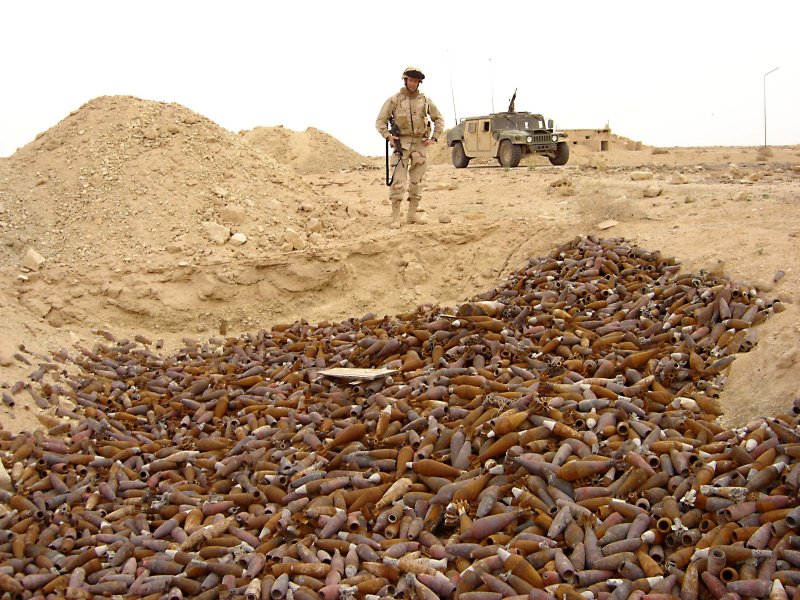
    Well, the trend continues, courtesy of the home page of the 56th Brigade Combat Team (click for larger version of photo):

    SGT Hartmann on guard

    Sgt. William J. Hartman [sic] of the 3rd Battalion, 112th Armored Regiment, 56th Brigade Combat Team, 36th Infantry Division, stand [sic] watch over a pit full of Iraqi mortar rounds waiting to be destroyed by a civilian explosive ordnance disposal team at the Akudar Ammunition Depot located in central Iraq.

    Thanks for serving for our independence, Bill. Hope you had a happy Fourth, and keep safe, bro.

  • News from the Brussels Conference

    Representatives of over 80 nations attended yesterday’s international conference on Iraq in Brussels. Here are three stories coming out of the gathering, co-hosted by the U.S. and the European Union, that I found interesting or significant.

    Iraq Begs the World for A Marshall Plan

    The staid conference room in Brussels could not have seemed further from the bloodstained streets of Baghdad. There, Iraqi leaders pleaded with the world to focus on the human costs of the conflict engulfing their homeland, and to do more to bring peace

    “The children of Iraq are just like yours – they don’t want to lose their fathers” Iraqi Prime Minister Ibrahim al-Jaafari said in opening remarks to an international conference that concluded with calls for not just cash, but a Marshall Plan-style commitment to help those most vulnerable among Iraq’s citizens.

    The UN, the European Union, the US and more than 80 other nations pledged their support – while saying Iraq could also do more to help itself. No new money was offered at a meeting that was never intended as a donors’ conference, but the gathering was applauded as proof that sharp differences over the US-led invasion of Iraq could be put aside to help Iraqis.

    High price to pay if Iraq democracy fails: Fischer

    Speaking at a conference on Iraq being co-hosted in Brussels by the U.S. and the European Union, German Foreign Minister Joschka Fischer warned there would be a “high price to pay” if the democratisation process in Iraq fails.

    The conference is focusing on international support for the Iraqi transitional government on political reform, economic reconstruction and strengthening security through the rule of law. No new aid pledges or troop contributions are expected.

    […]

    Whether countries were for or against the U.S.- led Iraq war, the focus now was on stabilising the country, German Foreign Minister Joschka Fischer told reporters. “If the democratisation process fails, there will be a high price to pay…we cannot allow that to happen,” Fischer underlined.

    The meeting emphasised that “the international community, having been deeply divided over Iraq, has now come together actively,” said British Foreign Secretary Jack Straw.

    Syria to discuss cross-border infiltration claims

    Syria will ask the Baghdad government to provide evidence of would-be insurgents infiltrating across the Syrian-Iraqi border, Syrian Foreign Minister Farouk al-Sharaa said Thursday.

    Speaking to reporters, al-Sharaa indicated his government’s concern about charges that it is allowing infiltration into Iraq – accusations that were repeated by US and Iraqi envoys at the international conference on Iraq in Brussels on Wednesday.

    […]

    “The delegation will ask for documents and evidence about the accusations (of infiltration), because we want to know the source and truth,” al-Sharaa said.

    “Any border in the world, including the United States’ borders, is prone to infiltration,” Sharaa added.

    Unfortunately, there is much truth in that last statement, far too much when considering the U.S. borders. Still, one would be quite foolish to state that Syria is doing all it can to assist the establishment of a stable, democratic Iraq, something that Syria does not want as a neighbor.

    Another donors conference is planned in mid-July in Amman, Jordan. The mind boggles at the security precautions that will have to be in place and how tempting such a target will have to be to the radical Islamists.

  • Colors. And a Break in Iraq?

    Colors — such a simple thing, yet so many meanings.

    In politics, we have red states and blue states. The Greens? Yawn.

    In gangs, color of clothing can mean life and death. Just ask Hollywood about Colors.

    In military jargon, colors take on a shifting meaning. In an armored company, at least in my day, the colors red, white and blue represented the call-sign of first, second and third platoon, respectively. In an exercise against an opposing force (OPFOR), the exercising units are designated blue and the OPFOR are called red.

    In the unfortunate case of friendly fire, such as the well-publicized loss of ranger Pat Tillman, occurrences are called blue-on-blue. These have historically been accidents caused by the infamous fog of war. Red-on-red stories would often carry the same accidental meaning.

    But sometimes red-on-red is not accidental. When the accidental enemy fraticide happens, that is fortuitous. When it’s intentional … well, that begs attention. Bill Roggio does just that (hat tip Ace):

    Red-on-Red

    The brutal acts of violence directed at civilians and Iraqi police is losing favor among some of the members of the Iraqi insurgency. During Operation Matador, we saw examples of the local tribes, some of whom are sympathetic or even participating in the insurgency, rise up to fight the foreign jihadis after their attempts to impose a Taliban-like rule of law in Western Anbar.

    Go, read it. It’s somewhat lengthy but worth every moment.

  • General: No Drawdown in Iraq Likely Soon

    Do we want the troops to be brought back from Iraq? Of course, everybody does. Some just know that there’s work yet to be done, and reductions aren’t wise now.

    The top U.S. combat commander in Iraq says American troop levels likely will remain steady through early next year and that drawdowns likely will not depend on political developments in the nascent Iraqi government.

    Army Lt. Gen. John Vines told Pentagon reporters Tuesday that the violent insurgency likely will continue through this autumn’s constitutional referendum.

    “We don’t see the insurgency contracting or expanding right now,” Vines said.

    Vines also said he would prefer not to have a timeline for troop withdrawals imposed by Congress and that there is a possibility the insurgency will evaporate following successful national elections this December.

    Feel free to peruse my thoughts on the cowardice of timelines and “exit strategies.”

    About 135,000 U.S. troops now serve in Iraq, with tens of thousands more in supporting roles outside that nation’s borders.

    Earlier this year, during the relative calm that followed the January election, senior commanders told Congress they expected to be prepared to recommend troop cuts by this summer. However, following a post-election lull, deadly attacks aimed at both Iraqis and U.S. troops have again become commonplace.

    “We’re not at that point yet,” Vines told reporters when asked whether he would recommend U.S. troop cuts soon.

    Troop levels are “conditions-based,” Vines said. “Currently we know that insurgents will do everything they can do disrupt ratification of a constitution. To them, that’s a terrifying event.”

    Iraq’s interim government is drafting a new constitution, scheduled to be ratified by national election in October. If that happens, national elections for a permanent government would take place in December.

    “At this point, I would not be prepared to recommend a drawdown prior to the election — certainly not in any significant numbers,” Vines said.

    I deem this a rational assessment based on pending political events and the shape of things on the ground. Vines does not rule out flexibility in the matter, though.

    He held out the possibility that he might not ask for replacements for some units currently deployed.

    “We continue to assess that,” he said. “We’re not at the point where we make that decision yet.”

    Is this another Viet Nam? Is history repeating itself? Are we tied to years of expanding deployment numbers and constant calls from the military for yet more troops?

    Conversely, Vines said he also does not expect to recommend a troop increase for the autumn referendum and winter elections. This past January, U.S. troop levels in Iraq were temporarily beefed up to nearly 160,000 — the peak for this mission — to help protect polls from insurgent attacks.

    “I would not be in a position to recommend any spike” in U.S. troop levels this autumn, Vines said. “I don’t see that. Is it possible? Yes, if we think he conditions have changed. But right now I don’t foresee a spike to support that referendum.”

    Well, how long until we can put the Viet Nam analogies to bed? My guess is a long, long while, as the left in America has absolutely tied itself to its skewed view of the American military, its Hollywood-taught-me-about-Nam mentality. So much of their worldview is built on those slanted foundations. Unfortunately, the same is true for the bulk of the “American” media.

  • Cedar Revolution Rolls to Lebanese Victory

    Anti-Syria alliance wins Lebanon poll

    Final results in Lebanon’s parliamentary election yesterday gave a clear victory to anti-Syrian candidates led by Saad Hariri, the 35-year-old son of the former prime minister Rafik Hariri who was assassinated in February.

    In the fourth and final phase of the month-long election, the opposition alliance won all the remaining 28 seats in northern Lebanon, bringing its total to 72 in the 128-member parliament.

    “The north has decided the character of the new parliament and given the absolute majority to the opposition,” Mr Hariri told a news conference.

    The result makes Mr Hariri, who entered politics as a result of his father’s death, an obvious candidate for prime minister, although he has so far refused to say whether he wants the job.

    Following the withdrawal of Syrian forces under international pressure in April, the elections were the first since the 1975-90 civil war to be free of extensive meddling from Damascus.

    Still, there were harsh lessons in democracy to be learned.

    Despite allegations of vote-buying and intimidation in some areas, an EU monitoring team said yesterday the elections “were well-managed and took place in a generally peaceful manner within the framework for elections”.

    Many voters were disappointed by the way rival factions struck pacts which guaranteed seats for themselves and made the results a foregone conclusion in large parts of the country.

    At least we’re not talking about a blatant screwing, such as that proven in the states of Wisconsin and Washington in a supposedly well-established election process.

    Sunday’s final stage was the more competitive, pitting the anti-Syrian list against an unlikely alliance of pro-Syrian candidates and supporters of the former general Michel Aoun, a Maronite who had previously been a vehement critic of Damascus.

    Mr Aoun, whose candidates won 21 seats a week ago in the Christian heartland of Mount Lebanon, accused Mr Hariri’s alliance of buying votes and playing on sectarian differences to secure victory and ruled out any possibility of teaming up with him in parliament.

    “We will be in the opposition. We can’t be with a majority that reached [parliament] through corruption,” Mr Aoun said.

    A further 54 seats in the new parliament are held by a pro-Syrian Shia alliance of Amal and Hizbullah.

    This leaves Mr Hariri’s alliance short of the two-thirds majority needed to amend the constitution and oust the Syrian-backed president, Emile Lahoud, who controls key parts of the security services.

    Last autumn, under Syrian pressure, the previous parliament gave Mr Lahoud an extra two years in office. There are also doubts about how long the alliances forged in the run-up to the election will last once parliament convenes.

    Obviously, there could be and quite probably will be tumultuous times ahead for Lebanon, perhaps even another civil war. Despite the amazing story of a free election, the chance of upheaval provides an ample doorway for the New York Times to waltz through with its negative spin.

    Anti-Syria Coalition’s Victory in Lebanon Raises New Tension

    Lebanon’s anti-Syrian movement swept the voting on Sunday in the country’s far north, official results released Monday night showed, giving it a firm parliamentary majority.

    But euphoric notions of a new era in national politics were mitigated by the fact that the election also revived religious hostilities that seemed buried when hundreds of thousands of Lebanese rallied last spring in revulsion over the assassination of the former prime minister, Rafik Hariri, and over Syria’s power.

    The Times seems to revel in the possibility of civil war, the chance of a failure of a democratic movement. I’ve acknowledged the possibility, but does it have to be trumpeted as the key aspect of today’s wondrous story? Would the Lebanese be better under the stability of Syrian occupation and repression? Would it be better that the former Soviet republics and Warsaw Pact satellite nations be kept under the boot of Moscow-led communism in the name of stability, rather than struggling their own ways to their own future? Oh, wait, I forgot for a moment I was discussing the New York Times.
  • Two Interesting Links on Iraq

    Is it a unilateral action? Chrenkoff makes it obvious the, despite the scheduled and unscheduled departure of some members, the Coalition is still a great representation of the international community.

    Are we losing? Dean Esmay examines the trends of Coalition combat deaths.

  • Wood: Rescue Shows Policy Working

    Douglass Wood, the Aussie recently freed from captivity in Iraq, has returned home and has had some choice statements regarding his capture and rescue.

    The Australian hostage held captive for nearly seven weeks in Iraq before being freed last week has said his rescue by Iraqi troops is a sign that U.S. and Australian policies are working.

    “I actually believe that I am proof positive that the current policy of training the Iraqi army — of recruiting, training and buddying them worked — because it was the Iraqis that got me out,” Douglas Wood told reporters in Melbourne after returning to Australia Monday morning.

    The 64-year-old engineer also apologized to U.S. President George W. Bush and Australian Prime Minister John Howard for statements he made at gunpoint in a DVD his captors released to the news media.

    On the DVD, Wood pleaded for Australian, U.S. and British troops to withdraw from Iraq.

    […]

    Wood was kidnapped April 30 and released [sic, as I’m just sure CNN meant to type rescued] June 15, when Iraqi forces supported by coalition forces stumbled across him during an unrelated raid in the Al Adel neighborhood of Baghdad.

    “Perhaps I’m proof positive that the current policies of the American and Australian governments is the right one,” he said.

    Wood would not even rule out a return to Iraq, despite his ordeal.

    I blogged last week that Wood’s immediate requests after rescue were for beer and football updates. Now, Wood gives even more reason to admire him.

    Asked what he thinks of his captors, Wood needed little time to reflect.

    “Arseholes,” he shot back.

    Wood said he did not know who the men were who kidnapped him.

    “I didn’t know whether it was al Qaeda or who it was,” he said. “I didn’t know … obviously, my head is intact, so it wasn’t al Qaeda.”

    I’d really love to buy this bloke a brew.

  • Israeli Security: One if by land

    … two if by sea.

    Israel is planning a barrier stretching almost a kilometre into the Mediterranean to prevent seaborne Palestinian militants infiltrating its coastline after it pulls out of Gaza.

    The barrier, which will be under water and above, and fitted with electronic sensors, will stretch out to sea in a line from Gaza’s northern border with Israel.

    The plan, which triggered immediate protests from Palestinian leaders, is ostensibly aimed at making up for the reduction is surveillance posts for the Israeli military after it dismantles its installations guarding the Strip’s 21 settlements.

    Military sources broadly confirmed a report in the Jerusalem Post which said that the barrier would stretch 950m into the sea. The newspaper said that the first 150m would consist of concrete pilings dug into the seabed, and the remaining 800m would be a submerged 1.8m (6ft) deep “floating fence”.

    Officials suggested that the barrier would use a combination of sensors and underwater radar to alert the military to possible infiltration as well as physically helping to prevent it. Palestinian fishermen off the coast of Gaza are already restricted by Israeli naval patrols on how far out to sea they can go.

    Although Israel has provoked the condemnation of the Palestinians and the International Court of Justice for the 600km land security barrier because it cuts deep into the West Bank, this is the first time it has constructed a sea barrier. It has laid a line of buoys more than four kilometres out to sea to mark the border between Israel and Lebanon, from where the militant group Hezbollah has launched attacks.

    As silly as the verbal attacks against the Israeli security fence have been, including rather poor comparisons to the Berlin Wall, I wonder what sort of complaints this will cause.

  • Australian Hostage Rescued by US-Iraqi Troops

    I wanted to blog about this story, the tale of the rescue of a hostage in Iraq.

    US and Iraqi forces rescued an Australian hostage in Baghdad while the death toll continued to rise across the country with suicide bombers killing 26 soldiers and eight policemen.

    Douglas Wood, a 64-year-old engineer, had been held for 47 days in Ghazaliyah, a western suburb of the capital. His kidnappers had demanded that the Australian government withdraw its 1,400 troops from Iraq and pay a substantial ransom.

    I wanted to blog about it, but was unhappy with the information currently available about what I’m certain was a quite dramatic event. I shrugged it off until I found the following glimpse at Mr. Wood, post-rescue.

    Freed hostage craves beer and football results

    Freed after being held for 47 days by Iraqi insurgents, Douglas Wood just wanted a beer and to know how his favorite Australian Rules Football team was faring.

    Wood has not lived in Australia for years — he’s a U.S. resident married to a Californian woman — but he has not lost his typically Australian love of beer or his team from the southern city of Geelong where he grew up.

    At an emotional news conference in Canberra, two of his brothers, Malcolm and Vernon, recalled Thursday their first telephone conversations with their older brother since his dramatic rescue Wednesday from the clutches of Iraqi insurgents.

    “Doug sounded remarkably composed,” Malcolm Wood, 57, told reporters. “He asked me whether the Geelong Cats would win the premiership this year.”

    Wood, a 64-year-old engineer, is recovering in Baghdad after being held for more than six weeks by insurgents who kicked him in the head, shaved off his hair and demanded Australia remove its 1,400 troops from Iraq.

    One of his first questions to Australia’s counterterrorism chief Nick Warner, who headed Australia’s six-week quest to secure the engineer’s release, was whether he had any beer.

    Granted, he’s talking about soccer, but substitute any sport I really care for, keep the beer aspect, and I’d safely say we’re talking about a man I view as a kindred spirit. Here’s a tip of the brew to Douglas Wood.

    I’ll keep hunting for details on the actual rescue mission.

    EDIT: I stand corrected. As JohnL of TexasBestGrok pointed out in the comment section, the Geelong Cats are not a soccer team. Apparently, Douglas Wood is a huge fan of Aussie rules football, a very cool sport I used to be able to watch in the early days of ESPN. All the more reason to celebrate Mr. Wood’s rescue.