Category: Middle East

  • Iraq Insurgents’ Failure Raises Questions

    The Associated Press, in this piece on Yahoo! News, takes a look at the failure of the insurgents in Iraq to live up to their threats. The piece is authored by one Sally Buzbee, credited as an AP writer but actually apparently the AP’s chief of Middle East News. Let’s take a look at her look.

    They sent nine suicide bombers, killed more than 40 people, claimed to have shot down a British military plane and threatened to wash the streets with blood.

    Insurgents’ threats against Iraq’s historic election appeared to have some impact, keeping Sunni Arab turnout low in certain areas when Iraqis voted Sunday. Yet the rebels did not stop the balloting altogether, raising questions of just how much ability and influence they have.

    Yes, it does raise questions. However, the article will go on later to effectively not pursue those questions in any significant depth.

    “There will still be some acts of violence,” Iraqi Prime Minister Ayad Allawi said Monday, claiming the elections had dealt the insurgency a major blow. “But the terrorists now know that they cannot win.”

    The elections were hailed as a success around the world, including in Sunni Arab countries like Jordan.

    The elections may have been hailed world-wide as a success, but this article will instead turn it’s aim to undermining this assessment, as I will show later.

    British Foreign Secretary Jack Straw suggested the elections dealt a psychological setback to the insurgents because it demonstrated Iraqis were committed to democracy.

    “Yesterday’s elections represent a real blow to this disgusting campaign of violence and intimidation,” Straw said in London. “These elections were a moving demonstration that democracy and freedom are universal values, to which people everywhere aspire.”

    […]

    Jordanian terror mastermind Abu Musab al-Zarqawi’s militant group also pledged Monday to continue its attacks in Iraq despite the election. In a statement published on the Internet, the al-Qaida group in Iraq said the elections “will increase our strength and intention to get rid of injustice.”

    “Let Bush, Blair … know that we are the enemies of democracy,” the group said of the American president and British prime minister.

    Taking the focus off the article, let’s look at al-Zarqawi’s spin. His insurgency, the self-acclaimed enemies of rule by the people, finds itself facing the overwhelming desire of the people and thinks that its strength will increase? Who believes that, especially immediately after the elections themselves show al-Zarqawi to be a lying braggart? Yes, they are still dangerous and, yes, they still have some internal and much external support. However, they failed to show the world, especially the Arab and Iraqi world, that they had the strength to affect the tide of history when the spotlight on them was never brighter.

    Nevertheless, the insurgents’ failure to launch a catastrophic attack on election day may be a sign their power “has been more localized than thought previously,” said Paul Sullivan, an Iraq expert at the U.S.-funded National Defense University in Washington.

    Question to Buzbee: why does this seem surprising? I seem to recall a great many statements by the president, members of his administration and representatives of the DoD pointing out repeatedly that the terrorist activities have been generally focused in a very limited number of provinces.

    It’s possible insurgency leaders will lay low for a while. Or they may try for a quick, big attack to prove they are still potent, Sullivan said.

    Another quick question: this is worth including? The terrorists may do nothing soon or they may do something soon. Are you trying to reach a word count for a class assignment?

    Quick, let’s look for excuses for the terrorists’ impotence and try to find reasons it may be an aberration.

    A higher-than-usual U.S. troop presence and extremely tight security may have helped tamp down the violence.

    But many of the most extreme security measures — like a ban on most private driving and the closing of the country’s borders and airport — are only temporary, said Jeremy Binnie, a London-based analyst for Jane’s Terrorism and Insurgency Center.

    The number of U.S. troops, now at 150,000 because of rotation overlap, already is scheduled to drop soon to 138,000.

    C’mon, one more reason. Please.

    It’s also possible the insurgents simply chose not to strike, worried they would get caught, Binnie said.

    Look, you cannot excuse a failure to live up to a promise to make the streets run with blood simply because the terrorists chose not to do so. You can say they couldn’t. You can say they were cowards. But you can’t imply that they chose to order a pizza and kick back with the PlayStation2.

    They threatened. They failed. There is simply no “choosing not to strike” in this game if the terrorists want to maintain a substantial air of fear among the now-jubilant populace.

    Now, I said earlier that the piece will try to cut into the success of the election. Let’s see how it does so over the final roughly one-fifth of the story.

    But a U.S. diplomat in Baghdad, speaking on condition of anonymity, said Iraqi troops’ success on election day doesn’t necessarily mean they can defeat the insurgency going forward. The official predicted some insurgents may decide to ratchet up attacks.

    He also noted that “anecdotal evidence” indicates Sunni participation was “considerably lower” than other groups.

    That means the insurgents may have largely succeeded at their main election day goal — suppressing Sunni turnout, said Ken Katzman, an Iraq expert at the Congressional Research Service in Washington.

    The main Shiite faction is likely to win the most votes and take the biggest role in the new government. Because of that, Sunnis “now feel certain that they are at the mercy of the Shiites,” who comprise 60 percent of the population, Katzman said.

    And that means the election, despite relatively low violence, probably will not “produce the factional reconciliation” hoped for, he said.

    Get that? Despite the terrorists’ failed threats, despite the fact that, at worst, the elections went as thought in some Sunni areas and better than could be imagined everywhere else, despite the hope and self-determination the overwhelming bulk of Iraq is embracing, the terrorists “may have largely succeeded.”

    My ass they may have, Sally Buzbee. That is, unless you and you like-minded colleagues get your way, unless y’all can dim the shining city on the hill that is being built in the Arab world.
  • Iraqi Elections: Some Notes and Quotes

    Looking through a collection of anecdotal stories from the Associated Press, the following statements from Iraqi voters jump out at me:

    “Am I scared? Or course I’m not scared. This is my country,” said 50-year-old Fathiya Mohammed, heading to a nearby polling station alone, but moving quickly.

    In the “triangle of death,” where voting is a life-threatening experience, Karfia Abbasi held up her ink-stained finger, elated that for the first time she has been able to cast a ballot for someone besides Saddam Hussein.

    “This is democracy,” Abbasi said. “This is the first day I feel freedom.”

    Crowds burst into impromptu demonstrations, shouting, “No to dictatorship. Yes to democracy,” and “Long live freedom.”

    Abed Hunni, a stooped, whiskered man walked an hour with his wife to reach a polling site in Musayyib. “God is generous to give us this day,” he said.

    Well, maybe God, but most assuredly the militaries of the Americans and their allies. And, of course, the Iraqis’ own security forces, slowly growing in size, proficiency and confidence.

    Speaking of those Iraqi forces, repeatedly slammed in the media for their unwillingness to fight, what was their performance?

    “It has been a long and hard assignment for me,” said policeman Abbas Saedi, a veteran of 23 years in the force who earns $190 a month.

    “We fought terrorists who took shelter in a cemetery behind the polling center, we captured some and found weapons hidden in graves. It was all worth it. This is great.”

    Eight suicide bombers unleashed blasts throughout the day, killing themselves and at least 19 other people. An Iraqi policeman who spotted one of the attackers approaching a polling site leapt on the man as the blast ripped them both apart.

    Please realize that the Army of the Republic of Viet Nam (ARVN) carried the same reputation of cowardice and low regard. Thanks to the media, this reputation lasted until the end of the ARVN and the fall of South Viet Nam, despite the fact that ARVN units had become equal to or superior to their North Vietnamese counterparts for years (with the exception of external support, which disappointedly shriveled to nothingness for the ARVN in the post-Watergate days). Hopefully, history and the leftists’ propaganda success will not repeat for the improving Iraqi forces.

    What does this election mean going forward? Eric at Eric’s Random Musings muses at length about this, examining the impact on the American Left and the future of Iraq and American involvement.

    It’s too late to go back. The Left in the United States is focused on what was, which can’t be changed. Regardless of the reality of Iraqi nuclear weapons programs, chemical weapons stockpiles, support for terrorism or lack thereof what’s done is done. It’s time to go forward the best way possible. And abandoning the Iraqis (the Left’s cherished “exit strategy” [From Gunner: I’ve blogged in the past about my view on this pathetic phrase]) is absolutely the wrong path forward. What we need is a strategy to win. Winning means defeating the Ba’athist insurgents, marginalizing the al-Qaeda terrorists (and yes, they are two different groups, although they have similar goals and appear to work together), giving the Iraqi’s some room to establish a workable government and then slowly transitioning the security of the country to the Iraqi government.

    Are matters settled in Iraq? Of course not. From this vote, a slate of representatives will step forth to help shape a future Iraqi government, a government that will have a long row to hoe. However, two things must be noted. First, the so-called insurgency of terrorists and Saddamists does not have the strength it claimed. Second, and perhaps most important for the nation of Iraq, is that the Iraqi people can embrace the following feeling:

    And in heavily Shiite areas in the far south and mostly Kurdish regions in the north, some saw the vote as settling a score with the former dictator, Saddam.

    Now I feel that Saddam is really gone,” said Fatima Ibrahim, smiling as she headed home after voting in Irbil. She was 14 and a bride of just three months when her husband, father and brother were rounded up in a campaign of ethnic cleansing under Saddam. None have ever been found.

    Closure. And a new beginning.

  • History in the Making

    The Iraqis are voting.

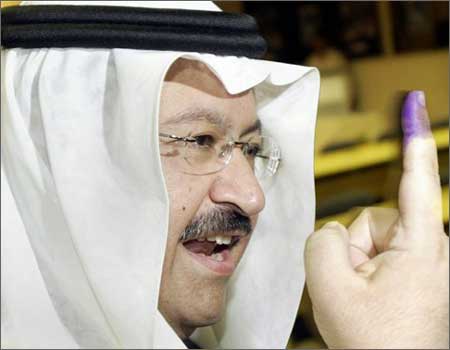
    Interim Iraqi President Ghazi al-Yawer holds up an ink-stained finger as evidence that he voted.

    Iraqis, mostly women, wait to vote in Shiite Sadr City.

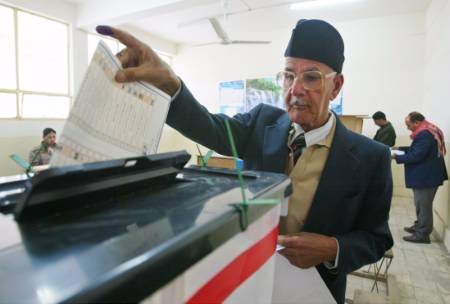
    Another Baghdad voter casts his first free ballot.

    As for the bloodbath promised by the terrorists? Well, it has yet to develop. At this time, it is almost noon in Iraq and the news is of three suicide bombings and a small handful of mortar attacks. With over 5,000 pollings sites, that’s pretty meek compared to the threats, though the day is young.

  • Israel Eyes Iran Nuke Threat

    Israel, obviously facing the greatest threat from a nuclear-armed Iran, is on the verge of drawing a line in the sand.

    Israeli Defense Minister Shaul Mofaz has told French lawmakers that Iran is at “the point of no-return” on building nuclear weapons, according to a transcript of his remarks to the National Assembly.

    Mofaz, who warned openly in London this week that Iran would not be permitted to build a nuclear bomb, has in the past said that Israel has operational plans in place for a strike against Iranian targets.

    Mofaz told the French National Assembly’s defense commission that “he ardently hoped that a recourse to military action would not be necessary” in Iran, according the transcript of the Tuesday meeting.

    But he said that to avoid this, there would have to be careful inspections aimed at removing any ambiguity about the existence of a military nuclear project.

    Even if Iran recognized Israel’s existence, Mofaz said “the possession of a nuclear weapon by an extremist regime is not acceptable.”

    “The danger is great,” he said. “The possession of non-conventional weapons could allow Iran to carry out terrorist actions with complete impunity and destabilize the free world.”

    Iran’s Revolutionary Guards warned earlier this week that any attack against the country would be met with an “astonishing” retaliation.

    The last portion about retaliation against a possible Israeli strike is not just idle bluster. That Iran has missiles that can reach Israel and could wage a vicious terrorism campaign against the Jewish state are a certainty; Israel would have to weigh these against the level of danger based on Iran’s feared nuclear capabilities. Desperation would indeed have to be the decisive factor. This is multiplied by the complexity and difficulty behind any Israeli move — this would be no raid on Osiraq. The Iranian nuclear facilities are said to be dispersed and would be assuredly better protected.

  • Damned If You Do (Vote), Damned If You Don’t

    I’ve blogged many times about the attempts to block the pending elections by the terrorists in Iraq. Election officials have been offed, polling places threatened, potential voters warned of death or religious condemnation. The USA Today has a story of some campaign literature meant to add to the intimidation.

    It’s just a scrap of white paper, a piece of a poor-quality photocopy slipped under the gates of homes in the al-Salam area of western Baghdad. But it and thousands of others like it could have a profound effect on Sunday’s elections.

    “God’s curse on this comedy named elections, this dirty game that serves the occupier and his bastards,” the note says, echoing the threats of the Sunni Muslim militants who lead the anti-American insurgency. “Be away from them and save your life. Being part in the dirty elections is considered a crime against religion, Iraq and the Iraqi people. Don’t participate in elections. All polls will be hit.”

    Okay, we already knew where the terrorists, Saddamists and many Sunnis, who fear the loss of decades-long power because of their status as a minority, stand on the election. Well, there’s a little twist to this story.

    The notes slipped under doors and threats scrawled on walls send a chilling message. Most are intended to scare people away from the polls, which is the aim of the Sunni-led insurgency. But Shiites may have also entered the fray. A note that was distributed in a Baghdad neighborhood recently threatens people if they don’t vote.

    “In order for you to avoid doomed death and the hell for a while, we have decided to give you the last chance for forgiveness for your children’s sake,” the note says. “You must raise a white flag on the roof of your houses and must go on polling day to the polling center to vote for anybody.”

    And you thought the Americans had a problem with negative campaigning.

  • Suspected Islamists held in Paris

    The French have detained several apparent Islamist terrorist wannabes before they could make their way to Iraq.

    A total of 11 suspected Islamic militants have been detained in Paris this week by intelligence agents who believe they have foiled an operation to send volunteers to fight against the US army in Iraq, officials said.

    Four young men arrested early yesterday were being held at the headquarters of the domestic intelligence service DST, along with six of the seven people detained on Monday in an high-immigration neighborhood in the northeast of the capital.

    One of two women detained on Monday was released yesterday morning, police said.

    The identities of the detainees were not disclosed, but officials said that eight of the nine men — all aged between 20 and 24 — were of north African, mainly Algerian, origin with French nationality and all born in Paris. The other was a French convert to Islam.

    They were arrested as part of an anti-terrorist investigation launched last September after evidence emerged of a so-called “Iraqi network” recruiting Islamic militants to fight US forces there.

    One of those held is considered by police to be a recruiter of young men willing to fight in Iraq. He was described as the brother-in-law of a a member of a terrorist group which was dismantled on the eve of the 1998 football World Cup which France hosted.

    Two of his charges were said to be on the point of leaving for Iraq.

    […]

    “At the moment it would be wrong to speak of organised networks like there were with Afghanistan,” said a senior official.

    “But we are determined to stop young people going to make jihad in Iraq because if they come back they will have greatly enhanced prestige, and be in a position to recruit more people to the cause — or even mount terrorist operations,” he said on condition of anonymity.

    Couple this with the recent bust in Germany of two suspected al-Qaida members and tell me Europe doesn’t have a problem. It seems, however, that the Euros are only willing to treat the symptoms rather than actually tackling the disease.

  • Bloody Day for Military Helicopters

    Weather Suspected in Deadly Marines Crash

    A top U.S. general said Wednesday there was severe weather at the site of a U.S. Marine helicopter crash in of western Iraq and that he had no reports of enemy fire in the area. President Bush expressed sorrow at the loss of life and said he knew Americans would find the new deaths discouraging.

    […]

    Lt. Gen. John Sattler, the top Marine commander in Iraq, said in a videotaped statement from his headquarters in Fallujah, west of Baghdad, that 30 Marines and one Navy sailor were killed. He made no mention of a possible cause and said a recovery team was at the crash site.

    Sattler identified the aircraft as a CH-53E Super Stallion, which is the largest helicopter in the American military. He provided no details about the circumstances of the crash; he said the victims were members of the 3rd Marine Aircract Wing and 1st Marine Division but was not more specific.

    Vietnamese Helicopter Crashes; 16 Dead

    A Vietnamese military helicopter crashed in northern Vietnam shortly after takeoff, killing all 16 people aboard, officials said Thursday.

    A loud explosion was heard just minutes after the Russian-made helicopter took off from Me Island off the coast of Thanh Hoa province Wednesday afternoon, officials of Nghe An province said.

    The bodies of three crew members and 13 military officers, including the commander of Military Zone 4 based in Nghe An and his deputy, have been recovered.

    The military is investigating the cause of the crash.

    The military is a dangerous business, even when bullets aren’t flying. My best wishes to the families.

  • Democracy a Chance to Divide Iraq’s Insurgency

    Holy crap, it appears the USA Today pretty much agrees with my interpretation of the latest alleged Abu Musab al-Zarqawi tape — that it is a statement of fear of democracy. To go one further, they spell out their idea of a way to use democracy as a wedge between foreign terrorists like al-Zarqawi and the Iraqis working with them.

    A week before Sunday’s scheduled elections, perhaps inadvertently, al-Qaeda terrorist Abu Musab al-Zarqawi revealed one weakness the United States can exploit. A taped audio message attributed to Zarqawi declared a “fierce war” on “this evil principle of democracy,” threatening everyone associated with the elections, from voters to poll workers to candidates.

    A group of Sunni Arab leaders in Iraq soon provided an equally revealing response. They said they would get involved in politics and in shaping a future constitution — despite encouraging Sunnis to boycott the elections.

    The Sunni leaders aren’t, of course, insurgents. But they helped expose a divide between foreign and Iraqi insurgents. Zarqawi and Iraq’s Sunni insurgents have joined forces to fight a common enemy: the U.S. occupiers. Over the long term, however, they have very different goals.

    Zarqawi has natural appeal to bin Laden fundamentalists who want to bring Taliban-style rule to the Middle East. The idea of democracy — man’s law against Allah’s — has long been an abomination to them.

    But that path is not one that would appeal to most Sunnis in Iraq. In polls last year, most favored some kind of representative government, with just an Islamic flavor.

    That distinction is useful in finding ways to fight the insurgency. Most Iraqi Sunnis, as the politicians’ statements showed, are mainly worried about losing the political clout they enjoyed for decades under fellow Sunni Saddam Hussein and his predecessors, despite making up less than 20% of Iraq’s population.

    But enough to opt for the kind of Dark Ages followers of Osama bin Laden aspire to? Not likely, given the kind of middle-class secular lives most have lived.

    No insurgency — Maoist guerrillas, Algerians fighting French rule or Vietnamese trying to rout Americans — can parlay military inferiority into advantage without maintaining support among local populations.

    Go give it a read.

  • Zarqawi’s ‘Most Lethal’ Lt. Nabbed

    There was a wealth of good news out of Iraq today.

    Iraqi security forces have arrested the “most lethal” top lieutenant of al Qaeda’s leader in Iraq — a man allegedly behind 75 percent of the car bombings in Baghdad since the U.S.-led invasion, the prime minister’s office said Monday.

    Sami Mohammed Ali Said al-Jaaf, also known as Abu Omar al-Kurdi, was arrested during a Jan. 15 raid in Baghdad, a government statement said Monday. Two other militants linked to Jordanian-born Abu Musab al-Zarqawi’s terror group also have been arrested, authorities announced Monday.

    Al-Jaaf was “the most lethal of Abu Musab al-Zarqawi’s lieutenants,” the statement said.

    […]

    Al-Jaaf was responsible for 32 car bombing attacks that killed hundreds of Iraqis, the statement said.

    “Abu Omar al-Kurdi claims responsibility for some of the most ruthless attacks on Iraqi police forces and police stations,” said Thaer al-Naqib, spokesman for interim Prime Minister Ayad Allawi.

    The statement said al-Jaaf “confessed to building approximately 75 percent of the car bombs used in attacks in Baghdad since March 2003,” al-Naqib said.

    Authorities also announced Monday that Iraqi security forces had arrested a man described as the chief of al-Zarqawi’s propaganda operations.

    And in the northern city of Mosul, Iraqi forces seized one of al-Zarqawi’s weapons suppliers.

    Excellent.

  • Purported al-Zarqawi Tape: Democracy a Lie

    I have previously written that the greatest enemies of the blood-drenched Islamist bastards are democracy and freedom, which is why they are desperately struggling and murdering to hold back the tide of time in Iraq. Don’t agree with me? Well, check out their own words on the matter.

    An Internet recording claiming to be from wanted terrorist Abu Musab al-Zarqawi condemned democracy as “the big American lie” on Sunday and said participants in Iraq’s January 30 election are enemies of Islam.

    The authenticity of the message could not immediately be confirmed by CNN.

    “We have declared a bitter war against democracy and all those who seek to enact it,” said the speaker in the 35-minute message.

    “Democracy is also based on the right to choose your religion,” he said, and that is “against the rule of God.”

    […]

    The speaker attacked the Iraqi interim government as a tool used by the “Americans to promote this lie that is called democracy … You have to be careful of the enemy’s plots that involve applying democracy in your country and confront these plots, because they only want to do so to … give the rejectionists the rule of Iraq. And after fighting the Baathists … and the Sunnis, they will spread their insidious beliefs, and Baghdad and all the Sunni areas will become Shiite. Even now, the signs of infidelity and polytheism are on the rise.”

    […]

    “Oh, people of Iraq, where is your honor?” he asked. “Have you accepted oppression of the crusader harlots … and the rejectionist pigs?”

    “For all these issues, we declared war against, and whoever helps promote this and all those candidates, as well as the voters, are also part of this, and are considered enemies of God,” the tape said.

    These terrorists cannot win a battle of ideas. By definition, their only true weapon is fear — it is the needed ingredient in how they “fight” and how they rule when empowered. They ask for honor from others yet exhibit none themselves. Their leader squawks of bitter war but tucks his tail and runs from Fallujah, choosing instead to hide and occasionally surface bravely on the internet.