Category: Middle East

  • Israel Paints Colorful West Bank Base

    Well, this certainly won’t be all the drab buildings I knew from Ft. Hood and Ft. Knox.

    A new army base going up in the northern part of the West Bank will be Israel’s most colorful, painted in a dazzling array of pink, brown, purple, light blue and orange, an army weekly reported.

    The current edition of “Bamahane,” a publication for soldiers, carries a small picture of the Jalameh base, going up near the Palestinian town of Jenin. It shows the stark structure of two-story cement blocks joined at right angles painted in eye-popping shades of orange and pink.

    “I’m sick of seeing the ugly and depressing colors of military buildings — always beige and gray,” the officer behind the artsy project, Capt. Itsik Koren, told the weekly. “I decided to do something different here.”

    The base is expected to be ready in two months. It will be home to a variety of units involved in Israel’s occupation of the West Bank, including infantry, roadblock guards, canine corps and field intelligence.

    The picture shows the base under construction on typically rocky, barren West Bank land, but Koren told the weekly that this too, will change. He plans to plant trees around the base.

    Israel is set to remove its four Jewish settlements from the northern West Bank next summer, but construction of the $5.76 million base, with its elaborate color scheme and landscaping, shows that the army is not planning to pull its forces out of the area anytime soon.

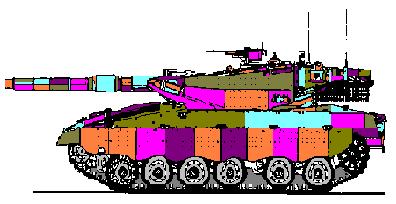
    Rather than look for pictures of the base, I’ve decided to envision this color scheme applied elsewhere, such as the fine Israeli Merkava Mk-3:

    So, what do you think?

  • Iraq Election Update: Sunnis and Powell and Osama

    Oh my!

    First, the Sunnis:

    Iraq’s Top Sunni Party Withdraws from Jan. Election

    Iraq’s top Sunni Muslim party said Monday it was withdrawing from Jan. 30 elections because relentless bloodshed would keep people from voting in the long dominant Sunni north and west.

    “The Iraqi Islamic Party is withdrawing from the elections because we do not think the situation will improve in the next few weeks to give conditions for credible elections,” party Secretary-General Tareq al-Hashimi said.

    Persistent violence in Sunni Arab cities, most of which are under curfew, has raised fears that voters there will be too intimidated to cast their ballots, skewing the poll in favor of Iraq’s 60-percent Shi’ite Muslim majority.

    The Islamic Party’s list of 275 candidates would still appear on ballot papers which were already being printed, a spokesman for Iraq’s Electoral Commission told Reuters.

    Farid Ayar said the Commission had received no formal request for withdrawal, but if it does, any votes cast for the Iraqi Islamic Party would be considered “invalid.”

    The leading mainstream Sunni religious party, along with at least 16 other Sunni and secular parties, had threatened to boycott the poll unless it was postponed by up to six months to ensure that voters across the country could take part.

    But most, including the Islamic Party itself, later fielded lists of candidates for the poll to elect a 275-seat National Assembly that will draft a constitution and appoint a cabinet.

    Counter this with Secretary Powell:

    Powell Says Next Iraqi Government Should Assure Sunni Representation

    U.S. Secretary of State Colin Powell says the transitional Iraqi government to be set up after next month’s elections will have to “find a way” to assure that Sunni Muslims are fairly represented. U.S. officials are concerned that the insurgency and a poor turnout by Sunnis could largely exclude them from a new national assembly.

    Mr. Powell says there is no provision in Iraq’s Transitional Administrative Law for handing Sunnis seats in the new national assembly that they don’t win in the January 30 election.

    But he is making clear the Bush administration’s view that Sunnis should have an adequate role in the new government that will be chosen by the assembly.

    ….

    At a news conference here, Mr. Powell said the law provides only for the direct election of legislators, but that the government they choose should reflect the religious and ethnic makeup of the country:

    “I think that for the government to be representative, and for the government to be effective, the transitional national assembly would certainly have to take into account the ethnic mix of the country, and find a way to make sure that all segments of the country believe that they are playing a proper role in the government. That’s the way the Iraqi Interim Government was formed and the current ministries operate, and it would seem to me to be sensible for the transitional government to do the same thing,” Mr. Powell says.

    Iraq’s Shiites, who make up about 60 per cent of the population and were largely denied power under Saddam Hussein, are energetically campaigning in the elections.

    ….

    Mr. Powell said having the election as scheduled January 30, with maximum participation, is essential. He said the United States is encouraging Sunnis to join in the effort, and to, in his words, “say no to terrorism, no to murder, and yes to democracy.”

    He said as part of that effort, the United States is talking to other Arab governments, urging them to encourage Iraqi Sunni leaders to turn out the vote.

    And then there’s the sonofabitch bin Laden:

    Osama Bid to Hijack Vote

    Terror chief Osama Bin Laden has made a blatant bid to destroy Iraq’s elections.

    In a chilling audiotape broadcast yesterday, the al-Qaeda leader urged all Iraqi Muslims to boycott the poll on January 30.

    Bin Laden also said he was PLEASED with the “gallant work” of evil terror chief Abu Musab al-Zarqawi — the man responsible for beheading 62-year-old British hostage Ken Bigley.

    The tape was aired by Arab satellite station Al-Jazeera and the voice seemed to be Bin Laden’s.

    He tells Iraqis: “This constitution is infidel and therefore everyone who participates in this election will be considered infidels.

    “Beware of henchmen who speak in the name of Islamic parties and urge people to participate in the election.”

    Bin Laden goes on to describe al-Zarqawi as the “emir of al-Qaeda in Iraq” and urges Muslims there “to listen to him”.

    Jordanian al-Zarqawi and his henchmen are responsible for numerous car bombings and beheadings of foreign hostages.

    If Osama’s recent releases are anything to judge by, there are two things he is concerned for — his life and his movement. These concerns are driven by two fears, and those are President Bush and progress towards a return to civilization by the world of Islam. He tried but failed to sway the U.S. to reject Bush, and now he is working to persuade the Iraqi people to reject democracy. Osama knows all too well that a free and prosperous society, even in a Moslem nation, will not willingly turn back the clock the centuries his beliefs require. Instead, such a society could potentially shine like the Lighthouse of Alexandria to the surrounding peoples. This could be more of an end of Osama than his death ever could be.
  • Iraq May Set Aside Seats for Sunnis

    It is important that the January elections go forward, and every terroristic action stresses this importance. That said, ideally the results of the elections would represent the will of the Iraqi people. With the election scheduled for a little over a month away, possibilities are still being considered to counter those working for the Saddamist past or an Islamist alternative future, including this.

    Iraq’s electoral commission is considering setting aside seats in the country’s national assembly for Sunni Arab politicians and other groups if their supporters don’t vote in the country’s Jan. 30 elections for fear of attacks by insurgents, a U.S. official said Sunday.

    Authorities are looking to counter the effects of threats by insurgents, who have vowed to attack voters and polling stations, said Marine Maj. Jim West, intelligence operations officer for the 1st Marine Expeditionary Force in Fallujah.

    The prospect of attacks and intimidation has led some Iraqis, especially in Sunni areas west of Baghdad, to say they’re too afraid to vote. Particularly at issue is the Sunni-dominated Anbar province, where the insurgents are strong.

    “They’re trying to find out several different courses of action to ensure that the Sunni population is not disenfranchised from the government,” West said. “That is to ensure that even if the insurgents are able to stop the election process in one area, that these people will still be represented.”

    The New York Times first reported the idea in its Sunday editions, citing an anonymous western diplomat who said the option had been presented to an aide to Grand Ayatollah Ali al-Sistani, an influential Shiite cleric who has urged Shiites to take part in the vote.

    Shiites comprise about 60 percent of Iraq’s population, with Kurds and Sunni Arabs making up 20 percent each. Some American and Iraqi leaders fear the legitimacy of the election would be jeopardized if Sunnis don’t vote.

    West said the electoral commission was particularly worried about the Anbar province, which includes the restive cities of Ramadi and Fallujah. He stressed that it was up to Iraq’s electoral commission and government to decide how to handle the vote, and the idea was one of many the interim Iraqi government was considering.

    Fallujah was emptied before a U.S.-led invasion that began Nov. 8 to root out the insurgents who had overrun the city. The government allowed people to start returning to some neighborhoods in the devastated city days ago as part of their bid to get Fallujah resettled for the vote.

    West said Iraqi leaders were still working to ensure that all major population centers take part in the vote. He said American and Iraqi officials had talked about the 1st Marine Expeditionary force helping with security by giving local officials intelligence information, setting up cordons and “outer security,” and providing more training to make sure polling places are safe.

    The United States does not want to have a visible presence at polling stations for fear that people would see the vote as an American, not Iraqi, process.

    “It’s an Iraqi election and the Iraqis need to conduct this election and want to conduct this election on their own,” West said. “We’re willing to help however they would like our help but we are not trying to get more involved by any means more than what they feel like they need.”

    West also said people in Fallujah need not register beforehand. Many Iraqis are on population lists compiled for a rationing system worked out under the U.N. oil-for-food program, and he said people could become eligible to vote by showing up on polling day and validating their name on those lists.

    I have little, if any, initial objections to such a move. The vote has to go forward to get the government into Iraqi hands and I’m not afraid of little hurdles that allow this. I’ll mull it over a bit while the situation develops, but the Iraqi people need to get their hands on a say in their government and their country’s direction. That is the best hope for their future.

  • Yemeni Youths Seeking Martyrdom in Iraq

    Looking for evidence of foreign involvement in Iraq’s troubles? There’s this pathetic tale.

    For weeks, Mohammed Ahmed Abdul-Rahman could only wonder where his son had gone. Then the mystery was solved in a will.

    “I am in Iraq, seeking martyrdom. I hope we are all forgiven,” Abdul-Rahman quoted his son’s will as reading, saying in a weekend interview that an unknown caller from Jordan had told him how to find the document three weeks after 20-year-old Hossam Abdul-Rahman vanished in September. He said he doesn’t know whether his son is dead.

    While only a few cases of Yemenis going to Iraq to fight have been documented, security officials say they are keeping a close eye on travelers leaving this country at the tip of the Arabian peninsula, where Islamic teaching is strong.

    Abdul-Rahman has taken the rare step of going public with his story, and is accusing Islamic extremists of brainwashing his university son.

    Although its government supports the U.S.-led war on terror, Yemen has long been a center of Islamic militancy, and has suffered several attacks and bombings in recent years. The security officials say they are trying to determine whether Yemeni individuals or groups were financing trips to Iraq or helping with travel logistics.

    A group of Yemeni clerics recently endorsed a call by 26 Saudi religious leaders to support the insurgency in Iraq, saying the attacks on U.S.-led forces are a legitimate form of resistance.

    An Islamic activist in the capital said that while he was not aware of any direct attempts by Islamic groups to recruit Yemeni fighters to go to Iraq, he was supportive of such travel.

    “I support it, because it is a duty. They are going to fight occupiers of Arab and Muslim land,” said Ali al-Kurdi. “Any Muslim who is hesitant in helping Iraqis is a sinner.”

    He said recent reports in the local media have encouraged others to make the trip.

    According to figures compiled by The Associated Press, there have been at least 12 cases of Yemeni men who have made their way into Iraq. The security officials said that three people suspected of trying to join the insurgency in Iraq were detained at the airport. Others are reported to have died in Iraq.

    Authorities watching for travelers to Iraq are focusing on those leaving for Syria and Jordan, security officials said. Yemenis don’t need visas to travel to either country, which both neighbor Iraq.

    Sadly, some could read this and still believe the war against radical Islamic terror should solely be about Osama bin Laden.

  • Israel to Boycott Blair’s Peace Conference

    As I read this story, I did not understand the usage of the word “boycott” and its negative connotations in the story’s headline.

    Tony Blair will take on the role of go-between for the Israelis and Palestinians as he tries to keep up the momentum of the Middle East peace process on a two-day visit to the region starting today.

    Meanwhile, the Israeli Prime Minister, Ariel Sharon announced yesterday that Israel would not attend the Middle East conference Mr Blair plans to host in London after next month’s Palestinian presidential election. The conference is due to discuss how the Palestinian Authority can meet its obligations under the internationally backed road map to peace.

    As Mr Blair prepared for a flying visit to Jerusalem and Ramallah, British diplomats received the news of Mr Sharon’s announcement with equanimity. It was seen as a logical outcome of preliminary talks last week between Israeli leaders and Sir Nigel Sheinwald, the Prime Minister’s senior foreign affairs adviser.

    “Mr Sharon’s decision neither surprises me nor disturbs me,” an official at the British embassy in Tel Aviv told The Independent. “It indicates an understanding on the part of the Israeli government of the purpose and scope of the London conference. It was always our intention that it should be a conference preparing the Palestinians for the day after Israel disengages from Gaza.”

    The summit will be attended by foreign ministers of donor countries and representatives of the quartet that drafted the road map – the United States, the European Union, Russia and the United Nations.

    Neither Israel nor Britain wanted to turn the road map into an alternative political initiative. They feared that Israeli participation would change the emphasis, which is meant to be on Palestinian democratisation, economic reform and reconstruction under a new leadership.

    A senior source in Mr Sharon’s office said that the Israeli decision had been co-ordinated with Downing Street in an extensive exchange of letters. “We support this conference,” he said, “but we see no purpose for us to participate. It’s between the Palestinians and the donor countries.” The Prime Minister will promise Israel that it will not be “bounced” into premature final-status negotiations before it is ready or before the emergence of a moderate Palestinian leadership committed to making political progress.

    At the same time, Mr Blair will offer to help the Palestinians to “fill the vacuum” when Israel implements Mr Sharon’s plan to withdraw more than 7,000 settlers from Gaza. His talks with the Palestinians will cover assistance on security, political reform and economic infrastructure. Mr Blair hopes these proposals will reassure Israel and the US that the Palestinians have a credible, non-militant leadership.

    The British say the Israelis aren’t needed. The Israelis agree, and even expressed support for the conference. So why call it a boycott?

    The press continues looking for a problem.

    Asked whether the timing of Mr Sharon’s announcement – during a meeting yesterday with the Czech Foreign Minister, Cyril Svoboda, might be seen as a snub to Mr Blair, he replied: “We decided to publicise the content of the letters in order to dispel all the rumours and misconceptions circulating about the purpose and scope of the conference.”

    Still no problem. So, why the headline? Well, there is this bit.

    No one, however, seems to have told the Palestinians. Saeb Erakat, their chief negotiator, denounced Mr Sharon’s decision as “very unfortunate”. The Palestinians, he said, believed a conference was the best way to restart peace talks. “We want to focus on reviving the peace process and resuming permanent status negotiations,” he said.

    So, it’s an Israeli boycott, as the press decides to shun the British and Israeli stances and view the matter through the eyes of the Palestinians. Very telling but not very surprising.

  • 50 Held for Iraq Blasts

    In a fast reaction to yesterday’s bombings, Iraqi authorities have rounded up 50 suspects, including some said to be rather unusual.

    Iraqi authorities detained 50 suspects in connection with an explosion in the Shia holy city of Najaf that killed at least 54 people and wounded 142, and thousands of mourners attended funerals for the victims on Monday.

    Najaf police chief Ghalib al-Jazaari said those arrested included “elements” who had allegedly confessed to having links with the intelligence services of neighbouring Syria and Iran.

    This is no proof positive of the oft-denied involvement of Iraq’s neighbors in the country’s struggles. However, the circumstantial evidence mounts, providing more and more support to the obvious conclusion.

  • 62 Die in Iraq Car Bomb Blasts

    It was a bloodier-than-usual day in Iraq as the terrorists desperately work to stave off the pending elections.

    Suicide car bombers struck Iraq’s two main Shi’ite holy cities of Najaf and Karbala yesterday, killing at least 62 people and wounding nearly 130, six weeks before a historic election.

    Both bombs, which went off about two hours apart, exploded near crowded bus stations in a seemingly co-ordinated attempt to cause as much bloodshed as possible among Shi’ites, a long-oppressed majority expected to dominate the January 30 vote.

    Earlier in Baghdad, gunmen killed three Electoral Commission employees after hauling them from a car on a busy street.

    In Najaf, the suicide bomber detonated his vehicle about 300 metres from the Imam Ali shrine, near crowds of people queuing for buses and taxis and not far from busy offices.

    Medical officials said there were at least 48 dead and 90 wounded in the blast. Police imposed a curfew in Najaf’s old city.

    In Karbala, where a suicide bomber stuck about two hours earlier, the main hospital said 14 people were killed and 39 wounded. A hospital official said all appeared to be civilians with many women and children among them.

    In an unrelated occurrence, I’ve just about finished my Christmas shopping.

  • Hamas, Jihad Slam Abbas Call to End Armed Attacks

    Palestinian terrorists are dissing PLO chairman and interim terrorist-in-chief Mahmoud Abbas as not being enough of a terrorist.

    Hamas and Islamic Jihad on Wednesday dismissed PLO chairman Mahmoud Abbas’s call for an end to armed attacks, saying such statements don’t serve the interests of the Palestinians.

    Farouk Kaddoumi, who has replaced Yasser Arafat as chairman of the Fatah Central Committee, also rejected Abbas’s call, saying there would be no cessation of violence until Israel withdraws to the pre-1967 borders.

    Trust me, even a withdrawal to pre-Six-Day-War borders would not bring peace to the Palestinians and Israelis. Instead, it would only bring about a fixation on the next excuse for murder, probably the right of return. The problem is not Israel’s borders but its existence.

    In an interview with the pan-Arab London-based daily Asharq al-Awsat published on Tuesday, Abbas called for an end to violence against Israel.

    “The intifada should be kept away from arms because it is a legitimate right of the people to express their rejection of the occupation by popular and social means,” he said.

    “The use of arms has been damaging and should end,” Abbas added.

    Abbas, who arrived in Qatar on Wednesday, suggested that some people might have misunderstood his comments.

    “All I meant is that we, at this stage, are against the militarization of the intifada because we want to negotiate,” he told reporters shortly before leaving Saudi Arabia on his way to Qatar. “And because we want to negotiate, the atmosphere should be calm in preparation for political action.”

    Abbas said the Palestinian Authority wants to “stop the military aspect of the intifada, especially by Hamas and Islamic Jihad, in order to achieve our objective of a Palestinian state with Jerusalem as its capital and a just settlement for the refugee problem.” He said the PLO is working towards achieving an agreement with all the Palestinian factions leading to a cease-fire and Israel’s withdrawal from Palestinian cities and villages.

    The PA-controlled media highlighted Abbas’s interview with Asharq al-Awsat, but did not comment on his statements. PA officials in Ramallah also refused to comment on his remarks, noting that Abbas had simply reiterated his long-standing position that the Palestinians had made a mistake by resorting to terrorism over the past four years.

    Of course the terrorism of the Intifada was a mistake if the goals were independence and prosperity for the Palestinian people. With Arafat pulling the strings, however, those were never the goals.

    Also, note that even Abbas calls for Israeli concessions on two of the key sticking points, a Palestinian capital in Jerusalem and the refugee problem (code for right of return).

    Hamas spokesman Sami Abu Zuhari said Abbas’s remarks are in contravention of the Palestinian consensus over the legitimacy of the “resistance.” “The problem is the occupation and not the resistance,” he said.

    Asked if his movement would agree to lay down its weapons, Abu Zuhari said “We hope that any dispute [over this] would be solved through negotiations between the Palestinian Authority and the Palestinian factions,” he added. Otherwise, he warned, there could be a clash between the Palestinian Authority and Hamas.

    Muhammad al-Hindi, a senior Islamic Jihad leader in the Gaza Strip, also rejected Abbas’s statements against the militarization of the intifada. “The resistance groups have the right to keep their weapons and to strengthen themselves as long as the Israeli occupation and the aggression continue,” he said.

    Hindi too stressed that his group would nevertheless avoid a confrontation with the PA and said the two sides should resort to dialogue to solve their differences.

    It should be quite obvious from these statements that neither Hamas nor Islamic Jihad recognize the authority of the Palestinian Authority, demanding to be negotiated with as equals.

    The Palestinians have spent decades twisting entire generations of children. Is it any surprise that no Palestinian with any real voice is speaking of the concept of peacefully promoting their own people?

  • U.S. Fears Iranian Influence in Iraqi Elections

    The Iranians, along with the Syrians, have been promoting and assisting the instability in Iraq, knowing the danger of a successful democracy next door. Now, it seems that Iran is also working on an insurance plan — pouring people and resources into Iraq to influence the elections they seem unable to stop.

    Kicking off his country’s first democratic election campaign Wednesday, Interim Prime Minister Ayad Allawi declared his own candidacy, saying the country can handle the challenge.

    But as Iraqis register to vote, the United States worries that the real winners could be the ayatollahs in neighboring Iran. U.S. intelligence sources tell NBC News that 1 million Iranians have already poured across the border to register to vote in Iraq. And Iran is spending as much as $100 million to elect its favored slate of candidates in Iraq — and may have thousands of spies in Iraq.

    “They’re putting money into Iraq,” says Danielle Pletka, an Iraq expert at the American Enterprise Institute. “They’re promoting candidates. They’re sponsoring terrorist groups that are pressuring people in Iraq. They’re doing everything they can.”

    And while Iraq’s defense minister warned Wednesday that both Iran and Syria are cooperating with Iraq’s No. 1 terrorist — Abu Musab al-Zarqawi — the United States has no proof of that.

    On Wednesday, President Bush, after a White House meeting with Italian Prime Minister Silvio Berlusconi, told Iran and Syria to stay out.

    “We will continue to make it clear to both Syria and Iran — as will other nations in our coalition, including our friend, the Italians, that meddling in the internal affairs of Iraq is not in their interest,” said the president.

    But, it is not clear what the United States can do.

    The United States says Iran is funding the leading Shiite candidate Abdul Aziz al-Hakim, who is expected to emerge as the country’s most powerful figure. A new Shiite government could oppose controversial military operations, like Fallujah, or even demand a rapid U.S. withdrawal.

    “I think we have to accept it might not be an outcome that we particularly desire, but if it’s a free and clear election, then that’s what our policy has been all about,” says Geoffrey Kemp, an Iranian expert at the Nixon Center.

    U.S. officials hope that Iraqi voters will resist Iran’s influence and remember that less than 20 years ago, Iran was their enemy in a brutal war.

    The rulers in Iran know they are sitting on a powderkeg next to an open flame. A sizable and restless portion of their country’s population stirs with a desire for democracy. The thought of a successful democracy taking root in neighboring Iraq without strong Iranian influence could only mean a growing threat of instability at home.

  • ‘Hitler Figure’ Could Rise from Iraq’s Instability

    Okay, wrapping up the flood of quick-hits for the night with this.

    The Iraqi president, Ghazi Yawar, yesterday warned that long-term instability in his country could give rise to an “Iraqi Hitler” if citizens continued to feel humiliated and despondent.

    Mr. Yawar also criticised the US-led coalition for dismantling Iraq’s security services too soon after the war and accused neighbouring states of doing nothing to stop the insurgency.

    Agreed, but it’s nice to see that this guy shares the trait of 20/20 hindsight with John Kerry, the former presidential candidate and occasional senator.

    The Iraqi president said bombings and kidnappings had plagued the country since last year’s invasion toppled Saddam Hussein, while the relentless Sunni-led insurgency had crippled reconstruction and development projects.

    “This could in the long term create an environment in which an Iraqi Hitler could emerge like the one created by the defeat of Germany and the humiliation of Germans in the First World War,” Mr Yawar said in an interview with the London-based newspaper Asharq al-Awsat.

    Perhaps we should round up any corporals who fought in the first Gulf War.

    Iraq’s interim leaders have come under fire for failing to reach out to some alienated factions and US-led offensives on rebel-held cities have led to further divisions.

    Mr Yawar — a Sunni Muslim who was chosen for the largely symbolic post of president in June — urged Iraq’s neighbours to break their “negative silence” about attacks in Iraq and play a positive role in helping stabilise the country.

    “When a fire breaks out in your neighbour’s house you should act quickly to put it out, not only for the sake of your neighbour but also so that you are not forced to put it out in your own home when it spreads there,” he said.

    Earlier this month, Iraq and its neighbours made vague promises to improve security co-operation after a meeting in which Iraqi officials voiced frustration that neighbouring states were not doing enough to halt the flow of people, arms and funds linked to guerrilla violence in Iraq.

    Agreed, the Syrians and Iranians cast a pall on the whole neighborhood. Not that anybody else has been much help, though. How much motivation does anybody in the region have for a free, democratic Iraq? Not much without a ton more pressure applied.

    Mr Yawar has said elections should go ahead on time on 30 January. But he told the BBC yesterday that he expected more violence aimed at derailing the polls. He said the security situation could not be solved unless Iraqi forces became efficient.

    Most parties representing Sunnis have called for the elections to be postponed for up to six months, saying a fair poll could not be held amidst the violence, most of which is affecting Sunni areas.

    Mr Yawar said some former army and police officers with clean records should be reinstated, adding that Washington had made a mistake when it dissolved the defence and interior ministries.

    I’m trying to be sarcastic, but this guy is making a lot of sense.