Month: March 2006

  • Prince Charles Calls for Tolerance in Egypt

    More naivety from our Euro friends? Apparently so, this time courtesy the British crown prince.

    Britain’s Prince Charles began his visit to Egypt on Monday urging people to bridge the gap between the Western and Islamic worlds even as his own trip to Cairo’s most renowned Islamic institution courted controversy.

    “As I’m going to say at Al-Azhar university, I find my heart is incredibly heavy from all the destruction and death that occurs,” Charles told Egypt’s state-owned satellite Nile TV channel, in an interview pre-recorded in London.

    […]

    Al-Azhar’s decided to honour Charles for his conciliatory stance during the recent controversy over cartoons satirising the Prophet Mohammed, but the move has angered some of the institution’s directors.

    “All that Prince Charles did is to say that Islam is the most widespread religion in the world and that’s a reality, not a discovery made by the prince,” Al-Azhar lecturer in Arab literature Abdel Azim al-Mataanni told AFP.

    In his interview with Nile TV, Charles touched on the broad issues of attacks carried out by Islamic extremists and the recent wave of violent Muslim and Arab protest over the cartoons satirising the Prophet Mohammed.

    “I know so well from having experienced the horror of terrorism myself, in losing my beloved great-uncle Lord Mountbatten back in 1979 when he was blown up in a terrorist bomb,” Charles said, invoking the memory of his mentor killed by the IRA.

    “I do have some understanding I think, a little, of what people go through with these horrors.”

    He pleaded for people on both sides of the Muslim-West divide to find common ground and acknowledge the shared heritage of Christianity, Judaism and Islam.

    Before mentioning Judaism, perhaps Prince Charles should look around Cairo for the apparently-fashionable swastikas. Yes, that’s a sure sign of a fertile common ground.
  • Defiant Hamas Packs Cabinet with Hardliners

    Guess what. The terrorist group-become-democratic-victors of Hamas have yet to be mollified by the rigours of leadership.

    Hamas, the militant Palestinian group, has named a government dominated by its own leadership, defying international pressure and confounding hopes that it would moderate its extremist stance.
    After other Palestinian factions refused to join a coalition, the victorious Islamist group nominated a Cabinet whose senior members have all been jailed, deported and escaped Israeli assassination. Chief among Prime Minister-designate Ismail Haniya’s 24 ministers are Dr Mahmoud al-Zahar, a hardliner, as Foreign Minister, and Said Siyam as Interior Minister. Most others are Hamas, with some pro-Islamist independents and technocrats, one woman and one Christian.
    President Mahmoud Abbas is expected to approve them but may try to delay the decision until after the Israeli general election on March 28. However, Shaul Mofaz, Israel’s Defence Minister, said that if President Abbas accepted the line-up he would “officially turn the Palestinian Authority into a terror entity”. Hamas faces a cash crisis, as EU foreign ministers met in Brussels yesterday to consider how to continue providing aid to Palestinians without endorsing what is regarded as a terrorist organisation by the EU and US.

    The article describes four of the key named figures as follows:

    Prime Minister: Ismail Haniya, 43. Imprisoned by Israelis twice

    Foreign Minister: Mahmoud al-Zahar, 55. Imprisoned once by Israelis. Survived Israeli assassination attempt but lost a son. Hardliner. Hostile to Israel and the US

    Finance Minister: Omar Abdel-Razeq, 48. Arrested twice by Israel

    Interior Minister: Said Siyam, 46. Teacher. Lost job with UN relief agency over political affiliations. Member of the Hamas’s political office in Gaza In charge of foreign relations for Hamas. Jailed four times by Israelis

    Should we be surprised that Hamas has yet to turn into a bunch of Pollyannas? No, of course not. First, they have yet to really shoulder the strain of actually trying to govern the madness that fills the Palestinian regions. They did get a taste of the “society” they’re expected to lead today, as Palestinian gunmen engaged in multiple firefights. Strangely, these violent outbursts of cordite involved no Israelis.

    Unfortunately, some of the immediate pressure of governing was alleviated from Hamas as the European Union agreed to a release of $78 million in emergency aid. Luckily, that largesse was accompanied with the oh-so-stern warning that Hamas must play nice.

    In Brussels on Monday, EU external relations commissioner Benita Ferrero-Waldner handed a cheque for 64m euros to Karen AbuZayed, of the UN Relief and Works Agency (UNRWA).

    She was insistent that Hamas, which has refused to recognise Israel or renounce violence, needs to fall into line with the international community.

    Hamas immediately buckled. No, wait, they actually took the money and thumbed their nose at their naive benefactors.

    A Hamas spokesman, Salah Bardawil, said the group recognised that the PA faced economic difficulties.

    “But we will not go begging to the United States and Europe because we will not be blackmailed over our political positions,” he said.

    He said Hamas, an Islamic organisation, would seek new funding from the Islamic world.

    Ah, sweet progress toward peace. I do, however, look forward to the times when Hamas does actually try to govern the mess it has played no small part in creating. If only fools would quit enabling Hamas and actually force them to confront the consequences of their positions.

  • Belarus President Faces Challenge from Protesters

    After victory in an election that the U.S. has decidedly declared “invalid,” the president of Belarus is trying to ride out a swarm of protests.

    Belarussian President Alexander Lukashenko faced a challenge to his electoral victory on Tuesday from international critics and protesters who camped out in the capital overnight accusing him of rigging the count.

    Lukashenko, in power since 1994 and criticized in the West for authoritarian Soviet-style rule, swept back into office on Monday with an official tally of 82.6 percent.

    Nearest rival Alexander Milinkevich, with 6 percent, called the poll fraudulent, a view shared widely in the West.

    About 300 protesters defied warnings by Lukashenko’s state security services and camped out in the early hours in dozens of tents in an action reminiscent of the highly organized 2004 “Orange Revolution” in Ukraine.

    Supporters brought sleeping bags, food, hot drinks and blankets to them.

    Witnesses said riot police were stationed in sidestreets near the square but there was no sign of any action against the unsanctioned rally, summoned by Milinkevich to demand a rerun of the election and denounce Lukashenko’s human rights policies.

    “We must stay here while we have the strength to do so. We must stay until victory,” Milinkevich told the rally on Monday.

    Unsurprisingly, Publius Pundit‘s Robert Mayer comes through with some of the best blogging on the region, this time providing lengthy and oft-updated coverage of the protest.

  • From the Blogroll

    I’m not in the mood for more tonight. As such, I would instead like to point you to a few postings from the fine members of my blogroll.

    Gateway Pundit honors the three-year anniversary of the Iraqi invasion by looking back at the predictions about the war and the global turnouts of protests on that anniversary.

    Protein Wisdom‘s Jeff Goldstein asks for help in shredding a recent “news” piece. He actually does well enough on his own, but his commenters chip in aplenty.

    TexasBestGrok‘s JohnL finally brings back some aircraft cheesecake with some sweet Raptor pics.

    Phil at Shades of Gray (finally) writes again. This time, it’s about, well, writing.

    Finally, Eric the Straight White Guy ponders on … Kiwi polish … and today’s society … and buffing brushes. Yes, I still keep and use one.

    That is all for tonight. See y’all tomorrow.

  • Aggie Hoops at the Dance: A&M Falls in Second Round’s Final Seconds

    Ah, last night brought such a heart-breaking loss, ending the Aggies’ season when they were only seconds away from the Sweet Sixteen.

    LSU calls the play “special,” and Darrel Mitchell ran it to perfection.

    With the clock running out on his team’s hopes, the Tigers’ lone senior made a long 3-pointer with 3.9 seconds remaining to give the Southeastern Conference regular-season champions a 58-57 victory over Texas A&M on Saturday in the second round of the Atlanta Region.

    […]

    The victory sends fourth-seeded LSU (25-8) to the regional semifinals against top-seed Duke (32-3) on Thursday night.

    Davis led LSU with 21 points, including a key basket in the final minute. Mitchell finished with 16.

    The Tigers seemingly were in control when Mitchell made two foul shots for a 53-46 lead with 3:31 to go. But No. 12 seed Texas A&M (22-9), in the tournament for the first time since 1987, wasn’t ready to go home.

    The Aggies wiped out the seven-point deficit over the next 91 seconds, then went ahead 55-53 on Joseph Jones’ jump hook in the lane.

    “That’s how it’s been all year. Things ain’t always going to go well for us,” Law said. “Coach always tells us to stick with it, continue to fight, continue to fight. We played a bad game. We weren’t ourselves tonight, but we continued to fight.”

    […]

    Law finished with 15 points on 5-for-16 shooting. Kavaliauskas added 12 for the Aggies.

    The Aggies were in the second round of the tournament for only the third time, and their victory over Syracuse was their first in the NCAAs since their only trip to a regional semifinal in 1980.

    Despite the loss, the Aggies clearly have a program on the rise under coach Billy Gillispie, the former Bill Self assistant who inherited a team that was winless in the Big 12 and won seven games overall two years ago.

    “This will leave a sour taste in our mouths. But it doesn’t take away from the year we had,” Law said.

    “A lot of people didn’t expect us to do what we did. We finished in fourth place and got 10 wins in the Big 12 and got our first Big 12 Tournament victory. … We had an outstanding year, but unfortunately for us, we didn’t finish out the year the way we wanted to.”

    All this just two seasons removed from an 0-16 Big 12 campaign. Yes, this is certainly a program on the rise.

    Thanks for the thrills and constant effort, Ags. I’m glad I finally got to watch my alma mater in March Madness.

  • Quote of the Week, 19 MAR 06

    You will usually find that the enemy has three courses open to him, and of these he will adopt the fourth.

    —Field Marshall Helmuth von Moltke, the Elder

  • How U.S. Assault Grabbed Global Attention

    Yesterday, I questioned a media description of Operation Swarmer as the “biggest attack since the Iraqi invasion.” Today, the media is questioning itself and finding its own coverage overblown because of a lack of understanding of American military terminology.

    It was billed by the US military as “the largest air assault operation” since the overthrow of Saddam Hussein in 2003, with attack and assault aircraft providing “aerial weapons support” for 1,500 US and Iraqi commandos moving in to clear “a suspected insurgent operating area north-east of Samarra.”

    The international news agencies immediately rang the urgent bells on the story.

    Around the world, programmes were interrupted as screens flashed the news, which dominated the global media agenda for the next 12 hours or more.

    […]

    By the middle of Day Two, the operation had already been scaled down to 900 men.

    Operation Swarmer clearly bore no comparison in scale to the initial attack which brought down Saddam Hussein’s regime, or to the massive assault on the insurgent stronghold in the city of Falluja in November 2004.

    Nor did it appear to match a series of counter-insurgency operations involving air strikes and ground forces in remote areas near the Syrian border in western Iraq last year.

    In one four-day campaign last May, the US military said it had killed 125 insurgents for the loss of nine of its own men killed and 40 injured.

    So how and why did this latest apparently routine combing operation, yielding a few arms caches and netting some low-grade suspects, manage to win stop-press coverage around the world?

    The use of the phrase “the largest air assault operation” was clearly crucial, raising visions of a massive bombing campaign.

    In fact, all the phrase meant is that more helicopters were deployed to airlift the troops into the area than in previous such operations.

    The 50 “aircraft” that had been deployed were not combat jets blasting insurgent targets, but helicopters ferrying in the forces. There was no rocketing or bombing from the sky.

    In US military parlance, “air assault” means transporting troops into a combat zone by air. It could include, but does not necessarily imply, air strikes.

    Ah yes, the media — get the story out, get it right later … maybe.

  • Six Meat March Madness Update

    Well, yesterday was good for the ol’ Gunner, as I found myself all alone in first place.

    Unfortunately, day two has been not so kind to my picks.

  • Coalition Launches Biggest Attack Since Iraq Invasion

    I’m not sold yet on the validity of that headline. Still, it it noticably the largest air assault since the end of major operations in the Iraqi theater.

    Combined American and Iraqi forces yesterday launched the largest air assault the country has seen since the US-led invasion, targeting insurgent strongholds near Baghdad.

    The US military said the offensive, dubbed Operation Swarmer, was aimed at clearing “a suspected insurgent operating area” north-east of Samarra and was expected to continue for several days.

    “More than 1,500 Iraqi and Coalition troops, over 200 tactical vehicles, and more than 50 aircraft participated in the operation,” the military statement said.

    Samarra, about 60 miles north of Baghdad, was the site of the massive bombing of a Shiite shrine on 22 February which touched off sectarian bloodshed that has killed more than 500 and injured hundreds more.

    It is a key city in Salahuddin province, a major part of the so-called Sunni triangle where insurgents have been active since shortly after the US-led invasion three years ago. Saddam Hussein was captured in the province, not far from his home town, Tikrit.

    Hoshyar Zebari, Iraq’s interim foreign minister, said the attack was necessary to prevent insurgents from forming a new stronghold such as they had established in Fallujah, west of Baghdad.

    “After Fallujah and some of the operations carried out successfully in the Euphrates and on the Syrian border, many of the insurgents moved to areas nearer to Baghdad,” Mr Zebari said. “They have to be pulled out by the roots.”

    Residents north of Samarra said there was a heavy US and Iraqi troop presence in the area and that large explosions could be heard in the distance.

    They said the operation appeared to be concentrated near four villages – Jillam, Mamlaha, Banat Hassan and Bukaddou – near the highway leading north from Samarra to the city of Adwar.

    Waqas al-Juwanya, a spokesman for the provincial government’s joint co-ordination centre in nearby Dowr, said: “Unknown gunmen exist in this area, killing and kidnapping policemen, soldiers and civilians.”

    The military said a number of weapons caches had been captured, containing shells, explosives, bomb-making materials and military uniforms.

    As expected, early reporting on this was sketchy. Bob Owens at Confederate Yankee gives CNN credit for getting the terminology of air assault correct, something that we both find somewhat surprising. Some early reporting (I’m too lazy too track down over dial-up) had talked of an air raid or an air attack or an air strike — all of which Mr. Owens points out graphically implies a completely different operation (as a side note, I got a little involved in the comments about the history of combat gliders).

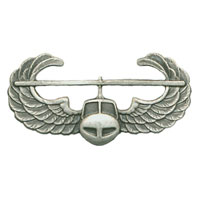
    Heck, maybe that’s why Air Assault has it’s own badge in the U.S. Army.

    Air Assault Badge

    Hooah for their success today.

  • Aggie Hoops at the Dance: A&M Wins Opener

    There’s always something magical about the 5-12 seeding matchup. Ags win 66-58.

    Next up in round two: border rival LSU.